
What humidity should my house be?
A healthy home generally sits in a moderate band of relative humidity — broadly around the middle of the scale, neither persistently damp nor uncomfortably dry. When indoor humidity stays too high, it feeds condensation, mould and dust mites; too low and the air feels dry. But the number itself matters less than what it tells you: persistently high humidity is a signal that the home is generating more moisture than its ventilation can remove.
 Reviewed by George Sora, Certified Passive House DesignerUpdated June 2026
Quick answer & key takeaways
6 min read- A moderate relative humidity band is healthiest — avoid persistently high readings.
- High humidity feeds condensation, mould and dust mites; very low feels dry.
- The reading is a signal: high humidity usually means too little ventilation for the moisture produced.
- Surface temperature matters too — the same humidity is riskier with cold surfaces.
- Biggest misconception: a single 'correct' number fixes everything. It is the moisture-ventilation balance that matters.
- Retrofit IQ's approach: log humidity over time and match ventilation to the home's moisture load.
What this usually means
Relative humidity is the amount of water vapour in the air compared with the most it could hold at that temperature. A home that sits in a moderate band most of the time is comfortable and low-risk; one that spends long periods at high humidity is providing the conditions condensation, mould and dust mites need. So rather than chasing a precise figure, the useful question is whether your home stays in a healthy band or drifts high.
When humidity is persistently high, it almost always means moisture is being generated faster than ventilation removes it — from cooking, bathing, drying clothes indoors and daily living. The fix is not to obsess over the number but to remove the moisture: better extract in wet rooms and adequate background ventilation bring the humidity down into the healthy band and keep it there. A dehumidifier can mask a high reading, but it does not address why the home is humid.
Surface temperature changes how risky a given humidity is. The same moderately high humidity that is harmless against warm, well-insulated surfaces will condense and grow mould against cold walls, reveals and corners. So the humidity reading is best understood alongside the surfaces in the home: warming cold surfaces widens the safe margin, while cold surfaces narrow it. Measuring humidity over time, and relating it to surface temperatures, is far more informative than a single spot reading.
Common causes
More moisture than ventilation can remove
High humidity usually reflects moisture generation outpacing the home's air change.
Drying laundry indoors
Drying clothes inside without ventilation adds a large, sustained moisture load.
Weak or unused extract ventilation
Kitchens and bathrooms without effective, used extract let moisture spread and humidity rise.
Cold surfaces raising the risk
Cold walls and reveals make a given humidity more likely to condense and grow mould.
Sealing without added ventilation
Tightening the home without ventilation can push humidity up.
Signs and symptoms
Persistent condensation on windows
Regular window misting indicates humidity is sitting too high for the surfaces.
Mould on cold surfaces
Mould appearing on cold walls and corners signals high humidity meeting cold surfaces.
A damp, clammy feel
Air that feels damp and slow to dry reflects high relative humidity.
Musty smells
Musty odours suggest sustained high moisture in the home.
Very dry air and discomfort (the opposite)
Persistently low humidity can feel dry, though high humidity is the more common home problem.
What most people check first
- Whether humidity stays in a moderate band or drifts persistently high.
- How much moisture the home generates (especially indoor drying).
- Whether wet rooms have effective, used extract ventilation.
- Whether cold surfaces are making a given humidity more risky.
What most people miss
- That high humidity is a signal of too little ventilation, not just a number to lower.
- That a dehumidifier masks the reading rather than fixing the cause.
- That surface temperature decides how risky a given humidity is.
- That logging humidity over time beats a single spot reading.
The building physics
Relative humidity depends on both the absolute moisture in the air and the air temperature, because warmer air can hold more vapour. Indoors, the absolute moisture is set by the balance of generation and ventilation: cooking, bathing, drying and occupancy add vapour, while ventilation removes it. When removal lags generation, absolute moisture and relative humidity climb, and the dew point rises with them — which is the link between a high humidity reading and the onset of condensation on cold surfaces.
Health and durability risks cluster at the extremes. Sustained high relative humidity supports mould germination and dust-mite populations and raises condensation risk; very low humidity can feel dry and uncomfortable. A moderate band avoids both, which is why ventilation aims to hold humidity there rather than drive it as low as possible. Because humidity varies through the day with activities, the meaningful measure is how much time the home spends in the healthy band, captured by logging rather than a single reading.
The reading must be read together with surface temperatures. Condensation and mould depend on a surface being below the dew point, so the same humidity is safe against warm surfaces and risky against cold ones. This is why the durable strategy combines ventilation (to hold humidity in the healthy band) with warming cold surfaces (to widen the margin). Logging humidity and mapping surface temperatures shows whether to add ventilation, warm surfaces, or both — turning a vague 'is my house too humid?' into a clear, measured answer.
How to reach a healthy humidity
Bring humidity into the healthy band by removing moisture with ventilation, and reduce the risk by warming cold surfaces. Measure over time rather than chasing a single number.
- 01
Log humidity over time
Record indoor humidity across days to see whether it sits in a healthy band or drifts high, and when.
- 02
Reduce moisture at source
Use extract while cooking and bathing and avoid drying laundry indoors to cut the moisture load.
- 03
Improve ventilation
Provide effective wet-room extract and adequate background ventilation to hold humidity down.
- 04
Warm cold surfaces
Insulate cold walls and reveals so a given humidity is less likely to condense or grow mould.
- 05
Avoid masking with a dehumidifier
Use dehumidification only as a stopgap; address the ventilation that keeps humidity healthy.
- 06
Verify it holds
Re-log humidity to confirm the home stays in the healthy band through normal use.
How to prevent it coming back
- Keep wet-room extract effective and used.
- Avoid drying clothes indoors without ventilation.
- Maintain adequate background ventilation across the home.
- Warm cold surfaces so humidity is less likely to condense.
How Retrofit IQ investigates this
We log humidity over time and relate it to surface temperatures so ventilation is matched to the home.
Do not spend money fixing symptoms before you understand the cause — investigate first, then build with confidence.
Do I need a professional investigation?
If your home feels damp, windows mist regularly, or mould appears, it is worth logging humidity and relating it to surface temperatures — so ventilation and surface warming can be matched to the home's moisture load rather than guessed at from a single reading.
Where to go next
Relevant services
Related comparisons
From the Academy
Related case studies
Evidence from Real Projects (10)
Real project and investigation images from our own fieldwork, matched to this page — not stock photography.
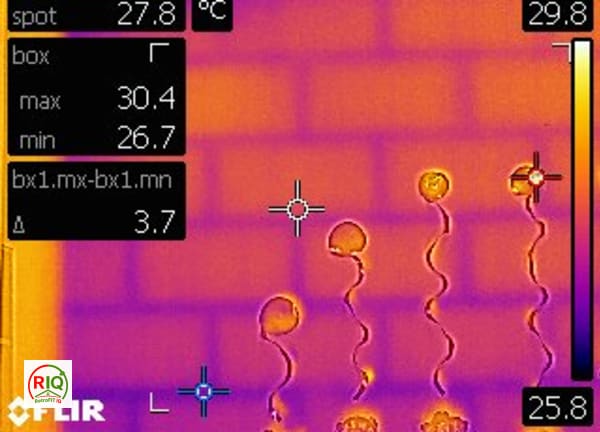
Thermal Bridging Visible Through Masonry Blockwork Wall

Sample Building Performance Investigation Report — Thermal Imaging

Thermal Bridge at Internal Corner Wall Junction

Thermal Bridge at Wall-Ceiling Junction Near Window

Airtightness Testing in a Stratford Victorian Terrace

Bathroom
No related investigations yet.
Browse all investigationsFrequently asked questions
What humidity should my house be?+
A moderate relative humidity band is healthiest — neither persistently damp nor very dry. More important than the exact figure is whether your home stays in that band; persistently high humidity signals too little ventilation for the moisture produced.
Is my house too humid?+
If windows mist regularly, mould appears on cold surfaces, or the air feels clammy, humidity is likely sitting too high. Logging it over time confirms whether it drifts out of the healthy band.
Why is my home so humid?+
Usually because moisture from cooking, bathing and drying clothes is generated faster than ventilation removes it. Improving extract and background ventilation brings humidity back into the healthy band.
What humidity causes mould?+
Sustained high relative humidity, especially against cold surfaces, supports mould. The risk depends on both the humidity and the surface temperature, so warming cold surfaces lowers it.
Should I use a dehumidifier to control humidity?+
A dehumidifier can help temporarily, but it masks the cause. The lasting answer is ventilation that removes the moisture, keeping humidity healthy without continuous running cost.
Can humidity be too low?+
Yes — very low humidity feels dry and can be uncomfortable, but in UK homes persistently high humidity is the far more common and damaging problem.
How do you assess my home's humidity?+
We log humidity over time, monitor carbon dioxide, map cold surfaces with thermal imaging and assess ventilation, then recommend how to hold humidity in the healthy band.
Stop guessing — find the real cause
Do not spend money fixing symptoms before you understand the cause. Every home behaves differently, and the only reliable way to know what is happening in yours is professional building performance diagnostics. At RetrofitIQ we verify buildings using the right combination of investigations:
- Thermal imaging
- Blower door testing
- Moisture & dew point readings
- Ventilation review
- Building physics assessment
- Passive House methodology