
Continuous vs Intermittent Extract: Which Controls Moisture
Continuous extract ventilation vs Intermittent extract ventilation.
 Reviewed by George Sora, Certified Passive House DesignerUpdated June 2026
Quick answer & key takeaways
4 min read- Bottom line: Continuous extract removes moisture steadily all day and responds to humidity; intermittent fans only act in short bursts when triggered, leaving long unventilated gaps.
- When Continuous extract is enough: Condensation and humidity are recurring problems
- When Intermittent fans is the better choice: Background ventilation is good and moisture loads are low
- When you need both: Continuous background extract with intermittent-style boost gives the best of both in many homes
- Biggest misconception: “A bathroom fan on a timer is enough ventilation.” — It removes moisture only briefly after use and does nothing overnight, when condensation risk peaks.
- Retrofit IQ’s approach: We log humidity over time rather than judging ventilation from a single visit.
Quick answer
Continuous extract removes moisture steadily all day and responds to humidity; intermittent fans only act in short bursts when triggered, leaving long unventilated gaps. For controlling condensation and indoor humidity, continuous (or demand-controlled continuous) extract is markedly more effective and is increasingly the default. Intermittent fans can be adequate in leakier homes with good background ventilation, but they routinely under-ventilate in practice.
At a glance
| Attribute | Continuous extract ventilation | Intermittent extract ventilation |
|---|---|---|
| Run pattern | Continuous low rate, boost on demand | Short bursts when triggered |
| Moisture control | Steady, reliable | Intermittent — gaps between runs |
| Responds to humidity | Yes (sensors) | Sometimes (humidistat) |
| Running cost | Low, constant | Very low, occasional |
| Condensation risk | Lower | Higher in real use |
| Typical use | Modern regs, retrofit moisture control | Older installs, budget fixes |
What is Continuous extract ventilation?
Extract fans (central MEV or decentralised dMEV) that run permanently at a low background rate, boosting on humidity or occupancy. They provide steady, predictable moisture removal across the day rather than only when someone switches them on.
What is Intermittent extract ventilation?
Conventional bathroom and kitchen fans that run only when triggered — by a light switch, occupancy or a humidistat — and stop shortly after. They are cheap and familiar, but only remove moisture in short bursts, leaving long periods with little ventilation.
What each method measures — and what it doesn’t
Continuous extract
- A continuous background extract rate plus boosted rates on humidity or occupancy
- Cumulative moisture removal across the whole day
- Does not condition or filter incoming make-up air (that comes through inlets)
Intermittent fans
- Short-term extract while the fan is triggered
- Compliance with minimum boost extract rates for a wet room
- Moisture produced when the fan is off — overnight, between showers, while drying laundry
- Whole-house humidity, since it acts only at the point and time of use
The building science
Moisture in a home is produced more or less continuously — cooking, washing, drying clothes, breathing and respiration overnight — but intermittent fans only remove it for a few minutes after a trigger. The result is long periods, especially overnight, when humid air sits against cold surfaces, condenses and feeds mould. The peak risk is exactly when the fans are off.
Continuous extract changes the dynamic by maintaining a low background air change all the time, with automatic boost when humidity or occupancy rises. This keeps the average indoor humidity lower and prevents the overnight build-up that intermittent systems miss. Demand control (humidity or CO₂ sensing) lets the system stay quiet and economical at the background rate while still responding when moisture spikes.
Neither approach conditions or filters the replacement air, which enters through background ventilators and leakage — so both depend on adequate, well-placed inlets to avoid draughts and to ensure the extracted air is actually replaced. In airtight homes, extract-only ventilation of either type becomes less effective, and balanced MVHR is the better answer; in leakier homes, continuous extract is a strong, low-cost moisture-control strategy.
Key differences
- Continuous extract runs all day; intermittent fans run only in bursts.
- Continuous extract controls average humidity; intermittent fans leave long gaps.
- Demand-controlled continuous systems respond to humidity automatically; many intermittent fans rely on a switch.
- The biggest condensation risk — overnight — is covered by continuous extract but missed by intermittent fans.
- Both rely on adequate make-up air inlets and neither recovers heat.
Common misconceptions
Myth: A bathroom fan on a timer is enough ventilation.
It removes moisture only briefly after use and does nothing overnight, when condensation risk peaks.
Myth: Continuous extract uses a lot of electricity.
Modern low-power continuous fans use very little energy at their background rate, and demand control keeps boost periods short.
Myth: More powerful fans solve condensation.
Run pattern matters more than peak power; steady, continuous removal beats occasional high-rate bursts.
Real-world situations
Recurring bathroom and bedroom condensation despite a fan
Move to continuous (ideally humidity-controlled) extract so moisture is removed steadily, not just after showers.
Frequent laundry drying indoors
Continuous extract in the relevant rooms, plus warmer surfaces, to handle the sustained moisture load.
Airtight retrofit with condensation concerns
Consider balanced MVHR rather than extract-only — in an airtight home it controls moisture and recovers heat.
Which do you actually need?
When Continuous extract is enough
- Condensation and humidity are recurring problems
- You want reliable, low-cost moisture control in a leakier home
- Occupants will not operate fans consistently
When Intermittent fans is the better choice
- Background ventilation is good and moisture loads are low
- A simple, low-cost compliance solution is all that is needed
- The room is used briefly and infrequently
When you need both
- Continuous background extract with intermittent-style boost gives the best of both in many homes
What Retrofit IQ checks on site
We log humidity over time rather than judging ventilation from a single visit. That reveals the overnight and between-use moisture peaks that intermittent fans miss, so we can specify the right run pattern — continuous, demand-controlled or balanced MVHR — instead of simply fitting a bigger fan.
- Humidity and dewpoint logging across rooms and times to expose overnight moisture build-up
- Measured extract rates from existing fans against regulatory minima
- Assessment of make-up air provision so replacement air does not cause draughts
- Surface-temperature mapping to identify where condensation will form first
- Airtightness context to decide between extract-only and balanced MVHR
- Review of occupant moisture loads — laundry, cooking, occupancy — that drive the demand
What a Certified Passive House Designer recommends
Most condensation complaints I investigate come down to run pattern, not fan power. An intermittent fan that runs for ten minutes after a shower does nothing about the moisture produced overnight or while laundry dries, and that is when the cold surfaces are wettest.
Continuous, humidity-controlled extract solves that for very little energy, and in an airtight home I would move up to balanced MVHR. Either way, the make-up air has to be planned — extract without adequate inlets just pulls cold draughts through the worst gaps.
— George Sora, Certified Passive House Designer, Founder, RetrofitIQ
Reviewed using current building physics principles and Passive House methodology.
Related services
Related comparisons
Related investigations
Compare another way
Closely related comparisons our clients read next.
MVHR vs MEV (Mechanical Extract Ventilation)
MVHR is a balanced supply-and-extract system that recovers heat and filters incoming air; MEV is extract-only and relies on uncontrolled inlets to make up the air.
Read comparisonDehumidifier vs Fixing the Building Fabric
A dehumidifier manages the symptom by drying the air; fixing the fabric removes the cause by stopping condensation forming.
Read comparisonMVHR vs PIV (Positive Input Ventilation)
MVHR is a balanced, heat-recovering system best suited to airtight, well-insulated homes; PIV is a simpler, lower-cost system that dilutes humidity by pressurising the house but recovers no heat.
Read comparisonMVHR vs Natural (Trickle) Ventilation
Natural ventilation is uncontrolled — it depends on wind, temperature and whether people open windows and vents — and it discards heat with the air.
Read comparisonEvidence from Real Projects (7)
Real project and investigation images from our own fieldwork, matched to this page — not stock photography.

Sample Building Performance Investigation Report — Thermal Imaging
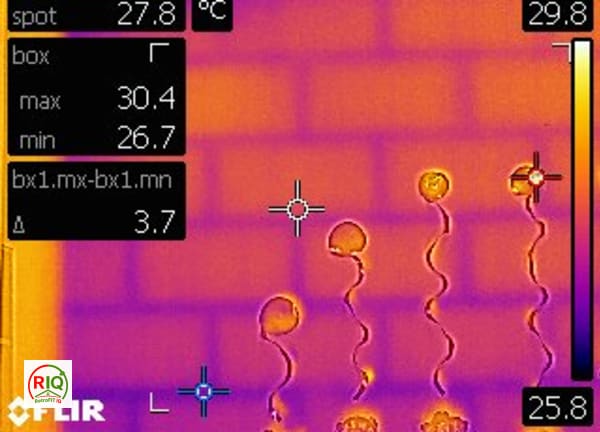
Thermal Bridging Visible Through Masonry Blockwork Wall

Thermal Bridge at Wall-Ceiling Junction Near Window

Thermal Bridge at Internal Corner Wall Junction

Airtightness Testing in a Stratford Victorian Terrace

Bathroom
No related investigations yet.
Browse all investigationsFrequently asked questions
Is a continuous extract fan expensive to run?+
No. Modern low-power units use very little electricity at their background rate, and demand control keeps high-rate boost periods short.
Why does condensation appear overnight if my fan works?+
Because intermittent fans are off overnight, when moisture from breathing builds up against the coldest surfaces. Continuous extract covers that gap.
What is dMEV?+
Decentralised mechanical extract ventilation — individual continuous-running extract units in each wet room, as opposed to a single central MEV unit.
Do I still need trickle vents with continuous extract?+
Yes — extract systems need adequate make-up air inlets, usually background ventilators, so replacement air enters in a controlled way.
Is continuous extract as good as MVHR?+
For moisture control in a leakier home, it is effective and cheaper. MVHR additionally recovers heat and filters supply air, which matters in airtight homes.
Will continuous extract fix mould on its own?+
It helps by lowering humidity, but durable results also need warmer surfaces (insulation) where the mould forms.
Can I just leave my bathroom fan running all the time?+
A standard fan is not designed for continuous low-rate running and may be noisy and inefficient. Purpose-made continuous units are the right tool.
How do I know which I need?+
Logging humidity over time shows whether moisture is being controlled. Persistent high readings point to continuous or balanced ventilation.
Need professional advice?
A comparison like this helps you understand the theory, but every property behaves differently. The only reliable way to establish the real cause in your home — rather than guessing — is professional building performance diagnostics. At RetrofitIQ we verify buildings using the appropriate combination of investigations:
- Thermal imaging
- Blower door testing
- Moisture investigation
- Building physics assessment
- Passive House methodology