
There are two ways water vapour gets into a building's construction: it can diffuse slowly through materials (vapour diffusion), or it can be carried bodily by moving air (air-transported moisture, or convection). The second mechanism is far more powerful — and it is exactly what air leakage enables. Understanding this changes how you think about airtightness: it's not just about heat, it's about keeping the structure dry.
Air-transported moisture vs vapour diffusion
The numbers are stark. Studies of moisture transport repeatedly show that the quantity of water carried into a construction by air leakage through a small gap can be tens to hundreds of times greater than the amount that diffuses through the same area of intact material over the same period. Warm indoor air holds a lot of water vapour; when that air is driven through a leak in the envelope, it carries all that moisture with it.
| Mechanism | Driver | Relative quantity of water moved |
|---|---|---|
| Vapour diffusion | Vapour pressure gradient through intact material | Small — slow, distributed |
| Air-transported moisture | Warm moist air driven through a leak (convection) | Large — tens to hundreds× more |
Exfiltration condensation — the hidden failure
Here's the mechanism that rots buildings from the inside out. In winter, the warm, moist indoor air is at higher pressure at high level (the stack effect), so it is driven outward through any leaks in the upper envelope — ceiling penetrations, the wall head, roof junctions. As this warm, humid air travels out through the cold construction, it cools. When it cools below its dew point, the water vapour it's carrying condenses — deep inside the wall or roof, on the cold side, where you cannot see it.
- Warm, moist indoor air (say 20 °C, 50% RH) leaks into the construction through a gap in the air barrier.
- As it moves toward the cold outer side, its temperature falls.
- When it reaches its dew point, moisture condenses on the cold surfaces inside the build-up (interstitial condensation).
- Repeated over a winter, this wets timber, sheathing and insulation — feeding rot, corrosion and mould, all hidden from view.
Why airtightness protects the structure
A continuous, well-positioned air barrier stops the warm, moist indoor air from entering the construction in the first place — removing the dominant moisture-transport mechanism. That's why, counter-intuitively, making a building more airtight generally makes it drier and safer, not damper: you've cut off the route by which most of the water was getting into the walls and roof. The key qualifier is 'well-positioned' — the air barrier and the vapour control strategy have to be designed together, especially in retrofit.
The dangerous mistake: sealing without ventilating
Here is where well-meant retrofits go wrong. If you make a building airtight but do NOT add controlled ventilation, you trap the moisture that occupants generate — cooking, washing, drying clothes, breathing — inside the living space. Indoor humidity climbs, and now you get the other kind of condensation: surface condensation and mould on cold internal surfaces, plus poor air quality. The building was relying on its draughts for ventilation, and you just removed them.
- Airtight + ventilated (right): moisture is barred from the structure AND removed from the living space. Dry, healthy, efficient.
- Airtight + NOT ventilated (wrong): structure protected, but indoor humidity soars → surface condensation, mould, stuffy air.
- Leaky (old default): draughts remove some moisture but waste energy and drive air-transported moisture into the fabric. Inefficient and risky.
Designing it right — the joined-up approach
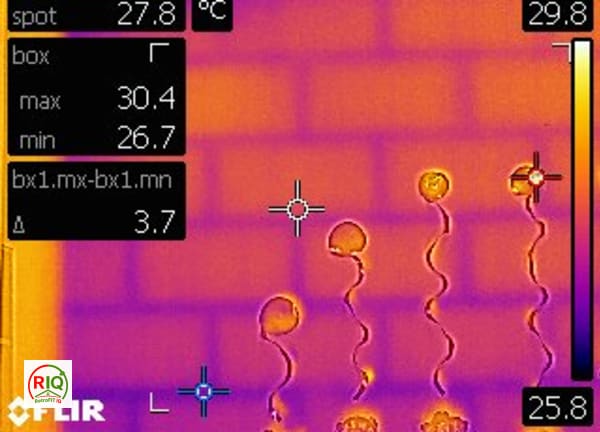
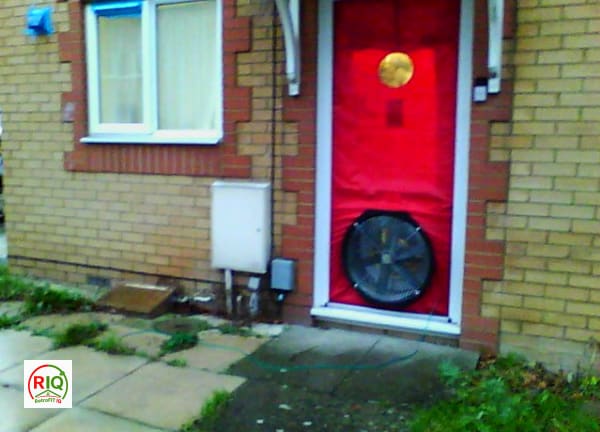
Moisture-safe airtightness means designing the air barrier, the vapour control, the insulation and the ventilation as one system — and verifying it. On our projects that means: a continuous air barrier positioned to keep warm moist air out of the cold construction; a vapour control strategy appropriate to the build-up (assessed by condensation-risk analysis where insulation is added); a designed ventilation system sized for the now-tight envelope; and verification by blower door testing and thermal imaging. Get those four working together and the building is drier, warmer, healthier and more durable than the leaky original — not less.
A worked example — moisture through a 1 mm gap
The scale of air-transported moisture is best felt with a rough calculation. Take warm indoor air at 20 °C and 50% RH — it carries roughly 7–8 grams of water vapour per kilogram of air. Now imagine a continuous 1 mm crack, a metre long, somewhere in the upper envelope (a poorly-sealed wall-head junction, say). Under the modest pressure the stack effect generates on a cold day, a surprising volume of air is driven out through that thin slot over a heating season — and every cubic metre carries its load of moisture into the cold construction, where much of it condenses. Building-science estimates for exactly this kind of detail put the air-leakage moisture deposit at many litres over a winter, against a fraction of a litre delivered by vapour diffusion through the same area of intact wall. One unsealed hairline junction can therefore do more moisture damage than a wall's worth of diffusion — which is precisely why the continuous air barrier is the front-line moisture defence.
Where the condensation-risk check fits
Because air leakage is so dominant, a condensation-risk assessment is only meaningful alongside an airtightness strategy. A Glaser or WUFI model assumes a defined vapour profile and a continuous air barrier; if the build is actually leaking warm air into the construction through unsealed junctions, the real moisture load can dwarf what the model assumed, and a build-up that 'passed' on paper can still fail in service. This is why we treat the two as a pair: the condensation-risk model establishes that the designed assembly is moisture-safe, and the blower door test (with leak detection under depressurisation) verifies that the air barrier the model relied upon was actually achieved. A clean hygrothermal model with a leaky air barrier is a false reassurance.