
Mould vs Condensation: The Symptom and Its Cause
Mould vs Condensation.
 Reviewed by George Sora, Certified Passive House DesignerUpdated June 2026
Quick answer & key takeaways
5 min read- Bottom line: Mould is the symptom; condensation is usually the cause.
- When Mould is enough: You can see and need to remove visible growth safely
- When Condensation is the better choice: You want the mould to stop coming back
- When you need both: You want to clean now and cure permanently
- Biggest misconception: “Anti-mould paint solves a mould problem.” — It suppresses growth on that surface for a while, but if the condensation continues the mould returns. The cause must be fixed.
- Retrofit IQ’s approach: Most mould 'treatments' attack the symptom and ignore the cause, which is why the mould comes back.
Quick answer
Mould is the symptom; condensation is usually the cause. Mould grows where surfaces stay cool and humid, and in most homes those conditions come from condensation. Cleaning or painting over mould without addressing the condensation behind it only delays its return. The lasting cure is to remove the conditions that feed it — warmer surfaces, a steadier heating pattern and controlled ventilation — not to treat the visible growth alone.
At a glance
| Attribute | Mould | Condensation |
|---|---|---|
| What it is | Visible fungal growth (symptom) | Moisture on cold surfaces (cause) |
| Where it appears | Cool, humid, poorly ventilated spots | Surfaces below dewpoint |
| Health relevance | Can affect respiratory health | Creates the conditions for mould |
| Treating it alone | Returns if cause remains | Fixing it removes the mould's food |
| Durable fix | Address the moisture source | Insulation, heating pattern, ventilation |
What is Mould?
Visible fungal growth — usually black — that appears where surfaces stay cool and humid for long enough. It is the symptom you see, and it can affect respiratory health, but it is the end of a chain, not the start.
What is Condensation?
Moisture from humid indoor air settling on surfaces below dewpoint. It is the most common cause of the cool, damp conditions that let mould grow, driven by cold surfaces, indoor humidity and inadequate ventilation.
What each method measures — and what it doesn’t
Mould
- The visible result of prolonged surface dampness
- Areas where conditions favour fungal growth
- The underlying cause of the dampness
- Whether the moisture is condensation, penetrating or rising
Condensation
- Surfaces falling below dewpoint
- Indoor humidity and ventilation adequacy
- Thermal weaknesses that chill surfaces
- Nothing critical — but it is the cause to address, not the symptom
The building science
Mould is a biological response to a physical condition. Spores are present in all buildings; they only germinate and grow where a surface stays cool and damp for long enough, typically at a sustained surface relative humidity around 80% or above. Remove that condition and the mould cannot establish, however many spores are in the air.
In the great majority of homes, the condition that feeds mould is condensation. Cold surfaces — uninsulated walls, thermal bridges, reveals, the area behind furniture — fall below the dewpoint of the indoor air, and moisture settles there. Add limited ventilation and high indoor humidity from cooking, washing and drying, and the surface stays damp long enough for mould to flourish.
This is why treating mould as if it were the problem fails. Wiping it off, bleaching it or painting with a fungicidal coating tackles the visible growth but leaves the cold, humid surface exactly as it was, so the mould returns — often within months. The growth is a messenger; killing the messenger changes nothing.
The durable cure works on the building physics behind the condensation: raise the surface temperature with insulation and thermal-bridge correction, steady the heating so surfaces do not get cold, and provide controlled ventilation to carry moisture away. Do that and the surface no longer reaches dewpoint, the dampness disappears, and the mould has nothing to live on.
Key differences
- Mould is the symptom; condensation is the usual cause.
- Killing mould without fixing condensation guarantees its return.
- Mould needs sustained surface dampness; condensation provides it.
- The cure is building physics, not a coating.
Common misconceptions
Myth: Anti-mould paint solves a mould problem.
It suppresses growth on that surface for a while, but if the condensation continues the mould returns. The cause must be fixed.
Myth: Mould means the house is dirty.
It means a surface stays cool and humid. Even spotless homes grow mould where condensation conditions exist.
Myth: Bleaching the mould fixes it.
It removes the visible growth temporarily; without addressing the moisture, it comes back.
Real-world situations
Recurring black mould in a bedroom corner
Diagnose the condensation: log surface temperature and humidity, then warm the surface and improve ventilation rather than just cleaning.
Mould behind furniture on an external wall
Cold trapped surface below dewpoint — improve insulation, allow air movement and ventilate; cleaning alone will not last.
Mould after new, airtight windows
Moisture that once escaped now condenses on the next-coldest surface; assess ventilation and surface temperatures together.
Health concerns from persistent mould
Diagnose and remove the moisture source promptly; persistent mould can affect respiratory health.
Which do you actually need?
When Mould is enough
- You can see and need to remove visible growth safely
- You are documenting the extent of affected areas
- You need interim control while planning the fix
When Condensation is the better choice
- You want the mould to stop coming back
- You are addressing the actual cause
- You are planning insulation, heating or ventilation works
When you need both
- You want to clean now and cure permanently
- Health concerns require prompt action plus a lasting fix
What Retrofit IQ checks on site
Most mould 'treatments' attack the symptom and ignore the cause, which is why the mould comes back. We investigate the condensation behind it — surface temperatures, humidity, ventilation and thermal weaknesses — and fix those, so the conditions mould depends on are removed for good.
- Surface-temperature and relative-humidity logging to confirm condensation risk
- Dewpoint analysis at the mould-affected surfaces
- Thermal imaging to find the cold surfaces and bridges feeding it
- Ventilation assessment to check moisture removal
- Identification of the moisture source, not just the visible growth
- A fabric-and-ventilation plan that removes the conditions mould needs
What a Certified Passive House Designer recommends
Mould is a symptom, and treating symptoms is why so many homes have the same problem year after year. The growth is telling you that a surface is cool and humid for too long — almost always condensation. Clean it for safety by all means, but if you stop there it will return.
The fix that lasts is building physics: warm the cold surfaces, correct the bridges, steady the heat and ventilate properly. Do that and the dewpoint is never reached at the surface, the dampness goes, and the mould simply cannot grow. That is the difference between managing mould and ending it.
— George Sora, Certified Passive House Designer, Founder, RetrofitIQ
Reviewed using current building physics principles and Passive House methodology.
Related services
Related comparisons
Related investigations
Compare another way
Closely related comparisons our clients read next.
Dehumidifier vs Fixing the Building Fabric
A dehumidifier manages the symptom by drying the air; fixing the fabric removes the cause by stopping condensation forming.
Read comparisonAnti-mould Paint vs Solving the Moisture Source
Anti-mould paint suppresses growth on a surface temporarily; solving the moisture source removes the reason mould grows at all.
Read comparisonCondensation vs Rising Damp
Condensation comes from warm, humid indoor air meeting cold surfaces; rising damp draws groundwater up through the wall.
Read comparisonCondensation vs Penetrating Damp vs Rising Damp
Condensation comes from moist indoor air meeting cold surfaces; penetrating damp comes from water getting in through an external defect; rising damp comes from groundwater moving up through the wall by capillarity.
Read comparisonEvidence from Real Projects (10)
Real project and investigation images from our own fieldwork, matched to this page — not stock photography.

Sample Building Performance Investigation Report — Thermal Imaging
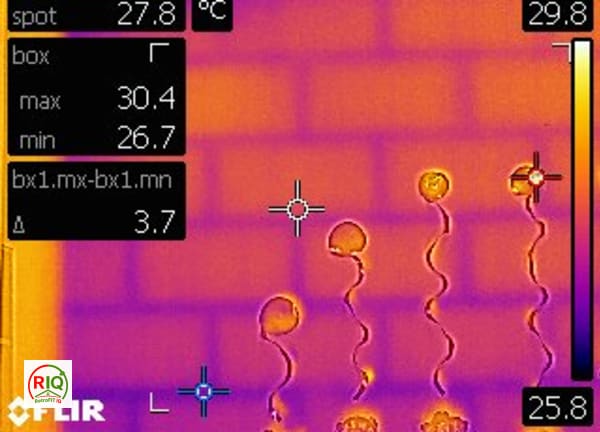
Thermal Bridging Visible Through Masonry Blockwork Wall

Thermal Bridge at Internal Corner Wall Junction

Thermal Bridge at Wall-Ceiling Junction Near Window

Airtightness Testing in a Stratford Victorian Terrace

Bathroom
No related investigations yet.
Browse all investigationsFrequently asked questions
Is mould the same as condensation?+
No. Condensation is moisture settling on cold surfaces; mould is the fungal growth that follows when a surface stays cool and damp. Condensation is usually the cause, mould the symptom.
Why does my mould keep coming back?+
Because the condensation feeding it has not been fixed. Cleaning or painting over mould without addressing the cold, humid surface only delays its return.
Does anti-mould paint work?+
It can suppress growth on that surface for a while, but if the condensation continues the mould returns. The underlying moisture must be addressed.
Is mould a health risk?+
Persistent mould can affect respiratory health, which is why diagnosing and removing the cause matters, not just cleaning the surface.
How do I stop mould permanently?+
Remove the conditions it needs: warmer surfaces through insulation, a steadier heating pattern and controlled ventilation, so the surface no longer reaches dewpoint.
Why is the mould worse behind furniture?+
Furniture against an external wall traps a cold, still surface that easily falls below dewpoint — ideal conditions for condensation and mould.
Did new windows cause my mould?+
Often new airtight windows reduce the leakage that used to remove moisture, so it condenses elsewhere. A ventilation assessment usually explains it.
Should I just buy a dehumidifier?+
It helps manage humidity but does not fix cold surfaces or poor ventilation. It is a tool, not a cure.
Can you find hidden mould risk before it shows?+
Yes — by logging surface temperatures and humidity we can identify condensation risk before visible mould develops.
Is bleaching enough?+
Bleach removes the visible growth temporarily, but without fixing the moisture the mould returns. Treat the cause, not just the surface.
Will more heating fix it?+
Steadier heating helps keep surfaces above dewpoint, but it works best combined with insulation and controlled ventilation.
Who diagnoses the cause?+
A Certified Passive House Designer, so the condensation behind the mould is identified and fixed at source.
Need professional advice?
A comparison like this helps you understand the theory, but every property behaves differently. The only reliable way to establish the real cause in your home — rather than guessing — is professional building performance diagnostics. At RetrofitIQ we verify buildings using the appropriate combination of investigations:
- Thermal imaging
- Blower door testing
- Moisture investigation
- Building physics assessment
- Passive House methodology