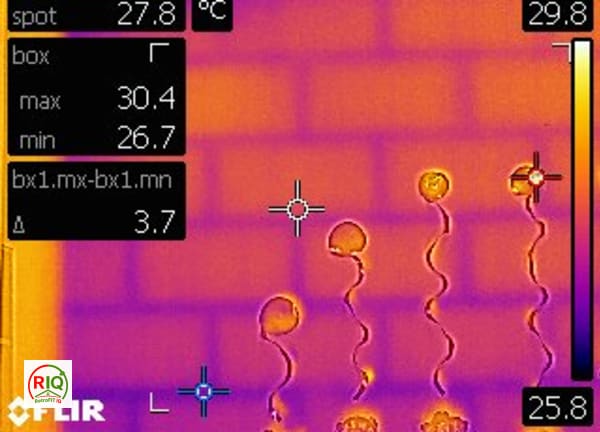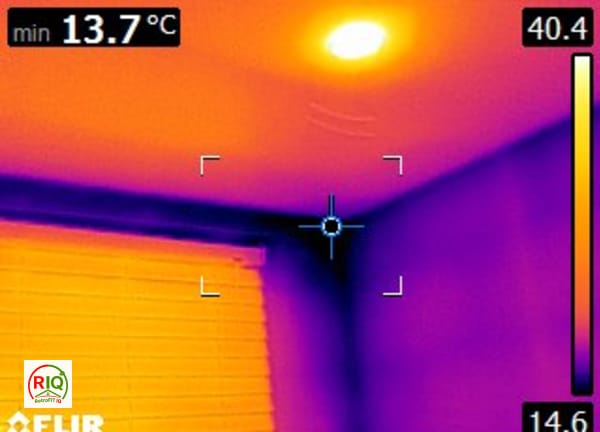

Surface condensation forms when a surface is colder than the dew point of the air touching it, so vapour condenses into visible liquid water on it. Mould, importantly, starts earlier than that — it only needs the surface relative humidity to stay high (around 80%) for sustained periods. So the visible black patches are the end of a process that began with a cold surface and humid air, long before any water was visible.
The mould growth mechanism
Mould spores are present in essentially all indoor air; they are harmless until they find the conditions to germinate. Three things must coincide for sustained growth: a high enough surface relative humidity, a tolerable temperature, and enough time. Building scientists describe this with 'isopleths' — curves showing the combination of surface RH and temperature (and duration) at which a given mould will germinate and grow:
- Surface RH around 80% sustained is the practical lower threshold for the most moisture-tolerant moulds — well below the 100% of visible condensation.
- Temperature in the typical indoor range (say 5–30 °C) is comfortable for mould; growth is fastest in warm, humid conditions.
- Time matters — brief humidity spikes (a shower) don't grow mould; sustained high surface RH (a cold corner all winter) does. This is the 'time of wetness' concept.
| Surface RH (sustained) | Condition | Risk |
|---|---|---|
| Below ~75% | Surface comfortably above dew point | Safe |
| ~80% | Germination threshold for tolerant moulds | Mould growth begins |
| 80–100% | Cold surface, no visible water yet | Active mould growth |
| 100% | Surface at/below dew point | Visible condensation + mould |
The fRsi temperature factor
Building physics quantifies the risk of a cold surface with the temperature factor fRsi — the ratio of (internal surface temperature minus external temperature) to (internal air temperature minus external temperature). A higher fRsi means a warmer internal surface relative to the conditions. UK guidance (informed by BS EN ISO 13788 and BRE work) sets a minimum fRsi of 0.75 for dwellings to avoid mould at junctions. Well-detailed, Passive-House-grade junctions comfortably exceed this; many older or poorly-detailed junctions fail it — which is exactly where mould appears.
Common indoor moulds and health
The usual culprits on damp internal surfaces include Cladosporium, Aspergillus, Penicillium and, in persistently wet conditions, Stachybotrys chartarum (the 'black mould' associated with the worst cases). Beyond staining and odour, mould and the damp conditions that cause it are linked to respiratory irritation, allergic responses and aggravation of asthma — and following high-profile cases, UK guidance now treats persistent damp and mould in homes as a health risk to be addressed at its cause, not just cleaned.
Why bleaching doesn't work
Wiping mould off with bleach or a fungicidal wash removes the visible growth but changes none of the conditions that created it. The surface is still cold; the air is still humid; the surface RH still crosses 80% every winter night. So the mould returns, usually within weeks to months. Treating the mould without treating the building physics is the single most common — and most futile — response to the problem.
A worked example — the numbers behind a mouldy corner
Put numbers to a typical bedroom and the mechanism becomes obvious. Suppose the room air is at 20 °C and 60% relative humidity — comfortable, unremarkable. That air has a dew point of about 12 °C, and its moisture will reach the 80% surface-RH mould threshold on any surface colder than roughly 15–16 °C. Now consider the top corner of an external, north-facing wall: as a geometric thermal bridge it might sit at just 13–14 °C in cold weather. The corner is below the mould threshold even though no liquid water is visible — and that is precisely why mould germinates there first while the middle of the wall, perhaps at 18 °C, stays clear. Raise that corner above ~16 °C (by insulating and correcting the bridge) or drop the room to 50% RH (by ventilating), and the same corner becomes safe. The fix is to move those two numbers apart.
The occupant moisture load
Indoor humidity is not random — it is generated by the household, and it is surprisingly large. A typical family of four can release 10–15 litres of water vapour into the air every day: breathing and perspiration (around 1.5–2 litres per person per day), cooking, showering and bathing, washing up, and — the big one — drying laundry indoors, which can add several litres per load. An unvented tumble dryer or clothes dried on radiators dumps litres straight into the air. The more moisture generated and the less it is ventilated away, the higher the relative humidity climbs, and the warmer a surface can be while still crossing the 80% mould threshold. Controlling moisture at source (lids on pans, venting the dryer outside, not drying washing on radiators) is part of the cure, alongside ventilation and warmer surfaces.
Ranking the remedies
Because mould lives in the gap between surface temperature and dew point, every effective remedy either warms the surface or lowers the humidity — usually both. In rough order of how fundamentally they address the cause:
- Warm the cold surface: internal or external wall insulation, or targeted thermal-bridge correction at the specific cold corner, reveal or lintel — the most fundamental fix, because it removes the cold spot permanently.
- Control the humidity: continuous mechanical extract (dMEV) from wet rooms, or MVHR in a tighter home, to hold relative humidity in the healthy 40–60% band.
- Reduce moisture at source: vent the tumble dryer outside, lids on pans, avoid drying laundry indoors, use extract fans during and after showers.
- Improve air movement: keep furniture off cold external walls so warm air can reach the surface.
- Last and least: fungicidal cleaning — necessary to remove existing growth, but useless on its own because it changes none of the conditions.
Where internal wall insulation is the chosen route to warm a cold wall, it must be hygrothermally modelled (Glaser or transient WUFI analysis) before it is specified, because adding insulation internally keeps the masonry colder and can move the dew point into the wall, trading visible surface mould for hidden interstitial condensation. Warming the surface safely is a design exercise, not just a matter of sticking up insulation board.
PAS 2035, Awaab's Law and treating the cause
The regulatory and legal context has caught up with the building physics. PAS 2035, the UK retrofit standard, requires moisture risk to be assessed and managed whenever a home is insulated or tightened — precisely to prevent the surface and interstitial condensation that poorly-coordinated retrofit can cause. Separately, following the tragic, well-publicised case of Awaab Ishak, social landlords now face strict duties to investigate and remedy damp and mould promptly and at the cause, rather than wiping and repainting. Both point the same way: damp and mould are a building-physics problem to be diagnosed and resolved at source, not a cosmetic nuisance to be managed with bleach.
A real investigation
These principles are not theoretical. In one RetrofitIQ investigation, a homeowner had persistent damp and mould in a built-in cupboard against a cold external wall, repeatedly cleaned and repainted to no avail. Thermal imaging confirmed the wall behind the cupboard was the coldest surface in the room; humidity logging showed the indoor RH was high enough for that cold surface to sit well above the 80% mould threshold. The remedy was not more fungicide but a moisture-checked internal wall insulation build-up to warm the surface, combined with improved ventilation — addressing both numbers at once so the mould had nowhere to return to.
Common mistakes homeowners make
- Repeatedly bleaching and repainting the same patch without changing the surface temperature or humidity
- Relying on anti-mould paint as a standalone cure
- Sealing draughts and trickle vents to save heat, which traps moisture and makes mould worse
- Drying laundry indoors or venting a tumble dryer into the room
- Accepting a 'rising damp' diagnosis and a chemical DPC when the real cause is surface condensation
- Keeping wardrobes and beds hard against cold external walls, creating a cold, still, humid micro-climate
Interstitial condensation — the hidden cousin
Surface condensation is the version you can see — water and mould on a wall, window or corner. Interstitial condensation is its hidden, more dangerous cousin: it forms inside a wall, roof or floor build-up, where warm, moist air has migrated into the construction and reached a layer colder than its dew point. Because it is concealed, it can quietly saturate insulation (destroying its thermal performance) and wet structural timber (leading to rot and decay) for years before any sign appears on the inside surface. It is the failure mode that turns a well-intentioned insulation upgrade into an expensive liability.
The risk is greatest with internal wall insulation on solid walls, because adding insulation on the inside keeps the original masonry colder and shifts the dew point outward into the wall. It is also a risk wherever a vapour-tight layer is placed on the wrong (cold) side of the insulation, trapping moisture. This is precisely why any internal insulation build-up should be assessed with hygrothermal modelling — a Glaser-method check or, better, a transient WUFI simulation against local climate data — before it is specified, and why vapour-open, breathable build-ups are often preferred for traditional masonry. Diagnosing and designing out interstitial condensation is invisible work that protects the building for decades, and it is exactly the kind of moisture risk PAS 2035 requires to be assessed before insulation is installed.
How we diagnose it
- Log room temperature and RH over a representative period to capture the real daily humidity cycle.
- Thermal-image the affected surfaces to map the cold spots and read their surface temperatures.
- Calculate dew point and surface RH at the mould locations — confirming the mechanism with numbers.
- Rule penetrating/rising damp in or out (external survey, moisture measurement on multiple substrates).
- Specify a remediation that raises the cold surfaces and controls the humidity — not a coat of fungicide.