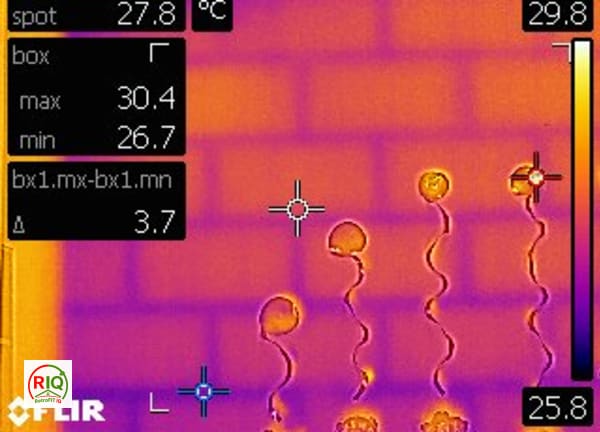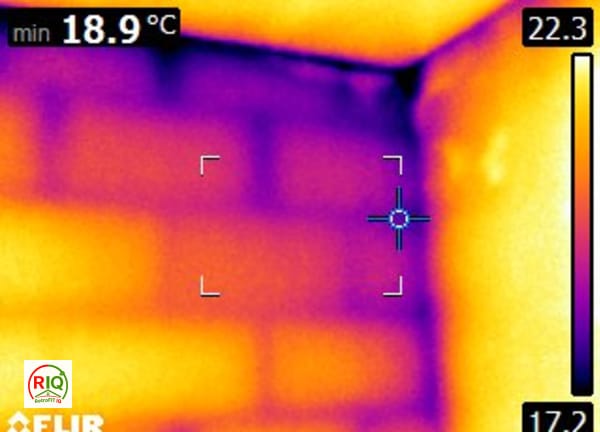

As covered in the Building Physics guide, mould grows where the surface relative humidity stays high (around 80%+) for sustained periods. Two things drive surface RH up: cold surfaces (low temperature raises local RH) and humid air (more moisture in the room). Ventilation attacks the second — it removes the water vapour that pushes indoor humidity up, lowering the dew point and the surface RH everywhere in the home.
How much moisture a household generates
Homes produce a surprising amount of water vapour every day, all of which has to be removed by ventilation or it accumulates as humidity and condensation:
| Activity | Approx. moisture added |
|---|---|
| Breathing & perspiration (occupants, per day) | Several litres for a family |
| Cooking | ~1–2 litres/day |
| Showering / bathing | ~0.5–1 litre per use |
| Drying laundry indoors | ~2–3 litres per load |
| Unflued sources (some heaters, etc.) | Significant — avoid |
Ventilation rate vs surface RH
The relationship is direct: the more effectively a home ventilates (relative to the moisture it generates), the lower its average indoor humidity, and the lower the surface RH on its cold spots. A home that's under-ventilated for its moisture load runs at high humidity, so even moderately cold surfaces cross the mould threshold; the same home, well ventilated, keeps humidity down so only the very coldest surfaces are at risk. Ventilation effectively buys back margin against mould.
Why ventilation alone isn't always enough
Ventilation controls the air; it doesn't warm the surfaces. If mould is driven mainly by a severe cold spot — a thermal bridge, an uninsulated corner, single glazing — ventilation reduces the humidity but may not lift that specific cold surface clear of the mould margin. That's why durable mould prevention usually combines both levers: ventilate to control humidity AND warm the cold surfaces (insulation, thermal-bridge correction). The two together move surface temperature and dew point apart so mould has nowhere to grow.
The right ventilation for mould control
- Extract at source — humidity-sensing continuous extract (dMEV) in kitchens and bathrooms removes moisture where it's generated.
- Background ventilation — keep trickle vents open (in leakier homes) so humidity doesn't accumulate when windows are shut.
- Whole-house solution — in a tighter, well-insulated home, MVHR provides continuous, balanced, heat-recovered fresh air that keeps humidity low across the whole house without a heating penalty.
- Behaviour — vent tumble dryers externally, dry washing outside or in a vented space, use the cooker hood, and don't block the vents.
A worked example — ventilating out the moisture load
Put the moisture balance into numbers and the role of ventilation becomes concrete. Suppose a family of four generates around 12 litres of water vapour a day — breathing, cooking, two showers, and a load of washing dried on the airer. In a home of, say, 250 m³ internal volume, that moisture has to be carried away by air exchange or it accumulates and the indoor humidity climbs. A continuous whole-house ventilation rate of roughly 0.5 air changes per hour moves about 125 m³ of air an hour, or 3,000 m³ a day — far more than enough, in principle, to export 12 litres of vapour and hold the indoor humidity in the healthy 40–60% band. The problem in a real under-ventilated home is that the actual exchange is a fraction of that, often concentrated in brief window-opening, so humidity spikes after each shower and load of washing and never fully recovers. The lesson is that the moisture load is manageable — but only if the ventilation runs continuously and is sized to the household, which is precisely what a humidity-sensing dMEV or an MVHR system delivers and what intermittent fans and the occasional open window do not.
Seasonal and behavioural patterns
Mould is overwhelmingly a winter phenomenon, and understanding why guides the cure. In summer, warm surfaces and open windows keep both surface temperatures and ventilation high, so surface RH rarely reaches the mould threshold. In winter the surfaces are cold and the windows stay shut, so the same daily moisture load produces far higher humidity against far colder surfaces — the two factors that set surface RH both move the wrong way at once. Behaviour amplifies it: people ventilate least exactly when they generate moisture indoors most (drying washing inside because it is wet outside, longer hot showers, more cooking), and they seal draughts and close trickle vents to save heat. This is why mould flares every autumn and clears every spring, and why the durable answer is a ventilation strategy that runs regardless of the weather or the occupants' habits — continuous, humidity-responsive extract or heat-recovered MVHR — rather than relying on people to open windows on a cold January night.