
Condensation vs Rising Damp: The Most Misdiagnosed Pair
Condensation vs Rising damp.
 Reviewed by George Sora, Certified Passive House DesignerUpdated June 2026
Quick answer & key takeaways
5 min read- Bottom line: Condensation comes from warm, humid indoor air meeting cold surfaces; rising damp draws groundwater up through the wall.
- When Condensation is enough: You see mould on cold surfaces and corners
- When Rising damp is the better choice: There is a clear tide mark and salts low on the wall
- When you need both: The diagnosis is unclear and money is about to be spent
- Biggest misconception: “Damp low on the wall must be rising damp.” — Far more often it is condensation against a cold surface or behind furniture. Salts, a tide mark and a moisture profile distinguish the two.
- Retrofit IQ’s approach: Rising damp is the most over-diagnosed defect in UK housing, largely because a 'free survey' from a damp-proofing company tends to find the problem its product solves.
Quick answer
Condensation comes from warm, humid indoor air meeting cold surfaces; rising damp draws groundwater up through the wall. They look superficially similar low down on a wall but behave completely differently — condensation tracks cold surfaces and winter humidity, while rising damp shows a tide mark and salts and persists year-round. The overwhelming majority of cases sold as 'rising damp' are actually condensation, which is why correct diagnosis is everything before any treatment.
At a glance
| Attribute | Condensation | Rising damp |
|---|---|---|
| Source of water | Indoor humidity | Groundwater via capillarity |
| Typical location | Cold surfaces, corners, reveals, behind furniture | Base of ground-floor walls, tide mark to ~1m |
| Worse when | Cold weather, poor ventilation, high occupancy | Persistent; less seasonal |
| Tell-tale signs | Black mould, surface moisture | Tide mark, hygroscopic salts, no mould |
| Frequency | Most common | Comparatively rare / over-diagnosed |
| Primary fix | Insulation, heating pattern, ventilation | Address DPC and ground conditions (if genuine) |
What is Condensation?
Moisture from humid indoor air condensing on surfaces that fall below dewpoint — cold walls, reveals, corners and behind furniture. It is by far the most common cause of household damp and mould, and it is a building-physics problem of surface temperature and ventilation.
What is Rising damp?
Groundwater drawn up through porous masonry by capillary action, typically leaving a tide mark and hygroscopic salts up to roughly a metre. Genuine rising damp exists but is comparatively rare — and is the most over-diagnosed defect in UK housing.
What each method measures — and what it doesn’t
Condensation
- Driven by surface temperature falling below dewpoint
- Linked to indoor relative humidity and ventilation
- Associated with mould growth on cold surfaces
- Anything originating from groundwater
- A defect requiring a damp-proof course
Rising damp
- Driven by capillary moisture from the ground
- Linked to a defective or bridged damp-proof course
- Associated with salts and a tide mark, rarely mould
- Anything caused by indoor humidity
- Mould growth, which it rarely supports
The building science
Warm air holds more water vapour than cold air. When humid indoor air meets a surface below its dewpoint, the vapour condenses into liquid water. That is why condensation concentrates on the coldest surfaces — single glazing, uninsulated reveals, thermal bridges and the corners of external walls — and why it is fundamentally a problem of surface temperature and ventilation, not of water coming from outside.
Rising damp obeys quite different physics. Where it genuinely occurs, groundwater is drawn up through porous masonry by capillary action against gravity, carrying dissolved salts that remain in the plaster as the water evaporates. The classic signature is a tide mark and a band of hygroscopic salts up to about a metre, and — crucially — it does not generally support the black mould that condensation produces.
The two are confused because both can appear low on a wall, but the evidence separates them. Condensation correlates with cold weather, indoor humidity and occupancy, and produces mould; rising damp is persistent, shows salts and a tide mark, and lacks mould. Measuring surface temperatures, relative humidity and dewpoint, plus a moisture profile and salts analysis, settles the question.
Getting it right matters enormously because the cures are opposite. Condensation is solved by warming surfaces (insulation and thermal-bridge correction), steadying the heating pattern and providing controlled ventilation. A chemical damp-proof course does nothing for it — yet such courses are sold repeatedly for what is, on inspection, condensation. The most expensive damp mistake in Britain is treating condensation as rising damp.
Key differences
- Condensation originates from indoor air; rising damp from groundwater.
- Condensation tracks cold surfaces and humidity; rising damp shows salts and a tide mark.
- Condensation produces mould; rising damp rarely does.
- Condensation is the most common cause; genuine rising damp is rare and over-diagnosed.
Common misconceptions
Myth: Damp low on the wall must be rising damp.
Far more often it is condensation against a cold surface or behind furniture. Salts, a tide mark and a moisture profile distinguish the two.
Myth: Black mould means rising damp.
Black mould is almost always condensation-related. Rising damp leaves salts, not mould.
Myth: A chemical injection cures most damp.
It only addresses genuine rising damp, which is rare. Most damp is condensation and needs a fabric-and-ventilation approach.
Real-world situations
Mould in bedroom corners and around windows in winter
Condensation — investigate surface temperatures, humidity and ventilation; address insulation and ventilation, not damp-proofing.
Tide mark and flaking paint low on a ground-floor wall
Investigate properly for rising damp with a moisture profile and salts analysis before assuming it — many such cases are condensation or penetrating damp.
You have been quoted for a damp-proof course
Get an independent diagnostic survey first; the cause is frequently condensation, which injection will not solve.
Damp behind a wardrobe on an external wall
Classic condensation — the trapped cold surface falls below dewpoint; the fix is insulation, air movement and ventilation.
Which do you actually need?
When Condensation is enough
- You see mould on cold surfaces and corners
- The problem worsens in cold weather
- Humidity and ventilation are likely factors
When Rising damp is the better choice
- There is a clear tide mark and salts low on the wall
- The damp is persistent and unseasonal
- A genuine DPC defect is suspected and confirmed
When you need both
- The diagnosis is unclear and money is about to be spent
- Multiple mechanisms may be present
- You want an independent, measured verdict
What Retrofit IQ checks on site
Rising damp is the most over-diagnosed defect in UK housing, largely because a 'free survey' from a damp-proofing company tends to find the problem its product solves. We investigate with measured diagnostics and building physics, identify the true mechanism, and only then recommend a remedy — so you do not pay for an injection that was never going to work.
- Surface-temperature and relative-humidity logging to identify condensation risk
- Dewpoint analysis at the affected surfaces
- Moisture profile up the wall and salts assessment where rising damp is suspected
- Thermal imaging to map cold surfaces and bridges
- External inspection to rule out penetrating damp
- An independent diagnosis of the mechanism with no treatment to sell
What a Certified Passive House Designer recommends
If I could correct one thing about how damp is handled in this country, it would be the reflex to call everything low on a wall 'rising damp'. The evidence almost always points elsewhere: cold surfaces, indoor humidity and inadequate ventilation — condensation. A damp-proof course injected into that does nothing, and the money is wasted.
From a Passive House perspective the fix is clear and durable: warm the cold surfaces, correct the thermal bridges, steady the heating and provide controlled ventilation, and the condensation has nowhere to form. Genuine rising damp does exist and needs proper attention — but only after it has actually been diagnosed.
— George Sora, Certified Passive House Designer, Founder, RetrofitIQ
Reviewed using current building physics principles and Passive House methodology.
Related services
Related comparisons
Related investigations
Compare another way
Closely related comparisons our clients read next.
Anti-mould Paint vs Solving the Moisture Source
Anti-mould paint suppresses growth on a surface temporarily; solving the moisture source removes the reason mould grows at all.
Read comparisonCondensation vs Penetrating Damp vs Rising Damp
Condensation comes from moist indoor air meeting cold surfaces; penetrating damp comes from water getting in through an external defect; rising damp comes from groundwater moving up through the wall by capillarity.
Read comparisonMould vs Condensation
Mould is the symptom; condensation is usually the cause.
Read comparisonThermal Imaging vs a Damp Survey
Thermal imaging is one tool within a proper damp survey, not a replacement for it.
Read comparisonEvidence from Real Projects (18)
Real project and investigation images from our own fieldwork, matched to this page — not stock photography.

Sample Building Performance Investigation Report — Thermal Imaging
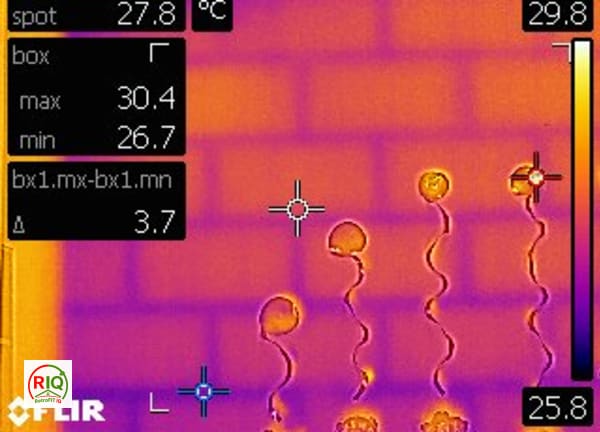
Thermal Bridging Visible Through Masonry Blockwork Wall

Thermal Bridge at Internal Corner Wall Junction

Thermal Bridge at Wall-Ceiling Junction Near Window

Bathroom external wall

Airtightness Testing in a Stratford Victorian Terrace
No related investigations yet.
Browse all investigationsFrequently asked questions
How do I tell condensation from rising damp?+
Condensation tracks cold surfaces and winter humidity and produces mould; rising damp shows a tide mark and salts low on the wall and rarely supports mould. Measurement of humidity, surface temperature and a moisture profile confirms which.
Is rising damp common?+
No. Genuine rising damp is comparatively rare and frequently over-diagnosed. Most cases sold as rising damp are actually condensation or penetrating damp.
Why is black mould a sign of condensation?+
Mould needs a cool, humid surface to grow, which is exactly what condensation provides. Rising damp leaves salts rather than mould.
Will a damp-proof course fix my damp?+
Only if you genuinely have rising damp. For condensation it does nothing, which is why injected courses so often fail to solve the problem.
Why does my damp come back after treatment?+
Usually because the wrong mechanism was treated. If the cause was condensation, treating it as rising damp leaves the real issue untouched.
Can a dehumidifier cure condensation?+
It reduces symptoms, but the durable fix is warmer surfaces, a steadier heating pattern and controlled ventilation.
What is a tide mark?+
A horizontal stain, often with salts, marking the height capillary moisture reached in a wall — a classic sign of genuine rising damp.
Does insulation help with condensation?+
Yes — warming the surface keeps it above dewpoint, provided it is detailed correctly with attention to thermal bridges and ventilation.
Are free damp surveys reliable?+
Be cautious; many are sales visits for a treatment. An independent, building-physics-based survey has no product to sell.
What measurements do you take?+
Surface temperatures, air temperature and humidity, dewpoint, a moisture profile and salts assessment where relevant, plus an external inspection.
Can both occur at once?+
Occasionally a wall has more than one mechanism. A proper survey identifies each contribution so the remedy addresses the real causes.
Who carries out the diagnosis?+
A Certified Passive House Designer — independent, evidence-led and focused on building physics rather than product sales.
Need professional advice?
A comparison like this helps you understand the theory, but every property behaves differently. The only reliable way to establish the real cause in your home — rather than guessing — is professional building performance diagnostics. At RetrofitIQ we verify buildings using the appropriate combination of investigations:
- Thermal imaging
- Blower door testing
- Moisture investigation
- Building physics assessment
- Passive House methodology