
Why most damp diagnoses are wrong
The traditional UK industry approach is to look at a damp wall, take a single moisture-meter reading, and label it as 'rising damp'. The 'fix' is then a chemical injection damp-proof course (DPC), a sand-cement waterproof render and new skirting. Six months later the problem returns — because in 80%+ of cases the original diagnosis was wrong.
There are three completely different mechanisms that can produce the same visible symptoms, and only one of them is solved by a chemical DPC. Diagnose the wrong one and you've spent thousands of pounds on a fix that was never going to work.
The three mechanisms — explained
1. Surface condensation
Warm, moist indoor air comes into contact with a cold internal surface (typically below the room's dewpoint), and water vapour in the air condenses into liquid water on that surface. Over time the resulting wet surface supports black mould (Cladosporium, Aspergillus, Stachybotrys).
2. Penetrating damp
Water enters from outside — through failed pointing, cracked render, blocked gutters, defective flashings, broken pipes or driving rain on solid walls. The water is liquid (not vapour), and it tracks along the path of least resistance until it appears internally as a wet patch.
3. Rising damp (genuinely rare)
Groundwater wicks up through porous masonry by capillary action, bringing dissolved hygroscopic salts with it. Genuine rising damp shows a clear horizontal tide-mark at the maximum capillary height, salt efflorescence at the tide-mark, and is present only on walls in direct contact with the ground.
How RetrofitIQ tells them apart — the measured approach
- Map the affected area photographically and visually — the pattern of damp is itself diagnostic.
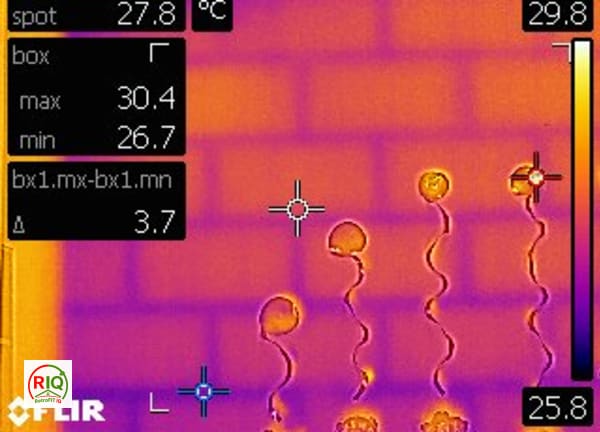
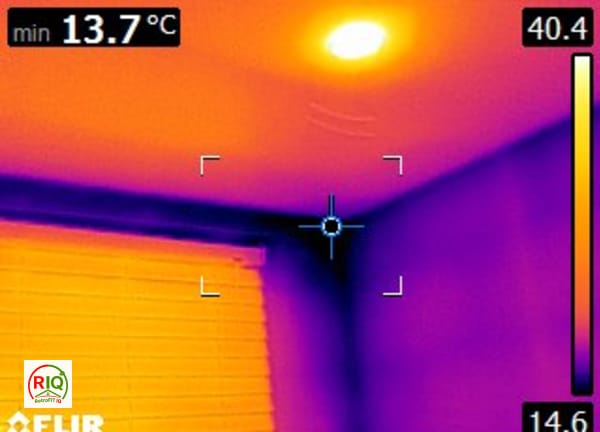
- Use a calibrated FLIR thermal camera to measure surface temperatures across the wall, ceiling and reveals.
- Measure indoor RH and temperature with a logger — calculate the room's dewpoint.
- Compare measured surface temperature against the dewpoint. If the surface is below dewpoint, you have condensation regardless of what the moisture meter says.
- Use a pin-type moisture meter on multiple substrates — high readings in plaster don't prove rising damp; hygroscopic salts give false-high readings.
- Inspect the external envelope for penetrating-damp sources — pointing, render, flashings, drainage, gutters.
- Only after all three mechanisms have been ruled in or ruled out, write the diagnosis.
Why this matters for your bank account
Chemical DPC injection on a wall that actually has condensation does nothing — the moisture is coming from the room air, not from the ground. Tanking the wall with a waterproof render makes condensation worse (the wall surface is now colder and even more impermeable). Within 12–18 months the mould returns, and the homeowner has spent £3,000–£8,000 with no improvement.
The correct remediation for surface condensation is to lift the wall surface temperature above dewpoint (internal wall insulation, thermal-bridge correction at lintels and reveals) and to control indoor humidity (background ventilation, dMEV/MVHR, source control). That's an entirely different specification from a DPC injection.
What the right report looks like
- Photographs of the affected areas with annotations
- Calibrated FLIR images showing surface temperatures
- Indoor RH and temperature data logged over a representative period
- Calculated dewpoint and the delta vs measured surface temperature
- Moisture-meter readings on at least three substrates per area
- An external survey report covering pointing, render, flashings and drainage
- A diagnosis stating which of the three mechanisms is responsible (often a mix)
- A prioritised, costed remediation plan addressing the actual cause