
Thermal Imaging vs a Damp Survey: Finding Damp the Right Way
Thermal imaging vs Damp survey (diagnostic).
 Reviewed by George Sora, Certified Passive House DesignerUpdated June 2026
Quick answer & key takeaways
6 min read- Bottom line: Thermal imaging is one tool within a proper damp survey, not a replacement for it.
- When Thermal imaging is enough: You want to quickly map where to investigate
- When Damp survey is the better choice: You need to know the cause, not just the location
- When you need both: You want an accurate, independent damp diagnosis
- Biggest misconception: “A blue patch on a thermal image proves damp.” — It proves the surface is cooler — which could be damp, a thermal bridge or air movement. A moisture meter and context decide.
- Retrofit IQ’s approach: Most damp 'surveys' on the market exist to sell a treatment, so they tend to find the problem that treatment solves.
Quick answer
Thermal imaging is one tool within a proper damp survey, not a replacement for it. The camera quickly maps cool, suspect areas, but it cannot measure moisture or identify whether the cause is condensation, penetrating or rising damp. A diagnostic damp survey adds moisture readings, humidity and surface-temperature logging, dewpoint analysis and an external inspection to name the mechanism — which is what dictates the fix. Beware 'damp surveys' that exist mainly to sell a damp-proofing product.
At a glance
| Attribute | Thermal imaging | Damp survey (diagnostic) |
|---|---|---|
| Measures moisture | No | Yes — meters and logging |
| Locates suspect areas | Yes, fast, whole-room | Targeted, guided by imaging |
| Identifies the cause | No, on its own | Yes — that is its purpose |
| Distinguishes damp types | No | Yes — condensation/penetrating/rising |
| Risk of misdiagnosis | High if used alone | Low when done properly |
| Independent of product sales | Tool only | Should be — beware product-led surveys |
| Best role | Map and triage | Diagnose and specify the fix |
What is Thermal imaging?
An infrared survey that quickly maps cool areas where evaporating moisture, cold surfaces or air movement lower the temperature — excellent for locating suspect zones across a whole room, but unable to measure moisture or, on its own, name the cause.
What is Damp survey (diagnostic)?
An investigation aimed at identifying the type and cause of damp — condensation, penetrating or rising — using moisture readings, surface temperature and humidity logging, dewpoint analysis and an external inspection, so the correct remedy can be specified.
What each method measures — and what it doesn’t
Thermal imaging
- Cool surface signatures that may indicate moisture
- Cold surfaces prone to condensation
- Air-movement patterns that affect surface temperature
- Whether a cool area is genuinely wet
- The mechanism causing the damp
- Moisture content or severity
Damp survey
- Actual moisture content at specific points
- Air temperature, relative humidity and dewpoint
- Surface temperatures over time
- External defects feeding penetrating damp
- Nothing critical when carried out fully — but a product-led 'survey' often skips humidity, dewpoint and external inspection
The building science
Damp in homes comes from three quite different mechanisms, and they demand different remedies. Condensation occurs when humid indoor air meets surfaces below dewpoint; penetrating damp enters through an external defect and worsens after rain; rising damp draws groundwater up porous masonry. Treating one as another wastes money and leaves the real cause untouched — the classic example being a chemical damp-proof course injected for what is actually condensation.
Thermal imaging contributes by mapping where surfaces are cool, which efficiently flags suspect areas across a whole room. But a cool patch is ambiguous: it can be evaporating moisture, a thermal bridge, missing insulation or a draught. The camera narrows the search; it does not, by itself, prove damp or name the mechanism.
That is the job of a diagnostic damp survey. Moisture meters confirm whether the suspect areas are genuinely wet and roughly how wet; humidity and surface-temperature logging reveal whether conditions favour condensation; dewpoint analysis ties it together; and an external inspection looks for the defects behind penetrating damp. Only with this evidence can the mechanism be identified with confidence.
The crucial caution is independence. Many 'free damp surveys' are sales visits for a particular treatment, and they reliably diagnose the problem the product happens to solve. An independent diagnostic survey, carried out by someone who understands building physics, has no incentive to reach a pre-set conclusion — and most often finds that the cause is condensation, fixable with insulation, heating pattern and ventilation rather than injection.
Key differences
- Thermal imaging maps suspect areas; a damp survey diagnoses the cause.
- The camera measures temperature, not moisture; the survey confirms moisture and mechanism.
- Used alone, imaging risks misdiagnosis; within a survey it is powerful.
- An independent diagnostic survey is not tied to selling a treatment.
Common misconceptions
Myth: A blue patch on a thermal image proves damp.
It proves the surface is cooler — which could be damp, a thermal bridge or air movement. A moisture meter and context decide.
Myth: Most damp is rising damp.
In our experience the large majority is condensation, driven by cold surfaces and indoor humidity. Rising damp is comparatively rare and over-diagnosed.
Myth: A free damp survey is impartial.
Many are sales visits for a specific treatment. An independent, building-physics-based survey has no product to sell.
Real-world situations
Black mould in bedroom corners each winter
A diagnostic survey: imaging to map cold surfaces, plus humidity, surface-temperature and dewpoint logging — almost always condensation, fixed with fabric and ventilation.
A damp patch that grows after heavy rain
Penetrating damp — external inspection of gutters, pointing and render, with imaging and moisture readings to confirm the path.
A tide mark low on a ground-floor wall
Proper investigation (moisture profile, salts, external check) before assuming rising damp, which is frequently misdiagnosed.
You have been quoted for a damp-proof course
Get an independent diagnostic survey first — the cause is often condensation, which injection will not solve.
Which do you actually need?
When Thermal imaging is enough
- You want to quickly map where to investigate
- You are scanning a whole room for suspect areas
- You want to guide where moisture readings are taken
When Damp survey is the better choice
- You need to know the cause, not just the location
- You have been offered a damp-proofing product
- Recurring or unexplained damp needs a definitive diagnosis
When you need both
- You want an accurate, independent damp diagnosis
- You are about to spend money on remedial works
- You need to distinguish condensation from penetrating or rising damp
What Retrofit IQ checks on site
Most damp 'surveys' on the market exist to sell a treatment, so they tend to find the problem that treatment solves. We investigate first, using measured diagnostics and building physics, and identify the actual mechanism — condensation, penetrating or rising — before any remedial work is recommended. That is how you avoid paying for the wrong fix and watching the damp return.
- Thermal imaging to map cool and suspect areas across each room
- Moisture readings (pin and pinless) to confirm genuine wetness
- Air temperature, relative humidity and dewpoint logging
- Surface-temperature assessment to identify condensation risk
- External fabric inspection for penetrating-damp defects
- An independent diagnosis of the mechanism, with no treatment to sell
What a Certified Passive House Designer recommends
Damp is where I see the most misdiagnosis, and it nearly always comes from relying on a single tool or from a survey that already knew its answer. A thermal camera is excellent for mapping, but it does not measure moisture and it does not name the cause — that needs meters, humidity and dewpoint logging, and an external eye.
As a Certified Passive House Designer I pay particular attention to surface temperature and dewpoint, because the majority of household damp and mould is condensation. The durable cure is warmer surfaces, a steadier heating pattern and controlled ventilation — not a chemical injection sold on the back of a free survey.
— George Sora, Certified Passive House Designer, Founder, RetrofitIQ
Reviewed using current building physics principles and Passive House methodology.
Related services
Related comparisons
Related investigations
Compare another way
Closely related comparisons our clients read next.
Thermal Imaging vs Moisture Meter for Finding Damp
Thermal imaging finds where to look; a moisture meter confirms what is actually there.
Read comparisonAnti-mould Paint vs Solving the Moisture Source
Anti-mould paint suppresses growth on a surface temporarily; solving the moisture source removes the reason mould grows at all.
Read comparisonCondensation vs Penetrating Damp vs Rising Damp
Condensation comes from moist indoor air meeting cold surfaces; penetrating damp comes from water getting in through an external defect; rising damp comes from groundwater moving up through the wall by capillarity.
Read comparisonMoisture Meter vs Building Physics Assessment
A moisture meter tells you whether a spot is wet; a building physics assessment tells you why it is wet and how to stop it.
Read comparisonEvidence from Real Projects (10)
Real project and investigation images from our own fieldwork, matched to this page — not stock photography.

Sample Building Performance Investigation Report — Thermal Imaging
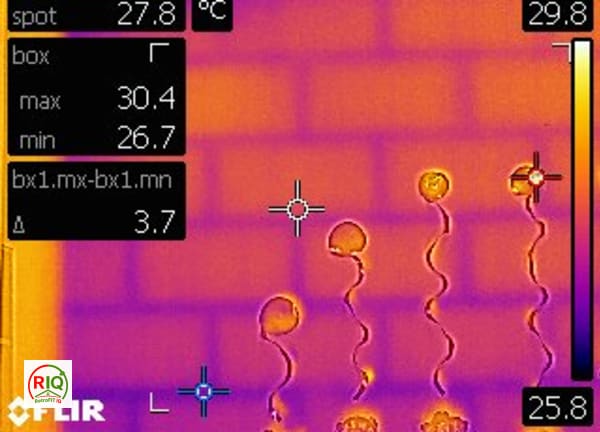
Thermal Bridging Visible Through Masonry Blockwork Wall

Thermal Bridge at Internal Corner Wall Junction

Thermal Bridge at Wall-Ceiling Junction Near Window

Airtightness Testing in a Stratford Victorian Terrace

Bathroom
No related investigations yet.
Browse all investigationsFrequently asked questions
Can thermal imaging detect damp?+
It can flag cool, suspect areas that may be damp, but it cannot measure moisture or prove the cause. Confirmation needs a moisture meter and a proper diagnostic survey.
Is a thermal survey the same as a damp survey?+
No. Thermal imaging is one tool used within a damp survey. A proper damp survey also measures moisture and humidity, analyses dewpoint and inspects the external fabric to identify the cause.
Why isn't a cold patch automatically damp?+
Because cold patches can be thermal bridges, missing insulation or draughts. Moisture must be confirmed by measurement, not assumed from a colour on an image.
What causes most damp in UK homes?+
Condensation is by far the most common — humid indoor air meeting cold surfaces — followed by penetrating damp. Genuine rising damp is comparatively rare.
Are free damp surveys reliable?+
Be cautious. Many are sales visits for a specific treatment and tend to diagnose the problem that treatment solves. An independent, building-physics-based survey is impartial.
Why does my damp keep coming back after treatment?+
Usually because the wrong mechanism was treated — for example a damp-proof course injected for what is actually condensation. The cause was never addressed.
What measurements do you take in a damp survey?+
Moisture readings, air temperature, relative humidity, dewpoint, surface temperatures and an external fabric inspection, mapped with thermal imaging.
Will you tell me the cause, not just that it's wet?+
Yes — identifying the mechanism is the entire point, because condensation, penetrating and rising damp each need a different remedy.
Can you find damp behind plaster?+
Imaging can flag cool areas that may indicate moisture, confirmed with moisture readings and an understanding of the construction.
Is mould always a sign of rising damp?+
No. Black mould is almost always condensation-related, driven by cold surfaces and humidity, not groundwater rising up the wall.
Do I need a damp-proof course?+
Only for genuine rising damp, which is rare. Most cases are condensation or penetrating damp and need a different, often cheaper, fix.
Is the survey non-destructive?+
Largely yes. Infrared and pinless readings are non-invasive; pin readings make tiny pinholes only where appropriate.
Can you check for condensation risk before mould appears?+
Yes — by logging surface temperatures and humidity we can identify condensation risk before visible mould develops.
How long does a damp survey take?+
Typically a couple of hours on site, with humidity logging sometimes left in place longer to capture conditions over time.
Who carries out the survey?+
A Certified Passive House Designer, so the diagnosis is independent, evidence-led and rooted in building physics rather than product sales.
Need professional advice?
A comparison like this helps you understand the theory, but every property behaves differently. The only reliable way to establish the real cause in your home — rather than guessing — is professional building performance diagnostics. At RetrofitIQ we verify buildings using the appropriate combination of investigations:
- Thermal imaging
- Blower door testing
- Moisture investigation
- Building physics assessment
- Passive House methodology