
Moisture Meter vs Building Physics Assessment: A Reading vs an Explanation
Moisture meter vs Building physics assessment.
 Reviewed by George Sora, Certified Passive House DesignerUpdated June 2026
Quick answer & key takeaways
5 min read- Bottom line: A moisture meter tells you whether a spot is wet; a building physics assessment tells you why it is wet and how to stop it.
- When Moisture meter is enough: You need to confirm whether a point is wet
- When Building physics assessment is the better choice: You need to know the cause, not just the wetness
- When you need both: You want a confirmed and explained diagnosis
- Biggest misconception: “A high meter reading proves rising damp.” — It proves the point is wet. The cause — condensation, penetrating or rising — needs building-physics interpretation and supporting evidence.
- Retrofit IQ’s approach: We use the moisture meter to confirm where it is wet and building physics to explain why, because a reading alone cannot tell you whether the cause is condensation, penetrating damp or a cold bridge — and the cause dictates the fix.
Quick answer
A moisture meter tells you whether a spot is wet; a building physics assessment tells you why it is wet and how to stop it. The meter is an essential confirmation tool, but a reading on its own is just a number — it cannot distinguish condensation from penetrating or rising damp, nor predict whether a proposed fix will work. The assessment puts the readings in context, using dewpoint, surface temperatures and moisture transport to diagnose the mechanism and design a durable remedy.
At a glance
| Attribute | Moisture meter | Building physics assessment |
|---|---|---|
| Output | Moisture reading at a point | Diagnosis and predicted performance |
| Explains the cause | No | Yes |
| Coverage | Point by point | Whole mechanism and build-up |
| Predicts fixes | No | Yes — condensation-risk modelling |
| Role | Confirmation tool | Diagnostic and design |
| Best together | Provides the data points | Interprets them in building physics |
What is Moisture meter?
A handheld instrument (pin or pinless) that indicates the moisture content or a relative reading at a specific point. It confirms whether a material is genuinely wet and roughly how wet, but it does not explain why.
What is Building physics assessment?
An analysis of how heat and moisture move through the building — dewpoint, surface temperatures, vapour behaviour, thermal bridges and ventilation — that explains the mechanism behind the damp and predicts how proposed fixes will perform.
What each method measures — and what it doesn’t
Moisture meter
- Moisture content or relative dampness at a point
- Whether a material is genuinely wet
- Comparative readings across a surface
- The cause or mechanism of the damp
- Whether a fix will work
- Conditions over time or across the build-up
Building physics assessment
- Dewpoint and surface-temperature relationships
- Vapour and moisture transport through the build-up
- Whether a proposed remedy will be moisture-safe
- Nothing critical — it uses meter readings as inputs
The building science
A moisture meter answers a narrow but important question: is this point wet, and roughly how wet? Pin meters read between two probes; pinless meters sense a shallow zone beneath the surface. Both are invaluable for confirming whether a suspect area is genuinely damp — but a single reading carries no explanation. Wet plaster could be condensation, a leak, penetrating damp or rising damp, and the meter cannot tell them apart.
A building physics assessment supplies the missing why. It considers the dewpoint of the indoor air against the surface temperatures, how water vapour moves through the construction, where thermal bridges chill the fabric, and how ventilation removes or fails to remove moisture. With that framework, the meter readings become evidence within a diagnosis rather than isolated numbers.
Crucially, the assessment can also predict. Condensation-risk modelling (such as Glaser or hygrothermal methods) tests whether a proposed build-up — for example internal wall insulation — will keep the construction above dewpoint or inadvertently move the condensation plane into the wall. A moisture meter can only tell you a wall is wet now; the assessment tells you whether your planned fix will keep it dry in future.
So the two operate at different levels. The meter gathers data points; the assessment interprets them, explains the mechanism and designs a remedy that will last. Relying on the meter alone is how damp gets a reading but never a diagnosis — and how the wrong fix gets specified.
Key differences
- The meter measures wetness; the assessment explains and predicts.
- A reading is a number; the assessment is a diagnosis.
- The meter cannot distinguish damp mechanisms; the assessment can.
- Only the assessment predicts whether a proposed fix will be moisture-safe.
Common misconceptions
Myth: A high meter reading proves rising damp.
It proves the point is wet. The cause — condensation, penetrating or rising — needs building-physics interpretation and supporting evidence.
Myth: A moisture meter is all a damp survey needs.
Readings without context can mislead. The mechanism and the fix require building physics, not just numbers.
Myth: If readings are low, there is no risk.
Dry today does not mean safe in future. Condensation-risk modelling reveals whether conditions or a planned build-up will cause problems later.
Real-world situations
Confirming whether a stain is genuinely wet
A moisture meter confirms wetness; pair it with an assessment to explain the cause if the damp is recurring or significant.
Planning internal wall insulation
A building physics assessment with condensation-risk modelling to ensure the build-up stays moisture-safe; meter readings inform the baseline.
Recurring damp with no obvious source
An assessment to diagnose the mechanism, using meter readings, humidity and dewpoint as evidence.
Disputing a 'rising damp' diagnosis
An independent building physics assessment, since a meter reading alone does not prove the mechanism.
Which do you actually need?
When Moisture meter is enough
- You need to confirm whether a point is wet
- You are checking the extent of dampness
- You want quick comparative readings
When Building physics assessment is the better choice
- You need to know the cause, not just the wetness
- You are designing a moisture-safe build-up
- You want to predict whether a fix will last
When you need both
- You want a confirmed and explained diagnosis
- You are about to spend money on remedial works
- You are insulating a wall and must avoid interstitial condensation
What Retrofit IQ checks on site
We use the moisture meter to confirm where it is wet and building physics to explain why, because a reading alone cannot tell you whether the cause is condensation, penetrating damp or a cold bridge — and the cause dictates the fix.
- Calibrated moisture readings (pin and pinless) at key points
- Air temperature, relative humidity and dewpoint assessment
- Surface-temperature mapping with thermal imaging
- Condensation-risk analysis of existing and proposed build-ups
- Identification of the damp mechanism behind the readings
- A moisture-safe remediation design, not just a list of wet spots
What a Certified Passive House Designer recommends
A moisture meter is one of the most useful tools in the bag and one of the most misused. A reading confirms wetness, but on its own it explains nothing — and a number waved at a wall has convinced many a homeowner to pay for the wrong treatment. The diagnosis lives in the building physics around that reading.
When the stakes are real — recurring damp, or a wall about to be internally insulated — I want the assessment: dewpoint, surface temperatures, vapour behaviour and condensation-risk modelling, with the meter readings as evidence. That is how you both explain the damp you have and avoid creating new damp with your fix.
— George Sora, Certified Passive House Designer, Founder, RetrofitIQ
Reviewed using current building physics principles and Passive House methodology.
Related services
Related comparisons
Related investigations
Compare another way
Closely related comparisons our clients read next.
Condensation vs Penetrating Damp vs Rising Damp
Condensation comes from moist indoor air meeting cold surfaces; penetrating damp comes from water getting in through an external defect; rising damp comes from groundwater moving up through the wall by capillarity.
Read comparisonInternal vs External Wall Insulation
EWI is generally the better building-physics solution because it keeps the wall warm and the insulation continuous, reducing thermal bridges and condensation risk.
Read comparisonBuilding Physics Assessment vs a Standard Survey
A standard survey inspects condition; a building physics assessment predicts performance.
Read comparisonThermal Imaging vs Moisture Meter for Finding Damp
Thermal imaging finds where to look; a moisture meter confirms what is actually there.
Read comparisonEvidence from Real Projects (18)
Real project and investigation images from our own fieldwork, matched to this page — not stock photography.

Thermal Bridge at Internal Corner Wall Junction
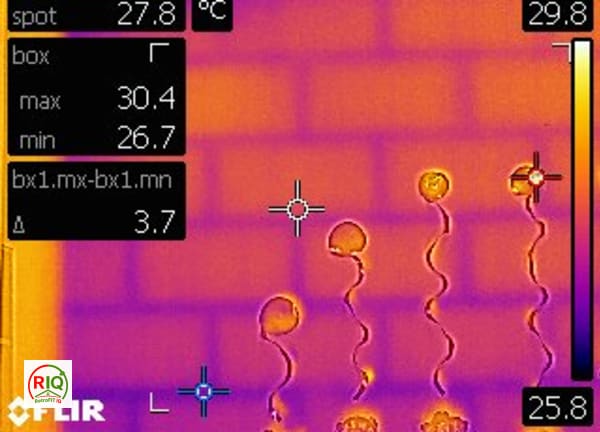
Thermal Bridging Visible Through Masonry Blockwork Wall

Sample Building Performance Investigation Report — Thermal Imaging

Thermal Bridge at Wall-Ceiling Junction Near Window

Airtightness Testing in a Stratford Victorian Terrace

Internal door head and reveal next to a framed picture on a warmer external wall
No related investigations yet.
Browse all investigationsFrequently asked questions
What does a moisture meter actually tell you?+
It indicates the moisture content or relative dampness at a specific point — whether a material is wet and roughly how wet — but not the cause.
Can a moisture meter diagnose rising damp?+
No. A reading confirms wetness but cannot distinguish rising damp from condensation or penetrating damp. That needs building-physics interpretation.
What is a building physics assessment?+
An analysis of how heat and moisture move through the building — dewpoint, surface temperatures, vapour behaviour and thermal bridges — that explains the damp and predicts how fixes will perform.
Why model condensation risk before insulating a wall?+
Because internal insulation can move the condensation plane into the wall. Modelling checks the build-up will stay moisture-safe before you build it.
Do I need both for a damp problem?+
For a confirmed and explained diagnosis, yes. The meter gathers the data; the assessment interprets it and designs the remedy.
Are meter readings ever misleading?+
Yes — surface salts, foil-backed materials and surface dampness can all affect readings, which is why context and interpretation matter.
Can the assessment predict whether my fix will work?+
Yes — condensation-risk modelling predicts whether a proposed build-up keeps the construction above dewpoint and dry.
Is a pinless meter better than a pin meter?+
They suit different situations; pinless senses a shallow zone non-invasively, pin reads between probes. We use both as appropriate.
Why did a meter reading lead to the wrong treatment?+
Because a number alone does not name the mechanism. Without building-physics context, a wet reading is too easily blamed on rising damp.
Is the assessment disruptive?+
Largely non-invasive — imaging, logging and surface readings, with any minor invasive checks agreed in advance.
Does this help with internal wall insulation?+
Yes — it is exactly the analysis needed to insulate solid walls safely without causing interstitial condensation.
Who carries out the assessment?+
A Certified Passive House Designer, so the readings are interpreted within proper building physics and a durable fix is designed.
Need professional advice?
A comparison like this helps you understand the theory, but every property behaves differently. The only reliable way to establish the real cause in your home — rather than guessing — is professional building performance diagnostics. At RetrofitIQ we verify buildings using the appropriate combination of investigations:
- Thermal imaging
- Blower door testing
- Moisture investigation
- Building physics assessment
- Passive House methodology