
There is no single 'damp meter' that reads true moisture everywhere. Different instruments measure different things — electrical resistance, dielectric properties, air humidity, true water content — and each is reliable only within its limits. Competent moisture investigation combines several methods and reads them against each other, rather than trusting one number.
| Method | What it measures | Key limitation |
|---|---|---|
| Resistance (pin) meter | Electrical resistance (relative) | False-high on hygroscopic salts; relative on masonry |
| Capacitance meter | Dielectric response (relative) | Shallow depth; affected by density/metals |
| Calcium carbide (CM) test | True total moisture content | Destructive (drilled sample) |
| Gravimetric (oven-dry) | True moisture content + salt analysis | Lab method; sampling required |
| RH / temperature logger | Air humidity & temperature over time | Measures air, not the wall |
| Interstitial probe | T/RH inside the construction | Requires drilling / embedding |
| Thermal imaging | Surface temperature | Locates, doesn't quantify moisture |
Resistance (pin / conductivity) moisture meters
The familiar two-pin meter measures the electrical resistance between its pins — wetter material conducts better, so lower resistance reads as higher moisture. It is genuinely useful in timber, for which these meters are calibrated and where they give a reasonable estimate of moisture content. But used on masonry and plaster, the readings are relative indicators, not true moisture content, and they have a notorious failure mode:
Capacitance (non-invasive) moisture meters
Capacitance (or dielectric) meters press a flat sensor against the surface and measure the material's dielectric response, which varies with moisture — without pins, so no damage. They are excellent for quickly mapping the relative distribution of moisture across a surface (finding where it's wetter), and for non-destructive scanning. Their limits: they read only a shallow depth, they're affected by the material's density and by metals/foils behind the surface, and like resistance meters they give relative comparisons, not absolute moisture content. Use them to map, not to quantify.
Reference tests: carbide and gravimetric
When you need the true moisture content of masonry — for example to confirm or refute a rising-damp diagnosis — you take a physical sample and use a reference method:
- Calcium carbide (CM / 'speedy') test: a drilled sample is mixed with calcium carbide in a sealed pressure vessel; water reacts to produce acetylene gas, and the pressure indicates the moisture content. It's a recognised on-site method giving true total moisture content, unaffected by salts.
- Gravimetric (oven-dry) test: a sample is weighed, oven-dried to constant mass and reweighed; the weight loss is the water. This is the laboratory reference standard for moisture content — and, with further analysis, can distinguish capillary moisture from hygroscopic (salt-held) moisture, which is decisive in diagnosing rising damp.
RH and temperature data loggers
For condensation and mould problems, the most important measurements aren't of the wall at all — they're of the air. Logging room air temperature and relative humidity over a representative period (days, capturing the cooking/showering/sleeping cycle) characterises the indoor environment, reveals humidity spikes, and — combined with surface temperatures — lets us calculate dew point and surface RH. A single spot RH reading is almost worthless because humidity swings constantly; the logged trend is what tells the story.
Interstitial probes and embedded sensors
To investigate moisture inside a construction, sensors can be placed within the build-up: temperature and RH probes inserted into drilled holes, or wood-moisture and relative-humidity sensors embedded at the cold face of insulation or in sensitive timber. On monitored retrofits these provide real, long-term, in-situ data on whether a wall is wetting up or drying out — the ground-truth that validates (or challenges) the hygrothermal model.
Thermal imaging — locating, not quantifying
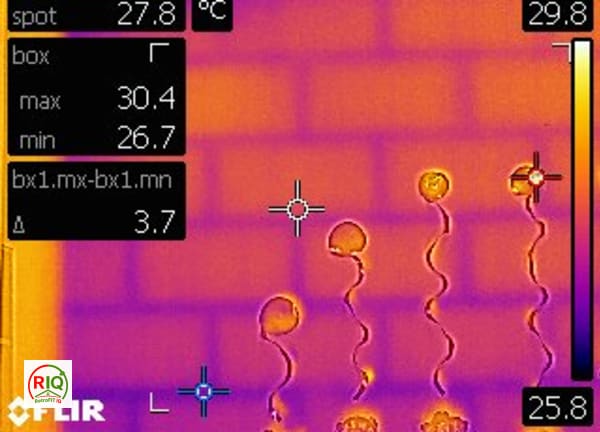
A thermal camera measures surface temperature, not moisture directly — but it's invaluable in moisture work. Evaporating moisture cools a surface, so damp areas often show as cooler patches; cold spots reveal the thermal bridges where condensation forms; and under blower-door depressurisation, air-leakage paths (which carry moisture) light up. Thermal imaging finds the where and the why quickly across a whole surface, which you then confirm and quantify with the contact methods above. (See the Thermal Imaging guide.)
The combined approach
Calibration, zeroing and the WME scale
A meter reading means nothing without knowing what scale it sits on and whether the instrument is true. Resistance meters are calibrated for a specific timber species and temperature; used on other materials they report a 'wood moisture equivalent' (WME) — the moisture content an equivalent piece of timber would have at that resistance — which is a useful relative indicator on masonry and plaster but emphatically not the true moisture content of those materials. Good practice is to zero and check meters against a known reference (a calibration block, a dry sample), to record the material and temperature, and to treat masonry readings as comparative (this spot is wetter than that one) rather than absolute. A number quoted without its scale and reference is not evidence.
Building a moisture map
The single most useful product of a contact survey is not a number but a map. By taking systematic capacitance and resistance readings on a grid across a wall — at several heights and across the suspect area and a known-dry control area — you build a picture of how moisture is distributed. The pattern is diagnostic in a way that no single reading is: a tide-mark rising from the floor with a salt band at its top suggests capillary rise; a plume spreading from a window head or a pipe run suggests penetrating water or a leak; a diffuse cold-corner pattern that tracks the thermal image suggests condensation. Overlaying the moisture map on the thermal image and the humidity log is where the mechanism finally reveals itself.
Long-term monitoring on retrofit
On moisture-sensitive retrofits — internal wall insulation especially — the highest-value measurement is the one taken over months, not minutes. Embedding wood-moisture and interstitial RH sensors at the critical interface (the cold face of the insulation, the masonry behind it, an embedded joist end) provides real, in-situ data on whether the wall is wetting up or drying out through the seasons. This is the ground-truth that validates — or challenges — the hygrothermal model used to design the build-up, and it is increasingly expected on monitored deep-retrofit and heritage projects. A sensor reading climbing year on year is an early warning that a static survey would never catch.