
Internal vs External Wall Insulation: Choosing the Right Approach
Internal wall insulation (IWI) vs External wall insulation (EWI).
 Reviewed by George Sora, Certified Passive House DesignerUpdated June 2026
Quick answer & key takeaways
4 min read- Bottom line: EWI is generally the better building-physics solution because it keeps the wall warm and the insulation continuous, reducing thermal bridges and condensation risk.
- When Internal wall insulation (IWI) is enough: The façade is protected or EWI is impractical
- When External wall insulation (EWI) is the better choice: No planning constraints and a deep retrofit
- When you need both: Mixed approach — IWI on a protected front, EWI elsewhere — with careful junction detailing
- Biggest misconception: “IWI is just a cheaper version of EWI with the same result.” — The building physics differ fundamentally. IWI carries higher moisture and thermal-bridge risk and must be designed accordingly.
- Retrofit IQ’s approach: We model the wall for interstitial condensation and check embedded timbers and junctions before specifying IWI, because internal insulation is an engineering exercise, not a board-on-wall job — done carelessly it can create hidden decay.
Quick answer
EWI is generally the better building-physics solution because it keeps the wall warm and the insulation continuous, reducing thermal bridges and condensation risk. IWI is cheaper and sometimes the only option (for example on protected façades), but it requires expert moisture detailing to be safe. The right choice depends on the building, the budget and the constraints.
At a glance
| Attribute | Internal wall insulation (IWI) | External wall insulation (EWI) |
|---|---|---|
| Where it goes | Inside face of external walls | Outside face, behind render/cladding |
| Thermal bridging | Harder to avoid (floors, party walls) | Largely eliminated — continuous layer |
| Keeps masonry warm? | No — wall stays cold | Yes — wall stays within the warm zone |
| Moisture risk | Higher — needs careful design | Lower — dewpoint kept outside the wall |
| Room size | Reduced | Unchanged |
| External appearance | Unchanged | Changed (may need planning) |
| Relative cost | Lower | Higher |
What is Internal wall insulation (IWI)?
Insulation applied to the inside face of external walls. It is cheaper, can be done room by room, and preserves the external appearance — important for many period and conservation properties — but it reduces room size and demands careful detailing to avoid thermal bridges and interstitial condensation.
What is External wall insulation (EWI)?
Insulation applied to the outside of the walls and finished with render or cladding. It keeps the masonry warm and the insulation layer continuous, virtually eliminating thermal bridging, but it is more expensive, alters the external appearance and may need planning consent.
What each method measures — and what it doesn’t
Internal wall insulation (IWI)
- Insulation on the inside face, cheaper and room-by-room
- A façade-preserving option for protected elevations
- Continuity — floors and party walls interrupt it, creating bridges
- A guaranteed-dry wall without careful vapour detailing
External wall insulation (EWI)
- Insulation on the outside, keeping masonry warm and the layer continuous
- Largely eliminated thermal bridging and a drier wall
- An unchanged external appearance — it alters the elevation
- A low-cost or room-by-room option
The building science
Where you put insulation changes where the dewpoint sits inside the wall. With EWI, the masonry stays on the warm side of the insulation, so it remains above dewpoint and stays dry; the thermal mass also helps stabilise internal temperatures. This is why EWI is generally the lower-risk, higher-performance option.
IWI leaves the original wall cold and outboard of the insulation, which moves the dewpoint inwards. Without correct detailing — a considered vapour control strategy, attention to embedded timbers and the junctions at floors and party walls — warm, moist internal air can reach the cold wall and condense within the construction. This is interstitial condensation, and it is the principal hazard of poorly designed IWI.
Thermal bridging is the other key difference. With IWI, intermediate floors and party walls penetrate the insulation line and create cold bridges that can become condensation and mould hotspots. EWI wraps the building in a continuous layer and avoids most of these — which is exactly why building physics modelling is so valuable before committing to IWI.
Key differences
- EWI keeps the wall warm and dry; IWI leaves it cold and needs moisture detailing.
- EWI is largely continuous; IWI is interrupted by floors and party walls (thermal bridges).
- IWI is cheaper and preserves the façade; EWI costs more and changes the external look.
- IWI can proceed room by room; EWI is usually a whole-elevation project.
Common misconceptions
Myth: IWI is just a cheaper version of EWI with the same result.
The building physics differ fundamentally. IWI carries higher moisture and thermal-bridge risk and must be designed accordingly.
Myth: Any insulation board on the inside will do.
The vapour strategy, junction detailing and embedded-timber checks determine whether IWI is safe or harmful.
Myth: EWI traps damp in the wall.
Correctly specified EWI keeps the masonry warm and above dewpoint, so it tends to stay drier, not wetter.
Real-world situations
Solid-wall Victorian terrace with a protected front façade
IWI to the front (façade preserved) with careful moisture detailing; EWI to the rear if permitted, for continuity.
1960s house with no planning constraints, deep retrofit
EWI for continuous insulation, minimal thermal bridging and a warm, dry wall.
Single room with persistent cold-wall mould, limited budget
Targeted IWI designed with building physics to control dewpoint, plus ventilation and heating-pattern advice.
Which do you actually need?
When Internal wall insulation (IWI) is enough
- The façade is protected or EWI is impractical
- Working room by room on a limited budget
When External wall insulation (EWI) is the better choice
- No planning constraints and a deep retrofit
- You want a continuous, thermal-bridge-free, warm wall
When you need both
- Mixed approach — IWI on a protected front, EWI elsewhere — with careful junction detailing
What Retrofit IQ checks on site
We model the wall for interstitial condensation and check embedded timbers and junctions before specifying IWI, because internal insulation is an engineering exercise, not a board-on-wall job — done carelessly it can create hidden decay.
- Condensation-risk (interstitial) modelling of the wall build-up
- Embedded-timber and joist-bearing checks for IWI
- Thermal-bridge detailing at floors, reveals and party walls
- Thermal imaging of the existing wall
- Ventilation reviewed alongside the insulation
What a Certified Passive House Designer recommends
Where the building and the planners allow it, I lean towards EWI: it solves the building physics by keeping the wall warm and the insulation continuous, and it removes most thermal bridges in one move. IWI is frequently necessary — on protected façades or where EWI is impractical — but it is an engineering exercise, not a DIY board-on-wall job.
Before any IWI, I model the wall build-up for interstitial condensation and detail the junctions, timber bearings and reveals. Done properly, IWI is safe and effective; done carelessly, it can create hidden decay. That is the difference a Certified Passive House Designer makes.
— George Sora, Certified Passive House Designer, Founder, RetrofitIQ
Reviewed using current building physics principles and Passive House methodology.
Related services
Related comparisons
Related investigations
Compare another way
Closely related comparisons our clients read next.
U-values vs Thermal Bridging in Heat Loss
U-values describe heat loss through the flat area of walls, roofs and windows; thermal bridges describe extra heat loss at junctions and interruptions.
Read comparisonCondensation vs Penetrating Damp vs Rising Damp
Condensation comes from moist indoor air meeting cold surfaces; penetrating damp comes from water getting in through an external defect; rising damp comes from groundwater moving up through the wall by capillarity.
Read comparisonEnerPHit vs New-Build Passive House
Passive House (classic) is the new-build standard; EnerPHit is its retrofit counterpart, with slightly relaxed targets that reflect the constraints of working with an existing building.
Read comparisonLoft Insulation vs Wall Insulation
Loft insulation is usually the cheapest, easiest and highest-return measure, so it is normally first; wall insulation tackles a larger heat-loss area and gives big comfort gains but costs more and needs careful detailing.
Read comparisonEvidence from Real Projects (26)
Real project and investigation images from our own fieldwork, matched to this page — not stock photography.
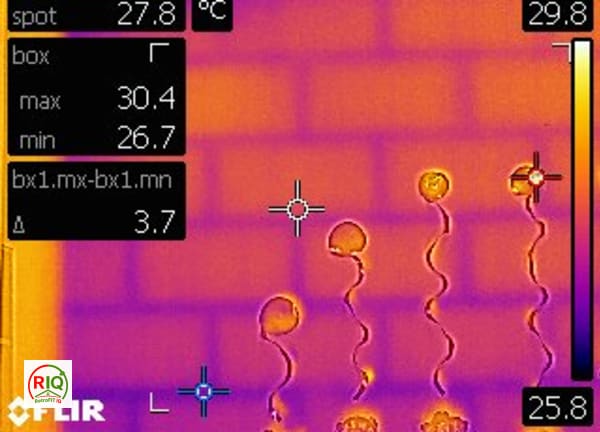
Thermal Bridging Visible Through Masonry Blockwork Wall

Thermal Bridge at Internal Corner Wall Junction

Sample Building Performance Investigation Report — Thermal Imaging

Thermal Bridge at Wall-Ceiling Junction Near Window

Airtightness Testing in a Stratford Victorian Terrace

Internal door head and reveal next to a framed picture on a warmer external wall
No related investigations yet.
Browse all investigationsFrequently asked questions
Which is better, internal or external wall insulation?+
On building-physics grounds EWI is usually better because it keeps the wall warm and continuous. IWI is cheaper and sometimes the only option, but needs expert moisture design.
Does internal wall insulation cause damp?+
It can if poorly designed, by moving the dewpoint into the wall. Correct vapour control and junction detailing prevent this.
Will EWI need planning permission?+
Often yes, because it changes the external appearance — particularly in conservation areas. We check this as part of the design.
How much room does IWI take?+
Typically several centimetres per wall depending on the build-up; this is a real consideration in small rooms.
Can I mix IWI and EWI on one house?+
Yes — for example IWI on a protected front and EWI elsewhere — provided the junctions between them are detailed carefully.
Do I need a building physics assessment first?+
For IWI especially, yes. Modelling the wall for condensation risk is what makes it safe.
Does insulation help with a heat pump?+
Yes — reducing fabric heat loss lowers the heat demand, allowing a smaller, more efficient heat pump.
What about embedded timber joists?+
Timbers bearing into a wall that is being internally insulated need specific checks, as they can become colder and damper. We assess these directly.
Need professional advice?
A comparison like this helps you understand the theory, but every property behaves differently. The only reliable way to establish the real cause in your home — rather than guessing — is professional building performance diagnostics. At RetrofitIQ we verify buildings using the appropriate combination of investigations:
- Thermal imaging
- Blower door testing
- Moisture investigation
- Building physics assessment
- Passive House methodology