
EnerPHit vs New-Build Passive House: The Standards Explained
EnerPHit (retrofit standard) vs Passive House (new-build standard).
 Reviewed by George Sora, Certified Passive House DesignerUpdated June 2026
Quick answer & key takeaways
4 min read- Bottom line: Passive House (classic) is the new-build standard; EnerPHit is its retrofit counterpart, with slightly relaxed targets that reflect the constraints of working with an existing building.
- When EnerPHit (retrofit standard) is enough: Upgrading an existing home to a high standard
- When Passive House (new-build standard) is the better choice: Building new with full design control
- When you need both: The principles, detailing and PHPP modelling are identical — only targets and route differ
- Biggest misconception: “EnerPHit is a watered-down standard.” — It is rigorous; the targets are simply calibrated to what is physically achievable in an existing building.
- Retrofit IQ’s approach: For existing homes we frame the work around EnerPHit, modelling in PHPP and verifying with a blower door — honest, achievable targets with full Passive House discipline, rather than chasing new-build numbers an existing building cannot reach.
Quick answer
Passive House (classic) is the new-build standard; EnerPHit is its retrofit counterpart, with slightly relaxed targets that reflect the constraints of working with an existing building. The principles — continuous insulation, airtightness, thermal-bridge-free detailing, MVHR and modelling in PHPP — are the same; the numbers and the route differ.
At a glance
| Attribute | EnerPHit (retrofit standard) | Passive House (new-build standard) |
|---|---|---|
| Applies to | Existing buildings (retrofit) | New construction |
| Heating demand target | ≤25 kWh/m².a (demand route, climate-dependent) | ≤15 kWh/m².a |
| Airtightness target | ≤1.0 ach@50 | ≤0.6 ach@50 |
| Compliance routes | Component method or energy-demand method | Energy-demand method |
| Main constraint | Existing geometry, junctions, party walls | Design freedom from the outset |
| Modelling tool | PHPP | PHPP |
| MVHR | Yes | Yes |
What is EnerPHit (retrofit standard)?
The Passive House Institute's standard for retrofits, with targets that acknowledge the practical limits of upgrading an existing building. It can be met by a component-based route or an energy-demand route, and recognises that existing geometry and party walls constrain what is achievable.
What is Passive House (new-build standard)?
The classic standard for new construction, with a heating demand limit of 15 kWh/m².a (or a 10 W/m² heating load), airtightness of 0.6 ach@50, and stringent comfort and thermal-bridge criteria — all easier to hit when you control the design from scratch.
What each method measures — and what it doesn’t
EnerPHit (retrofit standard)
- Retrofit-calibrated targets via a component or energy-demand route
- Achievable performance given existing geometry and party walls
- The tightest new-build targets — they are relaxed for retrofit reality
Passive House (new-build standard)
- The full standard — 15 kWh/m².a, 0.6 ach@50, stringent comfort criteria
- Design freedom from the outset
- Achievability in an existing building, where geometry constrains it
The building science
Both standards rest on the same physics: drive down heat demand with continuous insulation and airtightness, eliminate thermal bridges, then provide comfort and air quality with MVHR. Get the fabric right and the heating system becomes small, simple and cheap to run.
New build can hit the tighter numbers because the designer controls geometry, junctions and buildability from day one. Retrofit cannot — you inherit existing walls, floor junctions, party walls and often awkward thermal bridges that cannot be fully removed. EnerPHit's targets are calibrated to that reality, which is why its airtightness and heating-demand limits are a little more forgiving.
EnerPHit also offers a pragmatic component-based route: meet specified U-values and quality criteria element by element, which suits phased retrofits where the whole building cannot be upgraded at once. PHPP — the Passive House Planning Package — is the modelling engine for both, turning fabric decisions into a verified energy balance before work begins.
Key differences
- EnerPHit is for existing buildings; classic Passive House is for new build.
- EnerPHit targets are slightly relaxed (e.g. 1.0 vs 0.6 ach@50) to reflect retrofit constraints.
- EnerPHit offers a component route as well as an energy-demand route; new build uses the demand route.
- The underlying principles, detailing and PHPP modelling are identical.
Common misconceptions
Myth: EnerPHit is a watered-down standard.
It is rigorous; the targets are simply calibrated to what is physically achievable in an existing building.
Myth: You can certify Passive House without PHPP.
PHPP modelling is central to both standards — it is how performance is predicted and verified.
Myth: Passive House is only about saving energy.
It is equally about comfort, air quality and durability — stable temperatures, no draughts and low condensation risk.
Real-world situations
Upgrading a Victorian or 20th-century house to a high standard
EnerPHit — target the retrofit standard via the component or demand route, modelled in PHPP.
Building a new home to the highest comfort and efficiency
Classic Passive House — design to 15 kWh/m².a and 0.6 ach@50 from the outset.
Phased retrofit over several years
EnerPHit component route, upgrading elements to certified U-values as budget allows, with a whole-house plan to avoid lock-in.
Which do you actually need?
When EnerPHit (retrofit standard) is enough
- Upgrading an existing home to a high standard
- Phased retrofit using the component route
When Passive House (new-build standard) is the better choice
- Building new with full design control
- Targeting the highest comfort and lowest demand from scratch
When you need both
- The principles, detailing and PHPP modelling are identical — only targets and route differ
What Retrofit IQ checks on site
For existing homes we frame the work around EnerPHit, modelling in PHPP and verifying with a blower door — honest, achievable targets with full Passive House discipline, rather than chasing new-build numbers an existing building cannot reach.
- PHPP modelling against the appropriate target
- Blower door testing to verify airtightness
- Thermal-bridge detailing and thermal imaging
- Component-route planning for phased retrofit
- Verification that modelled performance is achieved
What a Certified Passive House Designer recommends
For existing homes I almost always frame the conversation around EnerPHit, because it sets honest, achievable targets while keeping the discipline of Passive House detailing and PHPP modelling. The component route in particular is a powerful tool for phased retrofits, letting owners upgrade in stages without painting themselves into a corner.
Whichever standard applies, the value is the same: model in PHPP first, detail the junctions properly, verify airtightness with a blower door, and you end up with a comfortable, low-energy, durable home rather than a hopeful guess.
— George Sora, Certified Passive House Designer, Founder, RetrofitIQ
Reviewed using current building physics principles and Passive House methodology.
Related services
Related comparisons
Compare another way
Closely related comparisons our clients read next.
PHPP vs SAP / RdSAP Energy Modelling
PHPP is a design tool that predicts real energy performance accurately; SAP and RdSAP are compliance and EPC tools, simplified for consistency rather than precision.
Read comparisonInternal vs External Wall Insulation
EWI is generally the better building-physics solution because it keeps the wall warm and the insulation continuous, reducing thermal bridges and condensation risk.
Read comparisonMVHR vs PIV (Positive Input Ventilation)
MVHR is a balanced, heat-recovering system best suited to airtight, well-insulated homes; PIV is a simpler, lower-cost system that dilutes humidity by pressurising the house but recovers no heat.
Read comparisonPassive House vs Building Regulations
Building Regulations set the legal minimum a building must reach; Passive House sets a measured performance standard far above it.
Read comparisonEvidence from Real Projects (9)
Real project and investigation images from our own fieldwork, matched to this page — not stock photography.
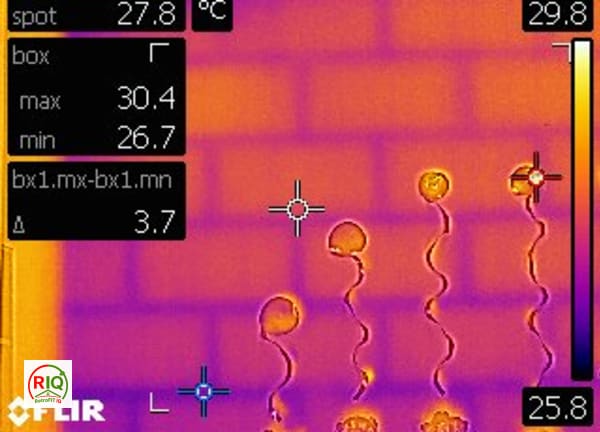
Thermal Bridging Visible Through Masonry Blockwork Wall

Sample Building Performance Investigation Report — Thermal Imaging
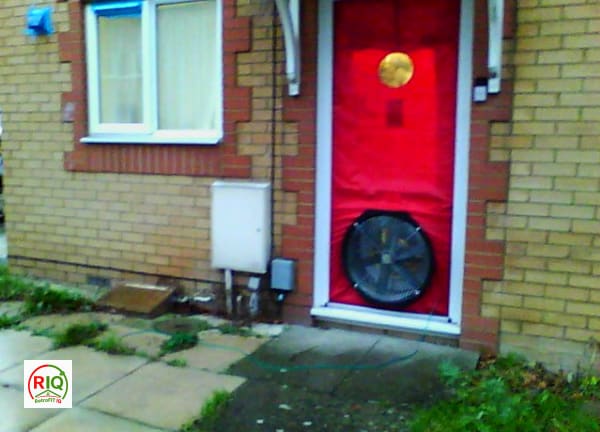
Blower Door Airtightness Test Setup

Thermal Bridge at Internal Corner Wall Junction

Internal door head and reveal next to a framed picture on a warmer external wall

Thermal Bridge at Wall-Ceiling Junction Near Window
No related investigations yet.
Browse all investigationsFrequently asked questions
What is the difference between EnerPHit and Passive House?+
EnerPHit is the retrofit standard for existing buildings; classic Passive House is for new build. EnerPHit's targets are slightly relaxed to reflect retrofit constraints.
What airtightness does EnerPHit require?+
1.0 ach@50, compared with 0.6 ach@50 for new-build Passive House.
What is the component route?+
An EnerPHit compliance route where each building element meets specified U-values and quality criteria — useful for phased retrofits.
Do I need PHPP?+
Yes — PHPP is the modelling tool used to predict and verify performance for both standards.
Is certification compulsory?+
No, but designing to the standard — certified or not — gives you the comfort and efficiency benefits. We also support formal certification.
Can any house reach EnerPHit?+
Most can get close; some junctions and party walls limit what is achievable, which is exactly what PHPP modelling reveals early.
Does EnerPHit require MVHR?+
Yes — controlled ventilation with heat recovery is integral to the standard.
Will EnerPHit help with a heat pump?+
Strongly — reducing heat demand lets you fit a smaller, more efficient heat pump and lowers running costs.
Need professional advice?
A comparison like this helps you understand the theory, but every property behaves differently. The only reliable way to establish the real cause in your home — rather than guessing — is professional building performance diagnostics. At RetrofitIQ we verify buildings using the appropriate combination of investigations:
- Thermal imaging
- Blower door testing
- Moisture investigation
- Building physics assessment
- Passive House methodology