
Damp and mould are fundamentally about the relationship between surface temperature and the moisture in the air (see the Building Physics guide). Surface condensation forms where a surface is colder than the dew point of the room air; mould grows where the surface relative humidity stays high. A thermal camera maps surface temperature across a room — so it directly reveals the cold surfaces where these problems will occur. That's its role in damp work: locating the cold, not detecting the water.
Locating surfaces below the dew point
The core technique is quantitative: measure the room air's temperature and relative humidity (giving the dew point), then use the thermal camera to read surface temperatures across walls, corners, reveals and lintels. Wherever a surface sits at or below the dew point, condensation will form; wherever it sits within the mould-risk margin (surface RH above ~80%), mould can grow — even without visible water. The thermal image and the psychrometrics together produce a map of risk.
The evaporative-cooling signature of damp
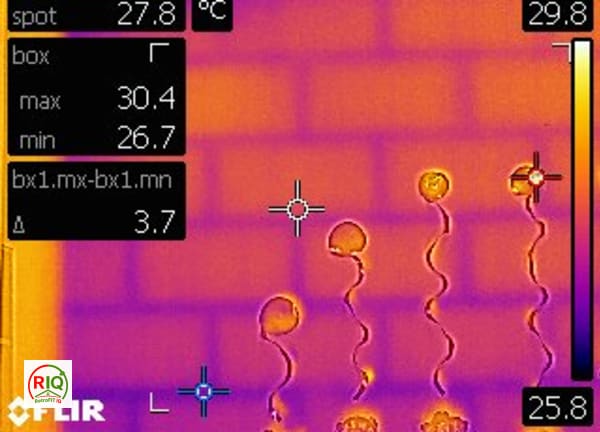
There is a second, subtler way thermography helps with actual moisture: evaporation cools a surface. Where a material is genuinely wet — from a leak, penetrating damp or drying-out — water evaporating from it draws latent heat and leaves the surface cooler than the surrounding dry area. So a damp patch can show as a distinctly cool, often irregularly-shaped region. Its boundary frequently follows the spread of the moisture (a tide-line, a run-down from a leak) rather than the geometry of the construction, which is a clue to its nature.
The interpretation problem — three cold things
Here is the crucial limitation. Three different problems all produce cold areas on a thermal image, and the camera alone often can't separate them:
| Cause | Typical pattern | How we confirm it |
|---|---|---|
| Missing/poor insulation | Cold patch matching construction geometry | Static; ignores blower door |
| Air leakage | Cold fingers/fans from a gap | Blooms under blower-door depressurisation; smoke trace |
| Evaporating moisture (damp) | Irregular cool area following moisture spread | Moisture meter, humidity data, source survey |
The combined damp survey
- Log room temperature and RH over a representative period to characterise the indoor air and derive the dew point.
- Thermal-image the affected surfaces to map cold spots and read surface temperatures.
- Calculate surface RH at the cold locations and compare surface temperature against the dew point — confirming condensation/mould risk with numbers.
- Use moisture meters (with the hygroscopic-salt caveat in mind) and, where needed, true moisture-content sampling to test for liquid moisture.
- Run a blower door if air leakage is suspected, to separate leakage from insulation and moisture.
- Survey the exterior for penetrating-damp sources (pointing, render, flashings, drainage).
- Only then write the diagnosis — which mechanism(s), where, and the targeted remedy.
This is the measured approach that distinguishes condensation from penetrating and rising damp — the subject of our 'condensation vs damp' article — and it is why a RetrofitIQ damp diagnosis rests on data from several instruments, not on a single dramatic thermal image.
Mapping the fRsi temperature factor on site
The most rigorous use of thermography in a damp investigation is quantitative: measuring the surface temperature at a junction precisely enough to assess its fRsi temperature factor. fRsi compares the internal surface temperature at the coldest point to the internal and external air temperatures, and UK guidance sets a minimum of 0.75 for dwellings to avoid mould at junctions. With the room and external air temperatures recorded and the camera correctly set for emissivity and reflected temperature, a surveyor can read the surface temperature at a suspect corner, reveal or lintel and calculate the achieved fRsi on the actual building. A junction below 0.75 is, in effect, certified as a mould risk by measurement — turning a subjective 'that corner looks cold' into a defensible number that justifies the remedy and, after the works, proves it succeeded.
Condensation pattern versus penetrating-damp pattern
The shape and location of a cool area help separate condensation from penetrating damp before the contact instruments even come out. Condensation and mould map onto the building's thermal geometry: they sit at the coldest surfaces — external corners, the tops of walls, window reveals, lintels and behind furniture on external walls — and the cool pattern follows the construction, not the weather. Penetrating damp, by contrast, follows the water: it spreads from a defect (a cracked render panel, a failed flashing, a leaking gutter, a bridged DPC) and its cool, evaporative pattern often runs downward or sideways from the source, frequently high on a wall or around an opening rather than confined to cold junctions, and it tends to worsen within hours of rain rather than on cold nights. Reading which logic a pattern obeys — thermal geometry or water path — is the first cut in attributing a damp problem, confirmed afterwards with moisture measurement and an external survey.