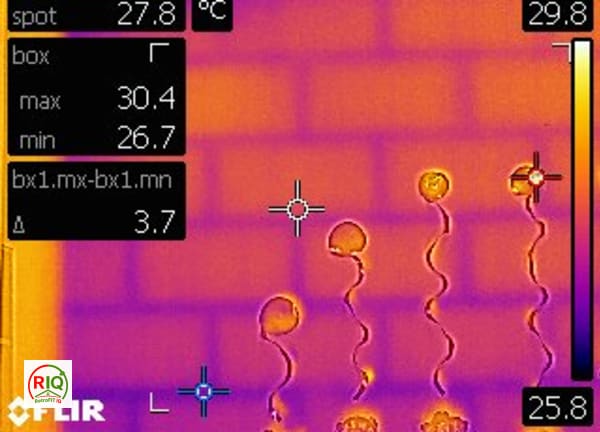

Retrofit measures are only as good as their installation, and most of that installation ends up hidden behind finishes. A beautifully specified internal wall insulation system installed with gaps at the joists, or an EWI wrap left bridged at the eaves, performs far below its design — and you'd never know from looking at the finished decoration. Thermal imaging makes the hidden quality visible, which is exactly why it belongs in every serious retrofit's quality-assurance plan.
Before-and-after surveys
The most compelling use is the paired survey: image the building before the works to map the existing defects (cold walls, thermal bridges, leakage), then image it again after, under comparable conditions, to show the improvement. The contrast is both a quality check and a powerful demonstration to the client that their money changed something measurable. Comparable conditions matter — similar ΔT, same internal/external viewpoint, same camera settings — or the comparison is meaningless.
Checking install quality during the works
| Stage | What thermal imaging verifies | Why it matters |
|---|---|---|
| Pre-works | Existing defects, cold bridges, baseline | Targets the works at real problems |
| During (air barrier exposed) | Insulation continuity, air-barrier integrity | Defects fixable in minutes, not by stripping out |
| Post-works (matched conditions) | Improvement, junctions warm, no new bridges | Documented proof the design was achieved |
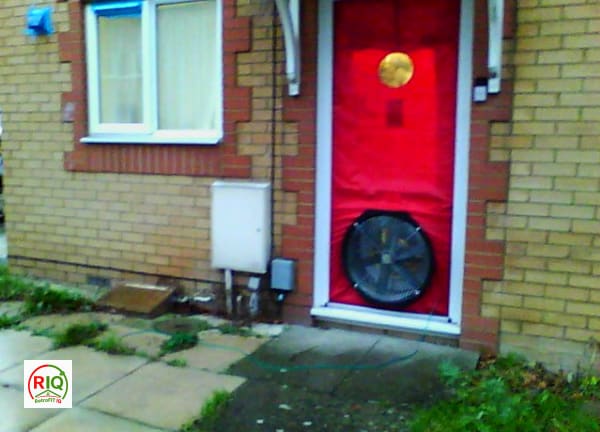
Even more valuable than the final 'after' shot is surveying while the work is still accessible. An interim thermal survey (with the building heated and, ideally, the blower door running) catches problems when they cost minutes to fix rather than a stripped-out wall later:
- Insulation continuity — confirming batts/boards are fitted tight with no gaps before they're boarded over.
- Junction detailing — checking that insulation is carried continuously around corners, reveals and floor/ceiling junctions, not stopped short.
- Air-barrier integrity — combined with depressurisation, confirming the new air barrier is continuous and hasn't been punctured by follow-on trades.
- Thermal-bridge correction — verifying that insulation returns at party walls and embedded elements actually warm the junction.
Confirming thermal bridges are designed out
Thermal-bridge-free detailing (covered in the Passive House guide) is only as good as its execution. After the works, a quantitative thermal survey reads the internal surface temperature at the critical junctions and confirms they are warm enough — comfortably above the dew point and clear of the mould-risk margin. Where surface temperatures are reported precisely (with correct emissivity and reflected-temperature compensation), they can be used to check the achieved fRsi temperature factor against the 0.75 minimum, providing genuine as-built evidence rather than a design assumption.
Closing the performance gap
The 'performance gap' — buildings using far more energy than designed — is largely a problem of as-built quality not matching as-designed intent (see the Passive House vs Building Regulations article). Verification is the antidote. A retrofit that is modelled, then built, then verified by thermal imaging and a blower door test, has actually demonstrated that it achieved what was specified. Without that verification, you're trusting that everything hidden behind the plaster was done perfectly — which, across a real building, it rarely is.
How we use it on a project
- Pre-works survey to map existing defects and establish the baseline.
- Interim survey while the insulation and air barrier are accessible, to catch and fix defects early.
- Post-works survey under matched conditions to verify continuity and improvement.
- Pair with a blower door test (before and after) to verify airtightness and locate any residual leakage.
- Report the evidence — annotated images, recorded conditions, surface temperatures at critical junctions — as the project's quality record.
Verification and the PAS 2035 quality framework
Thermal verification is not just good practice; it aligns with how the UK retrofit standard expects quality to be assured. PAS 2035 frames retrofit as a coordinated, evidence-based process with defined roles, moisture risk management and post-installation checks — precisely the gap that as-built thermal imaging and blower door testing fill. A retrofit coordinator working to PAS 2035 has to demonstrate that the installed measures perform and that moisture risk has been managed; a documented thermal survey showing continuous insulation, warm junctions clear of the dew point and a sound air barrier is exactly the kind of objective evidence that supports that obligation. For grant-funded work and quality-assured schemes, verification converts a contractor's assurance into independent proof, which protects the homeowner and the funder alike.
What a credible verification report contains
A verification survey is only as good as the record it produces, and a defensible report has a consistent anatomy:
- The conditions — internal and external temperatures (and therefore ΔT), weather, time, camera and emissivity/reflected-temperature settings — so the validity of the survey can be judged.
- Matched before-and-after images at the same viewpoints, scales and settings, so any change reflects the works rather than the weather.
- Measured surface temperatures at the critical junctions, with the calculated fRsi where relevant, checked against the 0.75 minimum.
- Clear attribution of any residual cold areas — insulation, air leakage or moisture — corroborated by the blower door and moisture measurement.
- A plain-language conclusion: what was verified, what (if anything) still needs attention, and the evidence behind each statement.