
Most bad thermal surveys aren't bad because of the camera — they're bad because of the conditions, the settings or the interpretation. The physics that makes thermography powerful also makes it easy to fool: get the temperature difference, the emissivity, the solar exposure or the scale wrong and you'll still get a striking image, just not a meaningful one. Here are the errors that matter, and how to spot them.
The conditions mistakes
- Insufficient temperature differential — surveying with too little inside-to-outside difference, so defects never develop a thermal pattern. The commonest fatal error (see the ΔT article).
- Solar loading — surveying a sunlit building, where stored solar heat re-radiates for hours and completely masks or mimics defects. External surveys should be before dawn or after dark, on overcast days.
- Surveying a cold or just-heated building — not allowing time for the temperature patterns to establish through the fabric, especially in heavyweight masonry with thermal lag.
- Wind and surface wetness — convective cooling and evaporation flatten and distort the patterns; recent rain or strong wind degrades the survey.
The settings and surface mistakes
| Mistake | Effect | Correct practice |
|---|---|---|
| Wrong emissivity setting | Measured temperatures shifted/false | Set ε for the actual surface (~0.9–0.95 typical) |
| Ignoring reflected temperature | Reflections read as real temperatures | Set reflected apparent temperature |
| Imaging shiny/metal/foil surfaces | Camera reads reflections, not the surface | Avoid, or interpret with extreme care |
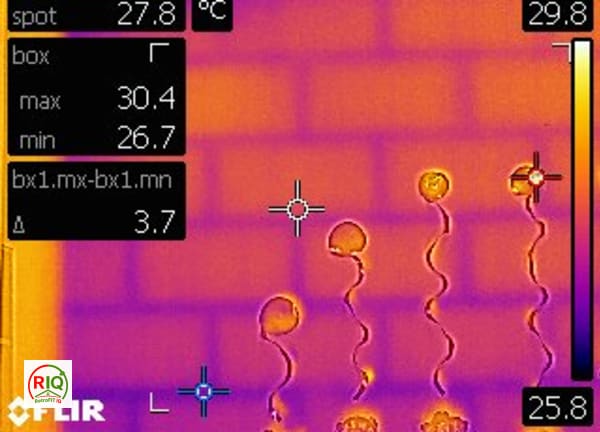
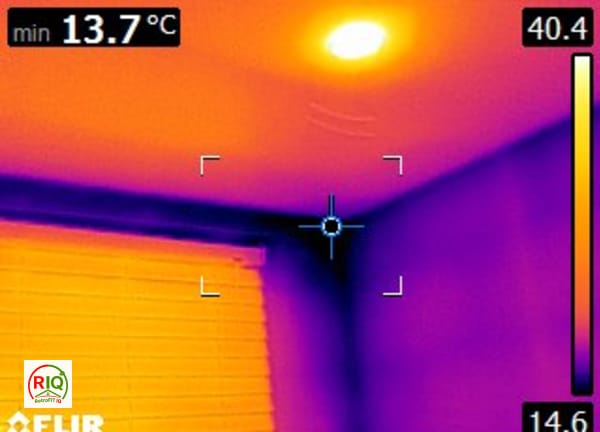
| Auto-ranging palette not fixed | A 1 °C spread looks as dramatic as 20 °C | Set and state the temperature scale |
| Steep viewing angles on glass | Glass becomes reflective | Image as near-perpendicular as possible |
The interpretation mistakes
- Confusing the three cold things — calling every cold patch 'missing insulation' when it could be air leakage or damp. Without a blower door and moisture measurement, the attribution is a guess.
- Mistaking normal construction for defects — reading the regular cool stripes of studs/joists (expected repeating thermal bridges) as faults.
- Reading the palette literally — treating the false-colour 'hot/cold' as absolute when the scale is auto-ranged and the differences may be tiny.
- Over-claiming — asserting 'damp', 'no insulation' or 'major heat loss' from a single image, with no measured temperatures, no conditions recorded and no corroborating method.
How to tell a good survey from a bad one
You don't need to be a thermographer to judge a survey. Look for these markers of competence:
- The conditions are recorded — ΔT, weather, time, internal/external, emissivity and reflected temperature.
- It was done in the right conditions — heating season, adequate ΔT, no solar loading; the surveyor explains why.
- The temperature scale is fixed and shown on the images, not left auto-ranging.
- Cold areas are attributed carefully — distinguishing insulation, air leakage and moisture, ideally corroborated by a blower door and moisture measurement.
- Claims are proportionate and explained, not dramatic assertions from a single picture.
- The surveyor holds a recognised thermography qualification (e.g. a Level 1/2 category certification) and understands building physics — not just camera operation.
The over-claiming epidemic
The most damaging mistake is not technical but commercial: over-claiming. Because a modern camera produces such confident, vivid images, it is tempting — and common — to present a single auto-scaled picture as proof of 'no insulation', 'serious damp' or 'major heat loss', and to attach a remedy (and a quote) to it. This is how homeowners end up paying for cavity-wall injection they didn't need, a chemical damp-proof course for what was condensation, or external insulation specified from a sunlit image that was mostly solar artefact. A cold patch is a question, not an answer. Responsible thermography states what the pattern shows, lists the possible causes, and explains which further measurements are needed to attribute it — it does not leap from a colourful image to a confident, billable conclusion. If a survey's findings always seem to justify the surveyor's own remediation services, treat that as a warning sign in itself.
Questions to ask before you book a survey
You can screen out most bad surveys with a few questions before any camera comes out:
- What conditions will you survey in, and why? (Expect: heating season, adequate ΔT, no solar loading, building conditioned beforehand.)
- Will you record the conditions and camera settings in the report? (A 'yes' is essential; vague answers are a red flag.)
- How will you tell missing insulation from air leakage or damp? (Expect: a blower door for leakage, moisture measurement for damp — not 'the camera shows it'.)
- What thermography qualification do you hold, and what's your building-physics background? (Expect a recognised certification plus genuine building knowledge.)
- Are you independent of the firms that would do any remedial work? (Independence guards against findings that conveniently match a sales pitch.)