
Air always contains some water vapour. How much it can hold depends entirely on its temperature: warm air can hold a lot, cold air very little. The dew point is the temperature to which you would have to cool a given parcel of air for it to become saturated — to reach 100% relative humidity — at which point any further cooling forces the vapour to condense into liquid water. It is a property of the air's actual moisture content, not of any surface.
Why warm air holds more moisture
The amount of water vapour air can hold rises steeply with temperature — the saturation vapour pressure roughly doubles for every 10–11 °C of warming. This is why a bathroom mirror fogs the instant warm, moist air meets the cold glass: the air touching the glass is chilled below its dew point and dumps its excess moisture. It is also why winter condensation is worse: cold external walls and windows sit closer to (or below) the indoor air's dew point.
The relationship between temperature, humidity and moisture content is described by psychrometrics — and plotted on a psychrometric chart. You don't need the chart to use dew point diagnostically; you need just two measurements: the air's temperature and relative humidity (which together fix the dew point), and the temperature of the surface you're worried about.
Surface temperature vs dew point — the core diagnostic
Condensation forms on a surface when, and only when, that surface is colder than the dew point of the air touching it. This simple rule is the foundation of measured damp diagnosis:
| Condition | Result |
|---|---|
| Surface temperature well above dew point | Surface stays dry |
| Surface temperature near dew point (small margin) | At risk; elevated surface RH → mould risk |
| Surface temperature at or below dew point | Condensation forms (visible liquid water) |
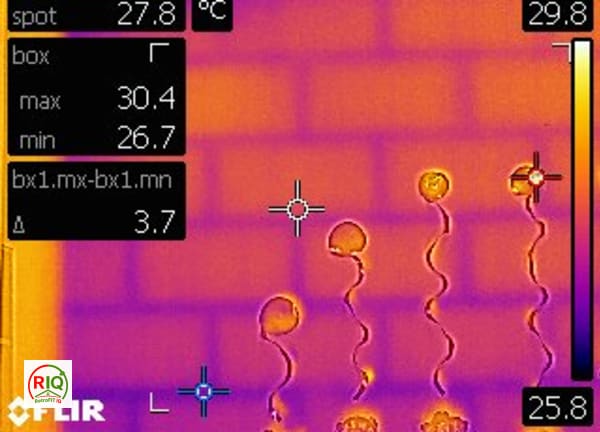
On a survey we measure room air temperature and RH (giving the dew point), then use a calibrated thermal camera to read the surface temperature across walls, reveals, lintels and corners. Wherever a surface is at or below the dew point, the thermal image and the physics agree: that is where condensation and mould will appear. It removes the guesswork from a diagnosis.
The dewpoint margin — and why mould beats condensation to it
Here is the subtlety that trips people up: you do not need liquid condensation to grow mould. Mould germinates when the relative humidity at a surface stays above roughly 80% for sustained periods — and a surface reaches 80% surface RH while it is still several degrees above the dew point. In other words, mould appears on surfaces that are cold but not actually wet.
Using dew point to choose the right fix
Once you frame a damp problem in dew-point terms, the remedy becomes obvious. There are only two levers:
- Raise the surface temperature above the dewpoint margin — internal or external wall insulation, thermal-bridge correction at lintels and reveals, eliminating cold spots. This is usually the durable structural fix.
- Lower the air's dew point by reducing indoor humidity — controlled ventilation (extract or MVHR), source control (lids on pans, venting tumble dryers, drying washing outside) and avoiding unflued moisture sources.
Most successful remediations use both: lift the cold surfaces and control the humidity, so the surface temperature and the dew point move apart and never meet. A chemical 'damp treatment' addresses neither lever, which is why it so often fails on what is actually a condensation problem.
How dew point is calculated — the Magnus approximation
You rarely calculate dew point by hand — every data logger and psychrometric app does it for you — but understanding the maths shows why the relationship is non-linear. The standard tool is the Magnus-Tetens approximation. First you compute the saturation vapour pressure at the air temperature, then multiply by the relative humidity to get the actual vapour pressure, then work backwards to find the temperature at which that actual vapour pressure would be the saturation value. That temperature is the dew point. The key behaviour is that saturation vapour pressure rises exponentially with temperature, so equal steps in temperature do not give equal steps in moisture capacity — which is why a small drop in a cold room can tip the air over its dew point surprisingly fast.
| Room air | 40% RH | 50% RH | 60% RH | 70% RH |
|---|---|---|---|---|
| 18 °C | 4.2 °C | 7.4 °C | 10.1 °C | 12.5 °C |
| 20 °C | 6.0 °C | 9.3 °C | 12.0 °C | 14.4 °C |
| 21 °C | 6.9 °C | 10.2 °C | 12.9 °C | 15.4 °C |
| 22 °C | 7.8 °C | 11.1 °C | 13.9 °C | 16.3 °C |
Read down a column and the lesson is stark: at 20 °C, lifting the room from 50% to 70% RH raises the dew point from about 9.3 °C to 14.4 °C — meaning surfaces up to 5 °C warmer are now at risk. This is why humidity control is such a powerful lever: a modest reduction in indoor RH lowers the dew point and rescues a whole band of cool surfaces at once.
Why winter is the danger window
Dew-point problems are overwhelmingly a heating-season phenomenon, and two effects stack. First, external walls, windows, reveals and corners are far colder in winter — a north-facing solid-wall corner can sit below 14 °C even with the heating on — so surface temperatures fall toward the dew point. Second, we ventilate less (windows shut, draughts sealed) while generating the same moisture from cooking, washing and breathing, so indoor RH and therefore the dew point climb. Cold surfaces moving down to meet a rising dew point is the precise recipe for the seasonal flush of condensation and mould that appears every autumn and clears every spring.
Dew point, thermal bridges and fRsi
Dew point explains where condensation lands, but the temperature factor fRsi explains why some surfaces are colder than others. fRsi is the ratio of (internal surface temperature minus external temperature) to (internal air temperature minus external temperature): a higher value means a warmer internal surface for the same weather. UK guidance (BS EN ISO 13788, informed by BRE work) sets a minimum fRsi of 0.75 for dwellings to keep surfaces clear of the mould-risk margin. A geometric thermal bridge such as an external corner, or a constructional one such as a concrete lintel or a balcony slab, has a lower fRsi than the surrounding wall, so its surface temperature drops closest to the dew point first. Mapping fRsi at junctions is how a designer proves, before building, that no surface will cross the dew-point margin in service.
From dew point to a ventilation target
Dew point also tells you how hard your ventilation has to work. If thermal imaging shows the coldest surface in a room sits at, say, 13 °C, then to keep that surface clear of the ~80% surface-RH mould margin you need to hold the room dew point a few degrees below it — which fixes a target indoor relative humidity for the prevailing temperature. Ventilation (extract or MVHR) is then sized to remove the household's daily moisture load fast enough to hold the air below that RH. Framed this way, ventilation is not a vague 'let the house breathe' instruction but a calculable requirement derived from the coldest surface and the dew point.