
What is the difference between condensation, rising and penetrating damp?
Damp is not one problem — it is three. Condensation, penetrating damp and rising damp produce similar-looking stains, smells and mould, but each is driven by entirely different building physics, and each needs a completely different fix. Getting the diagnosis right is the single most important decision you will make, because the cure for one type does nothing for the others.
 Reviewed by George Sora, Certified Passive House DesignerUpdated June 2026
Quick answer & key takeaways
11 min read- There are three distinct types of damp: condensation, penetrating and rising — with three different causes.
- Condensation is by far the most common in UK homes, and is driven by humid air meeting cold surfaces.
- Penetrating damp comes from water getting in through a defect in the external fabric.
- Rising damp — genuine capillary moisture from the ground — is real but comparatively rare and over-diagnosed.
- The pattern, timing and location of the damp usually point to the type, but only measurement confirms it.
- Biggest misconception: that all damp is 'rising damp' needing a chemical damp-proof course. Most is condensation.
- Retrofit IQ's approach: measure surface temperature, dew point, moisture profile and external fabric before recommending anything.
What this usually means
When a wall, floor or ceiling is wet, stained or growing mould, it is showing you that moisture is reaching a surface and staying there. But moisture can arrive by three completely separate routes, and the route — not the appearance — is what dictates the cure. This is why two homes with identical-looking damp patches can need opposite remedies, and why so much damp work fails: the symptom was treated without identifying the mechanism.
Condensation is moisture that was already inside your home as water vapour in the air, depositing onto a surface that has fallen below the dew point. The water comes from indoor activities — cooking, washing, drying clothes, even breathing — and the wall is simply the cold surface it lands on. Penetrating damp is the opposite: liquid water from outside, driven through a defect such as a cracked render, a failed seal, blocked gutters or a leaking roof, travelling inwards. Rising damp is different again — ground water drawn upwards through the pores of a wall by capillary action, limited to roughly a metre above ground level and usually accompanied by a tide mark and ground salts.
Understanding this trio matters because the industry frequently collapses all three into 'damp' and sells a single, expensive remedy — most often a chemical damp-proof course — regardless of the real cause. A damp-proof course does nothing for condensation or a leaking gutter, yet condensation accounts for the great majority of damp complaints in occupied UK homes. The honest, money-saving answer is to identify which mechanism is genuinely at work before spending anything.
Common causes
Indoor moisture + cold surfaces (condensation)
Everyday moisture from cooking, bathing and drying laundry raises indoor humidity; where it meets a cold wall or window it condenses. This is the dominant cause of damp in lived-in homes.
External fabric defects (penetrating damp)
Cracked render, failed pointing, perished sealant, blocked gutters, downpipe leaks and roof defects let rainwater track inwards to a localised patch.
Bridged or filled cavities (penetrating damp)
Mortar droppings on wall ties, or unsuitable cavity-fill insulation, can carry water across a cavity that was designed to keep it out.
Missing or breached damp-proof course (rising damp)
Where a wall has no DPC, or it has been bridged by raised external ground, a path or a render coat carried below ground level, capillary moisture can rise.
High external ground level
Patios, driveways and flower beds built up above the internal floor level breach the protection at the base of the wall and are a frequent trigger for ground-related damp.
Misdiagnosis itself
Treating condensation as rising damp — replastering and injecting a DPC — leaves the real cause untouched, so the damp and mould return within a season or two.
The three types of damp — and how each behaves
Condensation (most common)
Humid indoor air meets a surface below its dew point and water forms on it. It is worst in winter, in unheated and poorly ventilated rooms, and shows up on cold spots — window reveals, corners, behind furniture on external walls and around thermal bridges. It is driven by indoor moisture and cold surfaces, not by water coming from outside or below.
Penetrating damp
Liquid water enters through a defect in the external envelope — cracked or blown render, defective pointing, a failed window seal, a slipped tile, blocked or overflowing gutters, or a bridged cavity. It typically appears as a localised patch that worsens during and after rain, can occur at any height, and tracks back to a specific external fault.
Rising damp (least common, most over-diagnosed)
Genuine capillary moisture rising from the ground through a wall with no functioning damp-proof course. It is limited by gravity and evaporation to roughly a metre, leaves a distinctive horizontal tide mark, and is usually accompanied by hygroscopic ground salts (nitrates and chlorides) in the plaster. True rising damp is far rarer than the volume of 'rising damp' treatments sold would suggest.
Signs and symptoms
Worse in winter, on cold surfaces
Damp and mould that appear or worsen in cold weather, on corners, reveals and behind furniture, strongly indicate condensation rather than ingress from outside or below.
A patch that worsens after rain
Damp that darkens during and after wet weather, often mid-wall or near a window, gutter or downpipe, points to penetrating damp from an external defect.
A horizontal tide mark near the floor
A defined line up to about a metre above floor level, sometimes with a salty bloom on the plaster, is the classic — though over-claimed — signature of rising damp.
Musty smell with no visible water
A persistent damp smell can come from any of the three, and from moisture held in plaster or behind finishes; it tells you moisture is present but not where it comes from.
Mould following the cold spots
Mould concentrated in the coldest parts of a room — high corners, window reveals, behind wardrobes — is a condensation signature, because those surfaces sit closest to the dew point.
What most people check first
- When the damp appears or worsens — winter and cold rooms (condensation) versus after rain (penetrating).
- Where it is — cold corners and reveals (condensation), a localised mid-wall patch (penetrating), a low tide mark (rising).
- External clues — blocked gutters, cracked render, raised ground level, defective pointing.
- Indoor moisture sources — drying laundry indoors, unvented cooking, long showers, and how the home is ventilated.
What most people miss
- That most 'damp' in occupied homes is condensation, not rising damp — so a damp-proof course is the wrong fix.
- That a high external moisture meter reading does not, on its own, tell you which mechanism is causing it.
- That the timing (winter versus after rain) is one of the most reliable clues to the real cause.
- That condensation and penetrating damp can occur together, masking each other until both are measured.
The building physics
Each type of damp obeys a different physical law, which is exactly why measurement can separate them. Condensation is governed by the relationship between air temperature, relative humidity and surface temperature. Air holds a temperature-dependent maximum amount of water vapour; cool that air against a cold surface and its relative humidity rises until, at the dew point, it can hold no more and water condenses out. So condensation is predictable: measure the room's air temperature and humidity, calculate the dew point, and compare it with the surface temperature. Where the surface is colder than the dew point, condensation will form there — and that is where you will find the damp and mould.
Penetrating damp is governed by liquid water transport under gravity and pressure, not by air physics. Rainwater finds a defect — a crack, a failed seal, a blocked gutter overflowing down a wall — and is driven inwards by gravity, wind pressure and capillarity within the material. Because the driver is external rainfall, penetrating damp correlates with the weather: it appears or intensifies during and after rain and dries back between events. Its location tracks to the fault, so it is usually localised rather than spread across whole cold surfaces.
Rising damp is governed by capillary action — the same effect that draws water up a narrow tube or a paper towel. Ground water is pulled up through the fine pore network of masonry until the upward capillary pull is balanced by gravity and by evaporation from the wall face, which is why it stops at roughly a metre. As the water evaporates it leaves behind dissolved ground salts, which are hygroscopic — they attract atmospheric moisture — producing the characteristic salt-contaminated band and tide mark. Genuine rising damp therefore has a measurable salts signature that condensation and penetrating damp lack.
Because the three mechanisms have distinct signatures — dew-point relationships for condensation, rainfall correlation and a traceable external defect for penetrating damp, and a capillary height limit with ground salts for rising damp — a competent investigation can tell them apart with instruments rather than assumption. The crucial point is that the remedies do not overlap: ventilation and warmer surfaces cure condensation, fixing the external defect cures penetrating damp, and (rarely) a damp-proof course plus salt-resistant replastering addresses true rising damp. Apply one remedy to the wrong mechanism and it simply fails.
How to fix each type — once you know which it is
There is no single cure for 'damp', because the three types need three different approaches. The right sequence is always diagnosis first, then the remedy that matches the mechanism.
- 01
Confirm the mechanism before spending anything
Measure air temperature, humidity, surface temperatures and dew point; correlate with rainfall; and test for ground salts where a low tide mark exists. This single step prevents the most common and expensive mistake — treating the wrong type of damp.
- 02
For condensation: warm the surfaces and control the moisture
Raise cold surface temperatures with insulation and by treating thermal bridges so they stay above the dew point, and remove indoor moisture with controlled ventilation (continuous extract or balanced MVHR). Together these remove the conditions condensation needs.
- 03
For penetrating damp: find and repair the external defect
Trace the patch back to its source — gutter, downpipe, render, pointing, sealant or roof — and repair the fabric so water can no longer enter. Allow the wall to dry, then redecorate; no internal treatment substitutes for stopping the ingress.
- 04
For rising damp: confirm it genuinely, then treat the base
Where true rising damp is confirmed, address the cause (for example lower a bridging external ground level) and, if needed, install a damp-proof course and replaster with a salt-resistant system. Because real rising damp is rare, this should follow confirmation, not assumption.
- 05
Re-measure after the work
Verify the fix with the same instruments used to diagnose it. Surfaces should now stay above the dew point, patches should stop responding to rain, and humidity should sit in a healthy range — proof the cause, not just the stain, has been addressed.
How to prevent it coming back
- Keep indoor humidity in check with adequate, used ventilation — especially when cooking, bathing and drying clothes.
- Maintain the external fabric: clear gutters, repair pointing and render, and renew failed seals before water finds a way in.
- Keep external ground, paths and beds well below the internal floor level and any damp-proof course.
- Warm cold surfaces through insulation and thermal-bridge treatment so condensation has nowhere to form.
- Act on the first signs rather than redecorating over them — early diagnosis is cheaper than repeated remedial work.
How Retrofit IQ investigates this
We diagnose which type of damp is genuinely present before recommending anything, because the three mechanisms need three different remedies and the wrong one wastes money.
Do not spend money fixing symptoms before you understand the cause — investigate first, then build with confidence.
Do I need a professional investigation?
You should consider a professional investigation whenever damp keeps returning after redecoration or remedial work, when more than one possible cause is plausible, or when you have been quoted for expensive treatment — particularly a chemical damp-proof course — without anyone measuring the building first.
Diagnosis is also worthwhile before you buy or renovate a property with visible damp, because identifying the true mechanism changes both the cost and the scope of the work. A short, instrumented assessment that separates condensation, penetrating and rising damp routinely saves far more than it costs by directing money at the real cause rather than a presumed one.
Where to go next
Relevant services
Related comparisons
From the Academy
- Condensation vs damp — how to tell the difference (with measured data).
- Why most damp treatments fail — and what actually works.
- Surface condensation and mould — the mechanism, and the real fix.
- Moisture measurement methods — meters, loggers and their limitations.
- Dew point explained — the temperature where condensation begins.
Related case studies
Evidence from Real Projects (13)
Real project and investigation images from our own fieldwork, matched to this page — not stock photography.
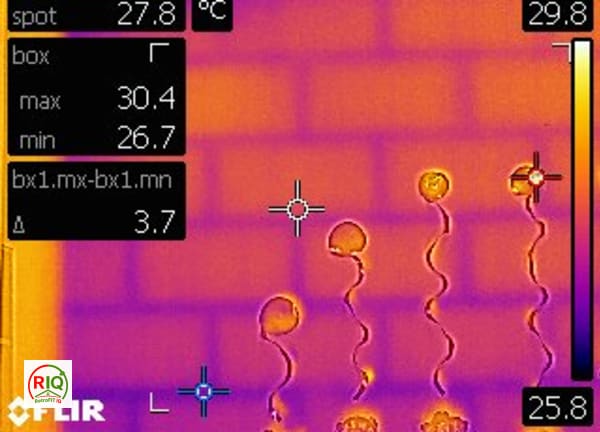
Thermal Bridging Visible Through Masonry Blockwork Wall

Sample Building Performance Investigation Report — Thermal Imaging

Thermal Bridge at Internal Corner Wall Junction

Thermal Bridge at Wall-Ceiling Junction Near Window

Airtightness Testing in a Stratford Victorian Terrace
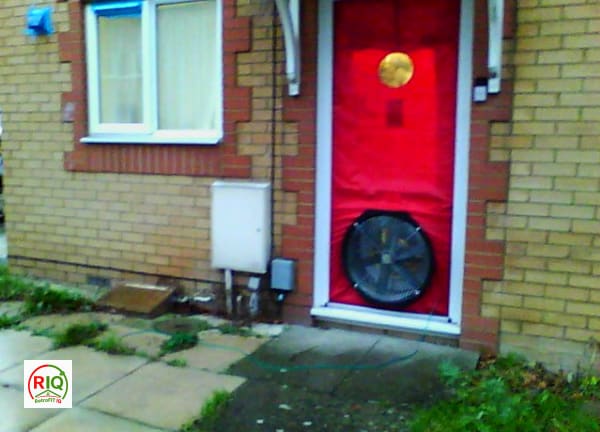
Blower Door Airtightness Test Setup
No related investigations yet.
Browse all investigationsFrequently asked questions
How do I tell condensation from rising damp?+
Condensation is worst in winter on cold surfaces such as corners, reveals and behind furniture; rising damp shows as a defined tide mark up to about a metre with ground salts in the plaster. Measuring surface temperature, dew point and salts confirms which it is.
Is most damp in UK homes rising damp?+
No. In occupied homes the great majority of damp is condensation. Genuine rising damp is comparatively rare and is often over-diagnosed, which leads to unnecessary damp-proof courses.
Does a damp-proof course fix condensation?+
No. A damp-proof course addresses ground moisture only. It does nothing for condensation, which is the most common cause, so injecting one for condensation simply wastes money.
Why does my damp get worse after rain?+
Damp that intensifies during and after rain is the signature of penetrating damp — water entering through an external defect such as a gutter, downpipe, render crack or failed seal. The fix is to repair the fabric, not to treat the inside.
Can I have more than one type of damp at once?+
Yes. Condensation and penetrating damp frequently occur together, and one can mask the other. Measuring all the mechanisms avoids fixing one while leaving the other active.
What are the white salts on my wall?+
Hygroscopic ground salts left behind as ground water evaporates are associated with rising damp, while efflorescence can also follow penetrating damp. A salts analysis with the moisture profile clarifies the source.
Do I need a damp survey or a building investigation?+
A traditional damp survey often focuses on selling a treatment. A building performance investigation measures the physics to identify the true mechanism first. See our guide on whether you need a damp survey or a full investigation.
How do you diagnose the type of damp?+
We measure air temperature, humidity, surface temperature and dew point, correlate the damp with rainfall, profile the moisture and screen for ground salts, and inspect the external fabric — so the remedy matches the real cause.
Stop guessing — find the real cause
Do not spend money fixing symptoms before you understand the cause. Every home behaves differently, and the only reliable way to know what is happening in yours is professional building performance diagnostics. At RetrofitIQ we verify buildings using the right combination of investigations:
- Thermal imaging
- Blower door testing
- Moisture & dew point readings
- Ventilation review
- Building physics assessment
- Passive House methodology