
Why is there damp on my walls?
Damp on a wall is a signal that moisture is reaching the surface and staying there long enough to darken plaster, lift paint or grow mould. In most occupied homes the cause is condensation on a cold wall, but penetrating and — less often — rising damp produce their own distinctive patterns. Reading where and when the damp appears is the first step to fixing it properly.
 Reviewed by George Sora, Certified Passive House DesignerUpdated June 2026
Quick answer & key takeaways
8 min read- Damp on internal walls is most often condensation on a cold surface, especially in winter.
- A localised patch that worsens after rain points to penetrating damp from an external defect.
- A low tide mark with salts can indicate rising damp, though this is far less common.
- External walls, corners, reveals and the wall behind furniture are the usual condensation sites.
- Painting over the stain treats the symptom; the wall will damp again until the cause changes.
- Biggest misconception: damp walls always mean a leak or rising damp. Usually it is condensation.
- Retrofit IQ's approach: map cold surfaces and moisture with thermal imaging and dew-point readings before any repair.
What this usually means
A damp wall is the visible end of a moisture process you usually cannot see. Either moisture from inside the room is condensing onto the wall because the surface is cold, or liquid water is reaching the wall from outside or below. The appearance alone — a stain, a bloom of mould, peeling paint, a musty smell — rarely tells you which, because all three mechanisms can produce similar marks. What does tell you is the pattern: where on the wall the damp sits, and when it comes and goes.
Condensation on walls concentrates on the coldest surfaces, because those are where the air against the wall is chilled below its dew point. That means external walls rather than internal partitions, the upper corners of rooms, window reveals, and the area behind wardrobes, beds and sofas placed against external walls where still air cannot carry moisture away. It is typically a winter problem, worse in unheated and poorly ventilated rooms, and it spreads across a surface rather than tracking to a single point.
Penetrating damp on a wall behaves differently: it is usually a defined patch, often mid-wall or near a window, gutter or downpipe, and it responds to the weather — darkening during and after rain and drying back between. Rising damp, where it is genuinely present, sits low on the wall with a roughly horizontal upper limit and is associated with ground salts. Because the cure differs completely for each, the damp pattern is worth reading carefully before anyone starts opening up or replastering the wall.
Common causes
Condensation on a cold wall
Humid indoor air meets an uninsulated or shaded external wall below the dew point and condenses — the most common cause of damp walls in lived-in homes.
Thermal bridges
Lintels, junctions and corners run colder than the surrounding wall, so they condense and damp first and become the focus of mould.
Furniture against external walls
Wardrobes and sofas trap still, cold air against the wall, raising surface humidity and producing damp and mould behind them.
Penetrating damp from a defect
Cracked render, failed pointing, perished seals, blocked gutters or a leaking downpipe let rainwater track to a localised wet patch.
Rising damp (less common)
Where a damp-proof course is missing or bridged, capillary moisture can rise to roughly a metre, leaving a tide mark and salts.
Inadequate ventilation
Without enough moisture removal, indoor humidity stays high and any cold wall surface tips into condensation.
Signs and symptoms
Damp spread across a cold external wall
A diffuse damp area on an external wall, worse in winter and in corners, is the classic condensation pattern rather than a leak.
A defined patch that comes and goes with rain
A localised wet area that darkens after rain and dries between events indicates penetrating damp tracking from an external fault.
Peeling paint or bubbling plaster
Finishes lifting away from the wall show moisture is moving through the plaster, common to both condensation and ingress.
Mould in the corners and behind furniture
Mould following the coldest parts of the wall is a reliable condensation signature, because those surfaces sit closest to the dew point.
A low band with a salty bloom
A damp band near the floor with crystalline salts can indicate genuine rising damp and warrants a salts analysis to confirm.
What most people check first
- Whether the affected wall is external and which compass direction it faces.
- When the damp is worst — winter and cold weather (condensation) or after rain (penetrating).
- Whether furniture sits tight against the wall, trapping still air.
- External condition above and around the patch — gutters, downpipes, render, pointing and ground level.
What most people miss
- That the cold wall surface, not a hidden leak, is usually the cause of damp on external walls.
- That warming the surface with insulation is often the real cure, not waterproofing the inside.
- That ventilation must remove the indoor moisture as well as the surface being warmed.
- That replastering over condensation damp without changing the conditions guarantees its return.
The building physics
Whether a wall stays dry depends on the relationship between the room's dew point and the wall's surface temperature. The dew point is the temperature at which the air's water vapour begins to condense; it rises as the room gets warmer and more humid. The wall's surface temperature depends on how well the wall is insulated, how exposed it is, and whether room heat and air movement reach it. When the surface temperature falls below the dew point, condensation forms — and an uninsulated external wall in a humid, intermittently heated room routinely does exactly that.
This is why damp concentrates on external walls and not internal partitions: external walls lose heat to the outside and run colder. It is why corners, lintels and other thermal bridges damp first: their geometry and materials make them the coldest points, so they cross the dew point before the rest of the wall. And it is why the wall behind furniture is so often affected: the furniture blocks both warmth and air movement, so the trapped air cools and its surface humidity climbs even though the room as a whole may feel comfortable.
Penetrating damp follows a different physics: liquid water is driven through a fabric defect by gravity and wind pressure, so it correlates with rainfall and tracks to the fault rather than to the coldest surface. Rising damp follows capillary physics, limited in height and marked by ground salts. Because these mechanisms differ, so do the cures — and the most expensive mistake is to apply a waterproofing or damp-proofing remedy to what is in fact a condensation problem on a cold wall. The durable cure for condensation is to raise the surface temperature, with insulation and thermal-bridge treatment, and to lower indoor humidity with ventilation, so the surface stays above the dew point.
How to fix damp walls properly
The right repair depends entirely on the cause, so the first move is always to identify the mechanism rather than to assume it.
- 01
Identify the mechanism
Read the pattern and confirm it with measurement: dew-point and surface-temperature readings for condensation, rainfall correlation and an external inspection for penetrating damp, and a salts test for suspected rising damp.
- 02
If condensation: warm the wall and ventilate
Insulate the cold wall and treat thermal bridges so the surface stays above the dew point, and provide controlled ventilation to remove indoor moisture. Leave an air gap behind furniture on external walls.
- 03
If penetrating: repair the external defect
Fix the gutter, downpipe, render, pointing, seal or roof that is letting water in, then allow the wall to dry before redecorating.
- 04
If rising: confirm and treat the base
Where genuinely confirmed, remove any bridging ground level and, if required, install a damp-proof course with salt-resistant replastering.
- 05
Redecorate last, and verify
Only redecorate once the cause is fixed and the wall has dried, and re-measure to confirm the surface now stays above the dew point or no longer responds to rain.
How to prevent it coming back
- Keep external walls warmer than the dew point by insulating and treating thermal bridges.
- Ventilate to keep indoor humidity down, particularly in bedrooms, kitchens and bathrooms.
- Leave a small gap behind furniture placed against external walls so air can move.
- Maintain gutters, downpipes, render and pointing so rainwater cannot find a way in.
- Tackle the first signs of damp promptly rather than painting over them.
How Retrofit IQ investigates this
We establish why the wall is damp — and which mechanism is responsible — before any repair, so the work targets the cause rather than the stain.
Do not spend money fixing symptoms before you understand the cause — investigate first, then build with confidence.
Do I need a professional investigation?
It is worth measuring rather than guessing when the damp keeps coming back after redecoration, when the pattern is ambiguous, or when you are facing a quote for replastering or damp-proofing without anyone having measured the wall. A short instrumented assessment usually pays for itself by preventing work on the wrong cause.
Where to go next
Relevant services
Related comparisons
From the Academy
- Surface condensation and mould — the mechanism, and the real fix.
- Why most damp treatments fail — and what actually works.
- Thermal imaging for condensation and damp — cold surfaces and dew point.
- Dew point explained — the temperature where condensation begins.
- Internal Wall Insulation — how to upgrade a solid wall without causing hidden mould.
Related case studies
Evidence from Real Projects (20)
Real project and investigation images from our own fieldwork, matched to this page — not stock photography.

Thermal Bridge at Internal Corner Wall Junction
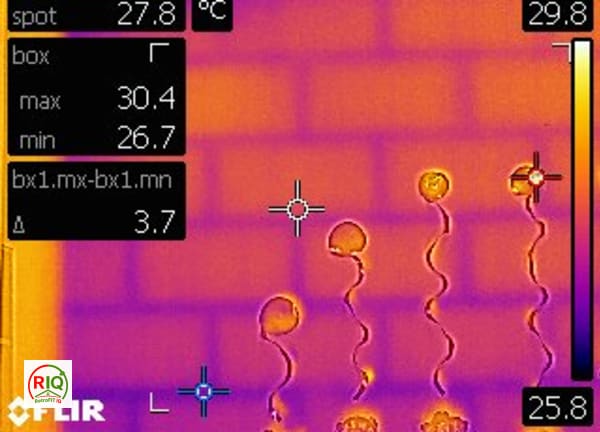
Thermal Bridging Visible Through Masonry Blockwork Wall

Thermal Bridge at Wall-Ceiling Junction Near Window

Sample Building Performance Investigation Report — Thermal Imaging

Living room internal wall

Wall / ceiling corner showing the characteristic geometric cold spot
No related investigations yet.
Browse all investigationsFrequently asked questions
Why is there damp on my wall but no leak?+
Because the most common cause is condensation, not a leak. Humid indoor air condenses on a cold external wall, especially in winter and in corners or behind furniture.
Why is the damp only on one wall?+
Usually because that wall is external and runs coldest, or it has an external defect letting water in. Internal partitions stay warmer and rarely show condensation.
Will waterproof paint stop damp on a wall?+
Not if the cause is condensation — it can trap moisture and make mould worse. The cure is to warm the surface and ventilate, not to seal the inside.
Why does my wall feel damp behind the wardrobe?+
The furniture traps still, cold air against an uninsulated external wall, raising the surface humidity until condensation and mould form. Warming the wall and leaving an air gap fixes it.
Is damp on the wall dangerous?+
The damp itself signals a building problem, and the mould it grows can affect air quality. The priority is to find and fix the cause rather than to clean repeatedly.
Should I replaster a damp wall?+
Not before the cause is fixed. Replastering over condensation damp without warming the surface or ventilating simply delays the return of the problem.
How do you find out why my wall is damp?+
We map cold surfaces and moisture with thermal imaging, measure surface humidity and dew point, profile the moisture and inspect the external fabric to identify the true cause.
Stop guessing — find the real cause
Do not spend money fixing symptoms before you understand the cause. Every home behaves differently, and the only reliable way to know what is happening in yours is professional building performance diagnostics. At RetrofitIQ we verify buildings using the right combination of investigations:
- Thermal imaging
- Blower door testing
- Moisture & dew point readings
- Ventilation review
- Building physics assessment
- Passive House methodology