
Why are my walls cold?
Cold walls are one of the clearest signs that a home is losing heat through its fabric — and they explain why a room can feel cold even when the air is warm. The cause is usually missing insulation, a thermal bridge, or damp.
 Reviewed by George Sora, Certified Passive House DesignerUpdated June 2026
Quick answer & key takeaways
6 min read- Cold walls usually mean the fabric is uninsulated or insulation is interrupted.
- You lose body heat to cold walls by radiation, so the room feels colder than the air temperature.
- Cold walls below the dew point are where condensation and mould begin.
- A localised cold wall or strip often signals a thermal bridge or a missing patch of insulation.
- Biggest misconception: cold walls just need more heating. They need warming at the surface — i.e. insulation.
- Retrofit IQ's approach: thermal imaging and surface/dew-point readings confirm whether it's insulation, bridging or moisture.
What this usually means
A wall's internal surface temperature reflects how well it resists heat flow. A well-insulated wall keeps its inner face close to room temperature; an uninsulated solid wall lets heat pour out, so the inner face runs cold. That cold face is what you feel and what drives radiant discomfort.
If only part of a wall is cold — a strip, a corner, around a window — the cause is usually localised: a thermal bridge, a gap in the insulation, or moisture cooling the surface as it evaporates. Mapping the pattern is the first step to naming the cause.
Common causes
Uninsulated solid or cavity walls
Solid brick walls (U-value ~2.0–2.2 W/m²K) and unfilled or poorly filled cavities let heat escape, keeping the inner surface cold.
Thermal bridges
Lintels, reveals, floor and party-wall junctions and structural elements bypass the insulation, creating cold strips and corners.
Missing or slumped insulation
Cavity fill that has slumped or been bridged by debris, or internal insulation with gaps, leaves cold zones on the wall.
Moisture in the wall
A damp wall conducts heat faster and is cooled by evaporation, so penetrating or interstitial moisture can make a wall feel persistently cold.
Air movement within the construction
Wind washing through poorly sealed cavities or behind dry-lining can strip heat from the inner leaf, chilling the surface.
Signs and symptoms
Walls cold to the touch
The internal surface feels cold even in a heated room, the hallmark of uninsulated or interrupted fabric.
A room that feels chilly despite warm air
Radiant heat loss to cold walls leaves you cold even when the thermostat reads a comfortable figure.
Cold strips or corners
Localised cold at junctions, lintels and reveals signals a thermal bridge — often where mould then appears.
Damp staining or salts
A musty smell, tide mark or salts on the cold area suggests moisture is involved and must be diagnosed first.
Mould on furniture-backed walls
External walls behind wardrobes and sofas grow mould where the cold surface meets still, humid air.
What most people check first
- Whether the walls are solid or cavity, and whether the cavity is filled.
- If the cold is over the whole wall or just a strip/corner.
- Signs of damp staining, salts or mould on the cold area.
- Whether cold corresponds to a junction, lintel or window reveal.
What most people miss
- That cold walls are a radiant-comfort problem, not just an air-temperature one.
- Thermal bridges, which create cold strips that insulation boards alone may not solve without proper detailing.
- That insulating internally without modelling moisture can trap damp and cause hidden decay.
- That a damp wall and a cold wall can be the same wall — and the moisture must be diagnosed first.
The building physics
The internal surface temperature of a wall depends on its thermal resistance and the indoor and outdoor temperatures. The lower the resistance (the higher the U-value), the colder the inner face. That matters twice over: it drives radiant heat loss from your body, and it determines how close the surface sits to the dew point. Once a surface drops below the dew point of the room air, condensation forms — which is why cold walls and mould travel together.
Thermal bridges concentrate the problem. Where the insulation is interrupted, the local heat-loss path is shorter and the inner surface there is colder than the surrounding wall, producing the classic cold corner with mould. Adding insulation without addressing the bridge can simply move the cold spot.
Moisture complicates it further. Water in masonry raises its conductivity and cools the surface through evaporation, so a damp wall is also a cold wall. That is why insulation must never be specified for a damp wall until the moisture source is understood — otherwise the moisture is sealed in and the fabric decays.
How to fix it — the right way
Cold walls are fixed by raising the internal surface temperature — but only after any moisture is understood, or insulation can trap damp.
- 01
Establish the wall construction and whether damp is present
Confirm solid or cavity, and test for moisture, before any insulation is specified.
- 02
Diagnose the moisture source if the wall is wet
A damp wall must be dried and the source fixed first — never sealed in behind insulation.
- 03
Insulate internally or externally with proper detailing
External insulation keeps the whole wall warm; internal suits protected façades but must be modelled for condensation risk.
- 04
Treat thermal bridges at junctions and reveals
Detail the cold strips and corners so insulation does not simply shift the cold spot.
- 05
Ventilate to manage the room's moisture
Pair warmer surfaces with controlled ventilation so condensation and mould cannot return.
How to prevent it coming back
- Only insulate a dry wall — or fix the moisture source first.
- Detail junctions and reveals so no cold bridge is left behind.
- Keep furniture slightly off cold external walls to allow air movement.
- Maintain external pointing and render so the wall stays dry.
How Retrofit IQ investigates this
Before any insulation is specified, we establish why the wall is cold — and whether moisture is involved — so the remedy is safe and effective.
Do not spend money fixing symptoms before you understand the cause — investigate first, then build with confidence.
Do I need a professional investigation?
If your walls feel persistently cold, thermal imaging plus surface, dew-point and moisture readings will show whether it is missing insulation, a thermal bridge or damp — and therefore which remedy is safe.
Always investigate before internal wall insulation, where a hidden moisture problem could otherwise be sealed in and cause decay.
Where to go next
Relevant services
Related comparisons
From the Academy
Evidence from Real Projects (28)
Real project and investigation images from our own fieldwork, matched to this page — not stock photography.
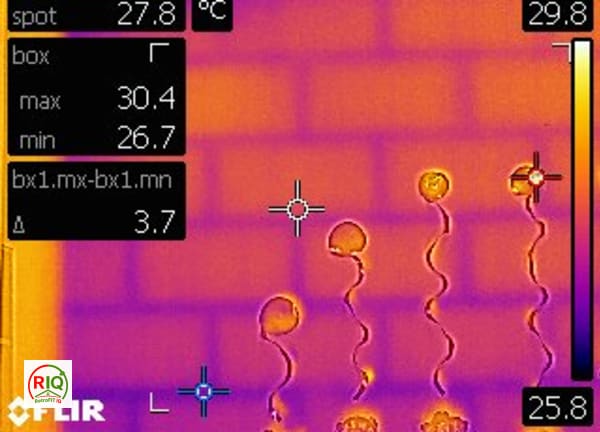
Thermal Bridging Visible Through Masonry Blockwork Wall

Thermal Bridge at Internal Corner Wall Junction

Thermal Bridge at Wall-Ceiling Junction Near Window

Sample Building Performance Investigation Report — Thermal Imaging

Bathroom external wall

Acoustic Floor Upgrades: Mineral Wool Insulation Between Joists
No related investigations yet.
Browse all investigationsFrequently asked questions
Why do my walls feel cold to the touch?+
Because they are uninsulated or the insulation is interrupted, so the inner surface sits well below room temperature.
Do cold walls cause condensation?+
Yes. When a wall surface drops below the dew point of the room air, moisture condenses on it — which is why cold walls and mould often appear together.
Will internal wall insulation fix cold walls?+
Usually, if detailed correctly — but on a potentially damp wall the moisture must be diagnosed and modelled first, or insulation can trap damp and cause decay.
Why is only the corner of my wall cold?+
Corners and junctions are common thermal bridges, where the insulation is bypassed and the surface runs colder than the rest of the wall.
Can a damp wall feel cold?+
Yes — moisture raises the wall's conductivity and cools the surface by evaporation, so damp walls feel persistently cold.
Is external or internal insulation better for cold walls?+
External insulation keeps the whole wall warm and avoids most thermal bridges, but internal insulation suits protected façades. The right choice depends on the building.
How do you check what's causing it?+
Thermal imaging maps the cold, surface and dew-point readings show condensation risk, and moisture readings confirm whether the wall is wet — together naming the cause.
Stop guessing — find the real cause
Do not spend money fixing symptoms before you understand the cause. Every home behaves differently, and the only reliable way to know what is happening in yours is professional building performance diagnostics. At RetrofitIQ we verify buildings using the right combination of investigations:
- Thermal imaging
- Blower door testing
- Moisture & dew point readings
- Ventilation review
- Building physics assessment
- Passive House methodology