
Why is there moisture on my walls?
Moisture on a wall has three possible mechanisms — condensation, penetrating damp or rising damp — and they look similar but need completely different remedies. Diagnosing which one you have is the single most important step.
 Reviewed by George Sora, Certified Passive House DesignerUpdated June 2026
Quick answer & key takeaways
5 min read- Wall moisture is condensation, penetrating damp or rising damp — and the cause dictates the fix.
- Condensation (the most common) is humid indoor air meeting a cold wall below the dew point.
- Penetrating damp enters through an external defect; rising damp draws up from the ground.
- Misdiagnosis is expensive — most 'rising damp' treatments are sold for what is actually condensation.
- Biggest misconception: all wall damp is rising damp. Genuine rising damp is comparatively rare.
- Retrofit IQ's approach: measure moisture, surface temperature, dew point and external fabric before any remedy.
What this usually means
Damp on a wall simply means water is present where it shouldn't be — but the source can be the air (condensation on a cold surface), the outside (water penetrating a defect), or the ground (capillary rise through masonry). Each leaves a different signature, and each needs a different fix; treating one as another wastes money and leaves the problem unsolved.
Because the symptoms overlap, the only reliable route is measurement: how wet, how cold, how humid, and whether the pattern tracks weather, height or temperature. That is what separates a ventilation-and-surface-temperature problem from an ingress one.
Common causes
Condensation on cold walls
Humid indoor air meets a cold wall surface below the dew point — the most common cause, worst on uninsulated walls and in corners.
Penetrating damp
Water enters through failed pointing, render, gutters, flashings or a bridged cavity; it worsens after rain and tracks to the external defect.
Rising damp
Groundwater drawn up porous masonry by capillarity, typically to about a metre, leaving a tide mark and hygroscopic salts. Comparatively rare.
Thermal bridges
Cold strips at junctions and lintels drop below the dew point and condense locally, mimicking other damp.
Internal moisture sources
Plumbing leaks or high indoor humidity raise the load and tip surfaces into condensation.
Signs and symptoms
Damp patches or staining on the wall
Discoloured, sometimes wet-feeling areas, often with a musty smell.
A cold wall surface
Condensation-driven damp sits on cold walls and corners that fall below the dew point.
Mould in corners (condensation)
Black spotting at junctions and behind furniture points to surface condensation rather than ingress.
A low tide mark with salts (rising)
Damp to about a metre with a salt band and tide mark suggests rising damp — comparatively rare.
Damp that worsens after rain (penetrating)
Moisture tracking to an external defect and increasing after wet weather indicates penetrating damp.
What most people check first
- Whether the damp worsens after rain (suggests penetrating) or in cold weather (suggests condensation).
- Height and pattern — a low tide mark with salts suggests rising; corners and cold walls suggest condensation.
- External fabric: pointing, render, gutters and ground levels.
- Indoor humidity and ventilation.
What most people miss
- That most 'rising damp' diagnoses are actually condensation or penetrating damp.
- That a damp-proof injection does nothing for condensation or a leaking gutter.
- Thermal bridges, which cause local condensation that's easily mistaken for ingress.
- That the cause must be measured, not assumed from appearance.
The building physics
Condensation is governed by humidity and surface temperature: when a wall surface falls below the room air's dew point, vapour condenses on it. Penetrating damp is governed by water finding a path through the external envelope — so it correlates with rainfall and tracks to a defect. Rising damp is a capillary phenomenon, drawing groundwater up porous masonry to a height where evaporation balances the rise, leaving salts and a tide mark.
Because each mechanism has a distinct physical driver, each leaves measurable signatures: condensation shows high surface humidity and surfaces near the dew point; penetrating damp shows moisture that increases after rain and maps to an external fault; rising damp shows a moisture and salts profile that decreases with height. Measuring these tells the three apart with confidence.
This matters because the remedies are entirely different — ventilation and insulation for condensation, external repair for penetrating damp, and (rarely) a damp-proofing solution for genuine rising damp. Guessing wrong is the classic way to spend money and still have a damp wall.
How to fix it — the right way
The right fix depends entirely on the mechanism — so the wall must be diagnosed before any remedy is chosen.
- 01
Diagnose the mechanism first
Measure to establish whether it is condensation, penetrating or rising damp — they look similar but need opposite remedies.
- 02
For condensation, ventilate and warm the surface
Control humidity and raise the wall temperature so it stays above the dew point.
- 03
For penetrating damp, repair the external defect
Fix the failed pointing, render, gutter, flashing or bridged cavity letting water in.
- 04
For genuine rising damp, treat appropriately
Only after confirmation with a moisture and salts profile should a damp-proofing remedy be considered.
- 05
Re-check after the remedy
Confirm the wall has dried and the cause has not simply moved elsewhere.
How to prevent it coming back
- Maintain external pointing, render, gutters and ground levels.
- Ventilate to keep indoor humidity down.
- Insulate cold walls to raise the surface temperature.
- Do not apply surface treatments before the cause is diagnosed.
How Retrofit IQ investigates this
We never assume the mechanism. We measure the wall and its context to establish which of the three is actually present before any remedy is proposed.
Do not spend money fixing symptoms before you understand the cause — investigate first, then build with confidence.
Do I need a professional investigation?
Because the three mechanisms need entirely different remedies, it is worth measuring moisture, surface temperature, dew point and the external fabric before spending — most 'rising damp' is actually condensation or penetrating damp.
Investigate especially if a previous treatment has failed, which usually means the wrong cause was treated.
Where to go next
Relevant services
Related comparisons
From the Academy
Related case studies
Evidence from Real Projects (9)
Real project and investigation images from our own fieldwork, matched to this page — not stock photography.
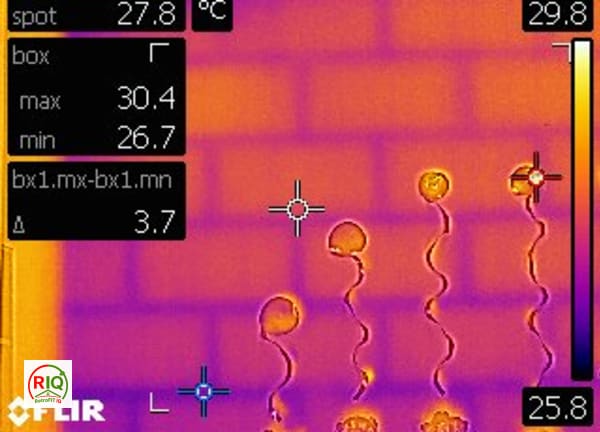
Thermal Bridging Visible Through Masonry Blockwork Wall

Sample Building Performance Investigation Report — Thermal Imaging

Thermal Bridge at Internal Corner Wall Junction

Thermal Bridge at Wall-Ceiling Junction Near Window

Airtightness Testing in a Stratford Victorian Terrace

Bathroom
No related investigations yet.
Browse all investigationsFrequently asked questions
Is moisture on my wall rising damp?+
Rarely. Genuine rising damp is comparatively uncommon; most wall moisture is condensation or penetrating damp, which need different fixes.
How do I tell condensation from penetrating damp?+
Condensation is worse in cold weather on cold walls; penetrating damp worsens after rain and tracks to an external defect. Measuring confirms it.
Why is there damp in the corner of my room?+
Corners are thermal bridges that run colder, so they drop below the dew point and condense first — usually condensation, not rising damp.
Will a damp-proof course fix it?+
Only if you genuinely have rising damp, which is rare. For condensation or penetrating damp it does nothing.
Can a leak cause wall moisture?+
Yes — internal plumbing leaks and external defects both introduce water. An inspection and moisture mapping locate the source.
Why does my damp wall keep coming back after treatment?+
Usually because the wrong cause was treated. If the real mechanism is condensation, surface treatments won't stop it.
How do you diagnose wall moisture?+
We measure moisture, surface temperature, dew point and external fabric to identify the true mechanism before recommending any remedy.
Stop guessing — find the real cause
Do not spend money fixing symptoms before you understand the cause. Every home behaves differently, and the only reliable way to know what is happening in yours is professional building performance diagnostics. At RetrofitIQ we verify buildings using the right combination of investigations:
- Thermal imaging
- Blower door testing
- Moisture & dew point readings
- Ventilation review
- Building physics assessment
- Passive House methodology