
Is black mould caused by condensation, damp or ventilation?
Black mould is almost always a condensation problem — humid indoor air meeting cold surfaces — made worse by inadequate ventilation. Genuine penetrating or rising damp is a far less common cause, though it does happen. Telling them apart is the key.
 Reviewed by George Sora, Certified Passive House DesignerUpdated June 2026
Quick answer & key takeaways
5 min read- Black mould is usually condensation: humid air meeting cold surfaces below the dew point.
- Poor ventilation is the close partner, letting moisture build up against those surfaces.
- Penetrating and rising damp can cause it too, but are much less common.
- The pattern and measurements distinguish the cause — and the cause dictates the fix.
- Biggest misconception: black mould means dangerous 'damp' needing damp-proofing. Usually it's condensation.
- Retrofit IQ's approach: measure surface temperature, dew point, humidity and external fabric to identify the true cause.
What this usually means
Black mould (often Aspergillus or Cladosporium species) needs a surface that stays damp. In the vast majority of homes that dampness comes from condensation: humid indoor air meeting a surface below its dew point, with too little ventilation to clear the moisture. Cold corners, reveals and external walls are the usual sites. So the honest answer is: condensation and ventilation are the common causes, while penetrating and rising damp are real but much rarer.
The reason this matters is money. Black mould is routinely misdiagnosed as a 'damp' problem requiring damp-proofing, when the real fix is warmer surfaces and better ventilation. Identifying the actual mechanism by measurement avoids paying for the wrong remedy.
Common causes
Condensation (most common)
Humid indoor air condensing on cold surfaces keeps them damp enough for black mould — especially corners, reveals and external walls.
Inadequate ventilation
Without moisture removal, indoor humidity stays high and the surface conditions for mould persist.
Cold surfaces and thermal bridges
Uninsulated walls and junctions run coldest, so they condense and grow mould first.
Penetrating damp (less common)
Water through an external defect can keep a patch wet enough for mould; it worsens after rain and tracks to a fault.
Rising damp (rare)
Genuine capillary rise, with salts and a tide mark, can occasionally support growth low on a wall — but is comparatively uncommon.
Signs and symptoms
Black spotting on cold surfaces (condensation)
Growth in corners, reveals and on cold external walls points to condensation, the most common cause.
Worse in winter and poorly ventilated rooms
Cold surfaces and trapped moisture are the classic condensation signature.
A patch worsening after rain (penetrating)
Mould tracking to an external defect and increasing after wet weather indicates penetrating damp.
A low tide mark with salts (rising)
Growth low on a wall with a salt band suggests rising damp — comparatively rare.
What most people check first
- Whether mould is in corners, around windows or behind furniture (suggests condensation).
- Whether it's worse in winter and in poorly ventilated rooms.
- Whether a patch worsens after rain (suggests penetrating damp).
- Whether there's a low tide mark with salts (suggests rising damp).
What most people miss
- That black mould is usually condensation, not the 'rising damp' it's often sold as.
- That ventilation is central — moisture removal, not just cleaning.
- That cold surfaces must be warmed to stop recurrence.
- That the cause must be measured, because the remedies are entirely different.
The building physics
Mould growth is controlled by the relative humidity at the surface and the time it stays high. Condensation raises surface humidity wherever a surface sits below the room air's dew point, which is why cold, poorly ventilated rooms grow black mould. Penetrating damp raises it via water ingress from outside (correlating with rain), and rising damp via capillary moisture from the ground (with salts and a height limit). Each mechanism leaves a distinct, measurable signature.
Because condensation depends on both humidity and surface temperature, two levers control it: ventilation (to keep humidity down) and surface temperature (to keep surfaces above the dew point). Penetrating and rising damp, by contrast, require fixing an external defect or — rarely — a damp-proofing solution. Using the condensation remedy on genuine ingress, or vice versa, fails.
So the question 'condensation, damp or ventilation?' is best answered by measurement rather than assumption: surface temperature and dew point for condensation, rainfall correlation and external inspection for penetrating damp, and a moisture-and-salts profile for rising damp. The diagnosis then dictates a remedy that actually works.
How to fix it — the right way
Because the three causes need entirely different remedies, the mechanism must be measured before anything is done.
- 01
Measure to identify the mechanism
Surface temperature, dew point, humidity and external inspection establish whether it is condensation, penetrating or rising damp.
- 02
For condensation, ventilate and warm surfaces
Control humidity and raise surface temperatures so they stay above the dew point — the fix for most black mould.
- 03
For penetrating damp, repair the external defect
Fix the failed pointing, render, gutter or flashing letting water in.
- 04
For genuine rising damp, treat appropriately
Only after confirmation with a moisture and salts profile should a damp-proofing remedy be considered.
- 05
Remove the growth and keep conditions changed
Clean the mould once the cause is being addressed so it cannot return.
How to prevent it coming back
- Ventilate to keep indoor humidity down.
- Warm cold surfaces so they stay above the dew point.
- Maintain external fabric — pointing, render and gutters.
- Diagnose the cause before paying for any 'damp' treatment.
How Retrofit IQ investigates this
We identify which mechanism is genuinely present before recommending anything, because the wrong diagnosis leads to expensive, ineffective work.
Do not spend money fixing symptoms before you understand the cause — investigate first, then build with confidence.
Do I need a professional investigation?
Because black mould is routinely misdiagnosed as 'rising damp' needing damp-proofing, it is worth measuring surface temperature, dew point, humidity and the external fabric to identify the true cause before spending.
Investigate especially if a previous treatment failed, which usually means the wrong mechanism was treated.
Where to go next
Relevant services
Related comparisons
From the Academy
Related case studies
Evidence from Real Projects (12)
Real project and investigation images from our own fieldwork, matched to this page — not stock photography.
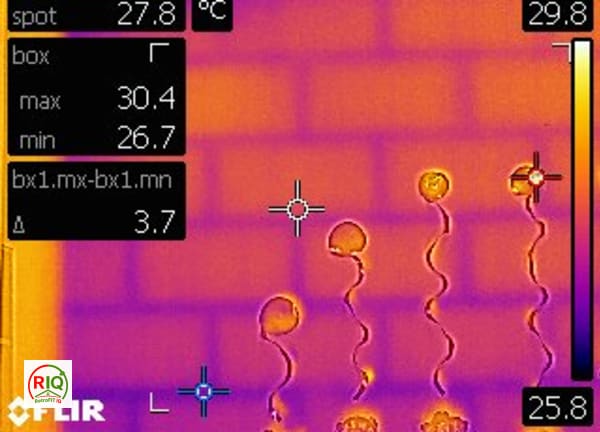
Thermal Bridging Visible Through Masonry Blockwork Wall

Sample Building Performance Investigation Report — Thermal Imaging

Thermal Bridge at Internal Corner Wall Junction

Thermal Bridge at Wall-Ceiling Junction Near Window

Airtightness Testing in a Stratford Victorian Terrace

Bathroom external wall
No related investigations yet.
Browse all investigationsFrequently asked questions
Is black mould caused by condensation or damp?+
Almost always condensation — humid air meeting cold surfaces — made worse by poor ventilation. Penetrating and rising damp are real but much rarer causes.
Is black mould dangerous?+
It's best removed and, more importantly, prevented by fixing the cause. The key is to stop the conditions that grow it rather than just clean it.
Does black mould mean I need a damp-proof course?+
Usually not. Most black mould is condensation, which a damp-proof course does nothing for. The fix is ventilation and warmer surfaces.
How can I tell if it's condensation or penetrating damp?+
Condensation is worse in winter on cold surfaces; penetrating damp worsens after rain and tracks to an external defect. Measuring confirms it.
Will better ventilation stop black mould?+
It's a major part of the fix for condensation-driven mould, alongside warming the cold surfaces it grows on.
Why does my black mould keep returning?+
Because the cold-surface-and-moisture conditions remain. Cleaning treats the symptom; warming surfaces and ventilating treats the cause.
How do you diagnose the cause of black mould?+
We measure surface temperature, dew point and humidity, and inspect the external fabric, to identify whether it's condensation, penetrating or rising damp.
Stop guessing — find the real cause
Do not spend money fixing symptoms before you understand the cause. Every home behaves differently, and the only reliable way to know what is happening in yours is professional building performance diagnostics. At RetrofitIQ we verify buildings using the right combination of investigations:
- Thermal imaging
- Blower door testing
- Moisture & dew point readings
- Ventilation review
- Building physics assessment
- Passive House methodology