
Is black mould in my home dangerous to health?
Black mould can affect health — it can trigger or worsen respiratory problems, allergies and irritation, and the risk is greater for babies, the elderly, and anyone with asthma or a weakened immune system — so it should not be ignored. But cleaning it off treats only the symptom: mould grows because a surface is repeatedly damp, so the lasting protection for your health is to remove the moisture that feeds it. Understanding both the health risk and the real cause is what lets you deal with mould properly rather than fighting it forever.
 Reviewed by George Sora, Certified Passive House DesignerUpdated July 2026
Quick answer & key takeaways
7 min read- Black mould can trigger or worsen breathing problems, allergies and irritation.
- The risk is greater for babies, the elderly, and those with asthma or low immunity.
- Cleaning mould off treats the symptom; it returns while the surface stays damp.
- The lasting protection for health is removing the moisture that feeds the mould.
- Biggest misconception: scrubbing mould or anti-mould paint solves it. The moisture must go.
- Retrofit IQ's approach: clean safely, then find and remove the moisture source for good.
What this usually means
Mould is a living organism that releases spores, and some people react to those spores and to the substances mould produces. The recognised health effects include triggering or worsening asthma and other respiratory conditions, allergic reactions, coughing, wheezing, a blocked or runny nose, and eye and skin irritation. These effects are more likely and more serious for vulnerable groups — infants and young children, older people, and anyone with a respiratory condition, allergy or a weakened immune system — which is why persistent mould in a bedroom or a child's room is taken particularly seriously.
However, the visible mould is the end of a chain, not the start. Mould can only grow where a surface is repeatedly damp — from condensation on cold surfaces, a leak, or penetrating damp — so the mould is a sign that part of your home is too wet, usually because warm, moist air is meeting a cold surface that is poorly ventilated. This is why scrubbing it off, or painting over it with anti-mould paint, never lasts: the surface is still damp, so the mould simply grows back, and the underlying moisture problem — and its health implications — continues.
So protecting your health means doing two things. First, deal with the existing mould safely — cleaning small amounts carefully, and protecting vulnerable occupants — to reduce the immediate exposure. Second, and crucially, find and remove the moisture source that is feeding it: warming the cold surface (insulation, treating thermal bridges), improving ventilation to remove humid air, and fixing any leak or damp. Once the surface is no longer repeatedly damp, the mould cannot return, which is the only way to genuinely remove the health risk rather than managing it indefinitely. Diagnosing why the surface is wet is therefore the key step.
Common causes
Spores and irritants from mould
Mould releases spores and substances that can trigger respiratory and allergic reactions.
Damp surfaces feeding mould
Mould grows only where a surface is repeatedly damp, so moisture is the root cause.
Condensation on cold surfaces
Humid air meeting cold, poorly ventilated surfaces is the commonest source of the damp.
Leaks or penetrating damp
A leak or penetrating damp can keep a surface wet enough for mould to grow.
Symptom-only treatments
Cleaning or anti-mould paint without removing the moisture lets the mould and the risk return.
Signs and symptoms
Respiratory symptoms indoors
Coughing, wheezing or worsened asthma at home can indicate exposure to mould.
Allergy-like symptoms
A blocked or runny nose, sneezing and eye or skin irritation may reflect mould spores.
Vulnerable occupants affected
Children, the elderly or those with asthma reacting points to a need to act promptly.
Mould returning after cleaning
Mould that regrows shows the moisture source — and the health risk — remains.
Visible mould in bedrooms or living spaces
Mould where people spend time raises the exposure and the importance of removing it.
What most people check first
- Whether anyone vulnerable is exposed and needs protecting promptly.
- Whether the mould keeps returning, indicating an unaddressed moisture source.
- Whether the damp is condensation, a leak or penetrating damp.
- Whether the affected surface is cold and poorly ventilated.
What most people miss
- That the health risk continues while the moisture source remains.
- That cleaning or anti-mould paint treats only the symptom.
- That vulnerable groups are more affected and need prompt action.
- That removing the moisture is the only lasting protection.
The building physics
Mould germination and growth require liquid water or sustained high humidity at a surface, a temperature within a broad comfortable range, and a food source — which ordinary dust and finishes readily provide. The limiting factor in homes is almost always surface moisture: mould establishes where the surface relative humidity stays high for long enough, typically on cold surfaces where condensation forms or near a leak. The health concern arises because active mould releases spores and metabolic products into the indoor air, to which sensitised and vulnerable individuals react, so reducing exposure means reducing both the mould and the airborne spores.
Because surface dampness is the controlling variable, the durable solution is hygrothermal, not cosmetic. Where condensation feeds the mould, raising the surface temperature above the dew point (through insulation and treating thermal bridges) and lowering the indoor humidity (through ventilation) stops the surface reaching the conditions mould needs; where a leak or penetrating damp feeds it, the water ingress must be stopped and the fabric dried. Biocidal cleaning and anti-mould coatings reduce the visible growth temporarily but do not change the surface moisture, so growth resumes — which is why symptom-only approaches fail and the exposure recurs.
Managing the health risk therefore has an immediate and a root-cause component. Immediately, existing mould should be cleaned safely and vulnerable occupants protected to cut current exposure. Fundamentally, the moisture source must be diagnosed and removed so the surface can no longer support mould — confirmed by humidity logging, thermal mapping of the cold surfaces, and identifying any leak. This investigation-led approach, which treats mould as a symptom of a building-physics moisture problem, is what permanently removes both the mould and the associated health risk, in contrast to repeated cleaning that leaves the underlying dampness — and the exposure — in place.
How to protect your health from black mould
Deal with the existing mould safely to cut immediate exposure, then find and remove the moisture source so it cannot return — the only lasting protection.
- 01
Protect vulnerable occupants
Reduce exposure for children, the elderly and those with respiratory conditions while you address it.
- 02
Clean existing mould safely
Remove small areas of mould carefully to cut the immediate spore exposure.
- 03
Diagnose the moisture source
Establish whether it is condensation, a leak or penetrating damp feeding the mould.
- 04
Warm the cold surface
Insulate and treat thermal bridges so the surface stays above the dew point.
- 05
Improve ventilation
Remove humid air with adequate ventilation so surfaces are no longer repeatedly damp.
- 06
Fix any leak and verify
Repair leaks or penetrating damp, then confirm the surface stays dry and the mould does not return.
How to prevent it coming back
- Remove the moisture source rather than just cleaning the mould.
- Warm cold surfaces and ventilate to stop condensation.
- Protect vulnerable occupants from exposure promptly.
- Fix leaks and penetrating damp that keep surfaces wet.
How Retrofit IQ investigates this
We treat mould as a symptom of a moisture problem: confirm the source, then remove it so the mould and the health risk cannot return.
Do not spend money fixing symptoms before you understand the cause — investigate first, then build with confidence.
Do I need a professional investigation?
Persistent black mould, especially where children, the elderly or those with respiratory conditions are exposed, is worth investigating promptly — both to reduce the health risk and because the mould signals an unaddressed moisture problem. Diagnosing why the surface is repeatedly damp lets you remove the source so the mould, and the exposure, cannot return.
Where to go next
Relevant services
Related comparisons
From the Academy
Related case studies
Evidence from Real Projects (10)
Real project and investigation images from our own fieldwork, matched to this page — not stock photography.
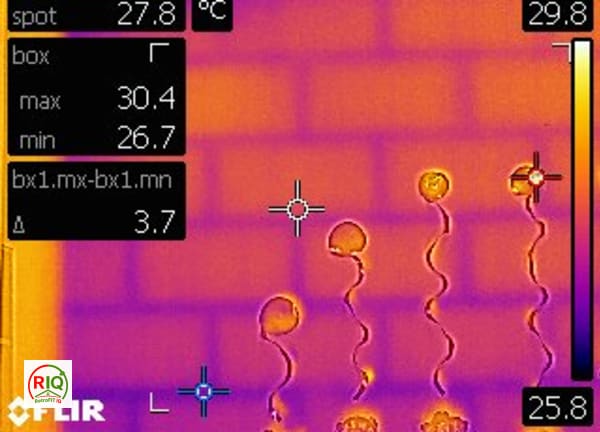
Thermal Bridging Visible Through Masonry Blockwork Wall

Sample Building Performance Investigation Report — Thermal Imaging

Thermal Bridge at Internal Corner Wall Junction

Thermal Bridge at Wall-Ceiling Junction Near Window

Airtightness Testing in a Stratford Victorian Terrace

Bathroom
No related investigations yet.
Browse all investigationsFrequently asked questions
Is black mould in my home dangerous to health?+
It can affect health — triggering or worsening asthma and respiratory problems, allergies, and eye and skin irritation — and the risk is greater for babies, the elderly and those with asthma or low immunity. It should not be ignored, but the lasting protection is removing the moisture that feeds it, not just cleaning it off.
What health problems can mould cause?+
Recognised effects include triggering or worsening asthma and other respiratory conditions, allergic reactions, coughing and wheezing, a blocked or runny nose, and eye and skin irritation — more likely and more serious for vulnerable groups.
Who is most at risk from mould?+
Infants and young children, older people, and anyone with a respiratory condition, allergy or weakened immune system are more affected, which is why persistent mould in bedrooms or children's rooms is taken especially seriously.
Will cleaning the mould off protect my health?+
Only temporarily. Cleaning reduces immediate exposure, but mould grows because a surface is repeatedly damp, so it returns — and the exposure with it — unless you remove the moisture source. Cleaning plus removing the moisture is what lasts.
Does anti-mould paint solve the health risk?+
No — it suppresses visible growth for a while but does not change the surface dampness, so the mould and the exposure return. The durable protection is warming the cold surface, ventilating, and fixing any leak so the surface is no longer wet.
Why does removing the moisture matter for my health?+
Because mould can only grow where a surface is repeatedly damp. Once you raise the surface temperature, ventilate to lower humidity, and fix any leak, the surface can no longer support mould — permanently removing both the mould and the health risk.
How do you remove mould for good?+
We clean the existing mould safely to cut exposure, then diagnose whether condensation, a leak or penetrating damp is the source, and specify surface warming, ventilation and leak repair so the surface stays dry and the mould cannot return.
Stop guessing — find the real cause
Do not spend money fixing symptoms before you understand the cause. Every home behaves differently, and the only reliable way to know what is happening in yours is professional building performance diagnostics. At RetrofitIQ we verify buildings using the right combination of investigations:
- Thermal imaging
- Blower door testing
- Moisture & dew point readings
- Ventilation review
- Building physics assessment
- Passive House methodology