
Do I need a thermal imaging survey?
A thermal imaging survey is worth it when you need to see what is happening inside your walls, roof and floors without opening them up — missing or slipped insulation, thermal bridges, air leakage paths and sometimes damp. It turns invisible performance problems into a clear, located picture, which is exactly what you need before insulating, after a retrofit, when snagging a new build, or when diagnosing cold spots, draughts and damp. It is a diagnostic tool, not a fix, and its value is in directing the right action.
 Reviewed by George Sora, Certified Passive House DesignerUpdated June 2026
Quick answer & key takeaways
7 min read- Thermal imaging reveals missing insulation, thermal bridges, air leakage and damp non-destructively.
- It is most valuable before insulating, after a retrofit, when snagging, or to diagnose cold/damp.
- It shows surface-temperature patterns, so it must be read by someone who understands the physics.
- It is a diagnostic that directs the fix — it does not fix anything itself.
- Biggest misconception: a thermal camera 'sees heat loss' directly. It needs correct conditions and interpretation.
- Retrofit IQ's approach: survey under the right conditions and interpret findings as building physics.
What this usually means
A thermal imaging (infrared) survey records the surface temperatures of a building. Because missing insulation, thermal bridges, air leakage and damp all change how warm or cold a surface is, they show up as distinctive patterns on the images that the eye cannot see — a cold patch where insulation has slipped, a cold line at a junction, a cold plume where air is leaking, a cool damp area. So a survey makes the building's hidden thermal behaviour visible and locatable without cutting anything open.
That is why it is so useful at specific moments: before insulating, to find where insulation is missing or thin and where bridges are; after a retrofit, to verify the work and catch defects; when snagging a new build, to evidence whether it was built as designed; and when diagnosing a cold room, draught or damp patch whose cause is not obvious. In each case it converts a vague symptom into a precise, mapped picture that tells you where to act.
It does, however, have to be done properly. Thermal imaging shows surface temperature, not heat loss directly, so it needs an adequate temperature difference between inside and outside, suitable conditions, and — crucially — interpretation by someone who understands building physics, because a cold patch can mean missing insulation, air leakage or damp, and these are distinguished by how they behave and by combining the imaging with other measurements. Read well, it is powerful; read naively, it can mislead. The value lies in the diagnosis, which then directs the right fix.
Common causes
Hidden insulation defects
Missing, slipped or compressed insulation is invisible behind finishes but shows clearly on thermal images.
Thermal bridges at junctions
Cold lines at floor, wall and roof junctions reveal bridges that lose heat and risk condensation.
Air leakage paths
Cold patterns where air leaks in (especially under depressurisation) locate the gaps to seal.
Damp areas
Evaporative cooling makes damp areas read cooler, helping locate moisture problems.
Verification needs
Before insulating, after a retrofit or when snagging, imaging confirms what is and isn't there.
Signs and symptoms
Cold spots or rooms you cannot explain
Unexplained cold areas are ideal for thermal imaging to locate the missing insulation or bridge.
Draughts you cannot find
Imaging, especially with a blower door, reveals the air-leakage paths behind felt draughts.
Damp patches of uncertain origin
Imaging helps locate damp and distinguish it from other cold patterns.
About to insulate or retrofit
A pre-work survey shows where to target and a post-work survey verifies the result.
Snagging a new build
Imaging evidences whether the insulation and airtightness were built as designed.
What most people check first
- What you need to know — insulation, bridges, air leakage or damp.
- Whether it is before insulating, after a retrofit, for snagging, or to diagnose a symptom.
- Whether there is enough temperature difference for a meaningful survey.
- Whether the survey will be interpreted by someone who understands building physics.
What most people miss
- That thermal imaging shows surface temperature, not heat loss directly.
- That a cold patch can be insulation, air leakage or damp — interpretation matters.
- That combining it with a blower door test makes air leakage far clearer.
- That its value is in the diagnosis it provides, not the camera itself.
The building physics
Infrared cameras detect emitted radiation and render it as surface temperature. Building defects alter surface temperature in characteristic ways: where insulation is missing or bridged, the inner surface runs cooler in winter as heat flows out faster; where air leaks inward, a cold plume cools the surrounding surface; where material is damp, evaporation cools it. A trained surveyor reads these signatures, but they only appear reliably with an adequate indoor-to-outdoor temperature difference and stable conditions, which is why timing and method matter as much as the camera.
Distinguishing the causes requires more than a single image. A cold patch from missing insulation behaves differently from one caused by air leakage, which intensifies and moves when the building is depressurised. Combining thermal imaging with a blower door test is therefore powerful: depressurising the home draws cold air through every leak, making leakage paths light up unmistakably and separating them from purely conductive cold spots. Moisture readings similarly confirm whether a cool area is damp. The diagnosis comes from this combination, interpreted through building physics.
Because it is non-destructive and whole-building, thermal imaging is the natural first step in a diagnostic survey: it maps where the problems are, so any opening-up, testing or remedial work is targeted rather than exploratory. It also verifies — confirming that new insulation is continuous, that a retrofit achieved its aim, or that a new build matches its design. Used this way it saves money by preventing misdirected work, which is the real answer to 'do I need a thermal imaging survey?': you need it when you need to see, locate or verify the hidden fabric performance before acting.
How a thermal imaging survey helps
Use it to see and locate hidden defects under the right conditions, interpreted as building physics, so the fix is targeted — not to fix anything directly.
- 01
Define what you need to see
Clarify whether you are locating insulation defects, bridges, air leakage or damp, or verifying work.
- 02
Survey under suitable conditions
Carry out the survey with an adequate temperature difference and stable conditions for reliable images.
- 03
Combine with a blower door test
Depressurise the home so air-leakage paths show clearly and separate from conductive cold spots.
- 04
Interpret as building physics
Read the patterns with moisture readings and context to distinguish insulation, leakage and damp.
- 05
Target the remedial work
Use the located findings to direct insulation, sealing or moisture work precisely.
- 06
Verify afterwards
Re-survey after work to confirm the defect is resolved and the fabric performs.
How to prevent it coming back
- Survey before insulating to target the work.
- Survey after a retrofit to verify and catch defects.
- Use imaging plus a blower door test for air leakage.
- Have findings interpreted by someone who understands the physics.
How Retrofit IQ investigates this
We carry out and interpret thermal imaging as part of a building-physics diagnosis, not just a set of pictures.
Do not spend money fixing symptoms before you understand the cause — investigate first, then build with confidence.
Do I need a professional investigation?
A thermal imaging survey is worth it whenever you need to see, locate or verify hidden fabric performance — before insulating, after a retrofit, when snagging a new build, or to diagnose unexplained cold spots, draughts or damp — so any work is targeted on evidence rather than guesswork.
Where to go next
Relevant services
Related comparisons
From the Academy
Related problems you may also have
Evidence from Real Projects (19)
Real project and investigation images from our own fieldwork, matched to this page — not stock photography.

Sample Building Performance Investigation Report — Thermal Imaging
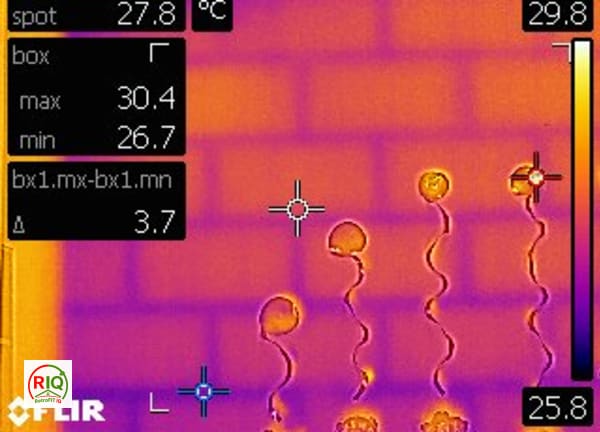
Thermal Bridging Visible Through Masonry Blockwork Wall
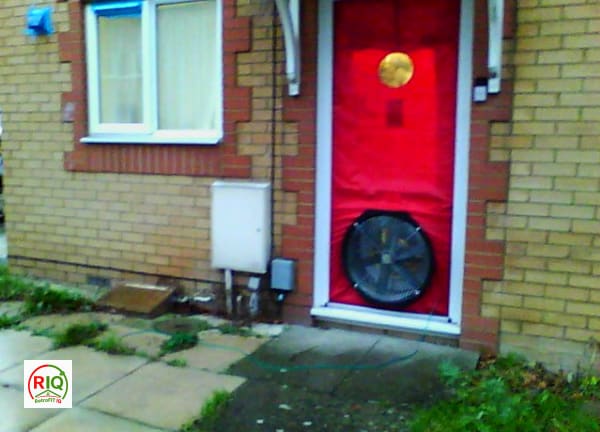
Blower Door Airtightness Test Setup

Thermal Bridge at Internal Corner Wall Junction

Thermal Bridge at Wall-Ceiling Junction Near Window

Bathroom
No related investigations yet.
Browse all investigationsFrequently asked questions
Do I need a thermal imaging survey?+
It is worth it when you need to see hidden fabric performance — missing insulation, thermal bridges, air leakage or damp — before insulating, after a retrofit, when snagging a new build, or to diagnose unexplained cold spots, draughts or damp. It is a diagnostic that directs the right fix.
What can a thermal imaging survey show?+
Surface-temperature patterns that reveal where insulation is missing or slipped, where thermal bridges run, where air leaks in, and where surfaces are damp — all non-destructively, without opening the building up.
Does a thermal camera see heat loss directly?+
No — it shows surface temperature, from which heat loss and defects are inferred. It needs a good temperature difference, suitable conditions and interpretation by someone who understands building physics.
Is thermal imaging better with a blower door test?+
Much better for air leakage. Depressurising the home with a blower door draws cold air through every leak, so the leakage paths show clearly and separate from purely conductive cold spots.
When is the best time for a survey?+
When there is an adequate temperature difference between inside and outside, typically the cooler months, and before insulating, after a retrofit, or when diagnosing a problem so the findings can direct action.
Will it tell me what to fix?+
It locates the problems; interpreted with other measurements it tells you what is wrong and where, so the remedial work — insulation, sealing or moisture control — is targeted rather than exploratory.
Do you interpret the survey or just provide images?+
We interpret the findings as building physics, combining the imaging with a blower door test and moisture readings, and turn them into a targeted action plan.
Stop guessing — find the real cause
Do not spend money fixing symptoms before you understand the cause. Every home behaves differently, and the only reliable way to know what is happening in yours is professional building performance diagnostics. At RetrofitIQ we verify buildings using the right combination of investigations:
- Thermal imaging
- Blower door testing
- Moisture & dew point readings
- Ventilation review
- Building physics assessment
- Passive House methodology