
What is a blower door test?
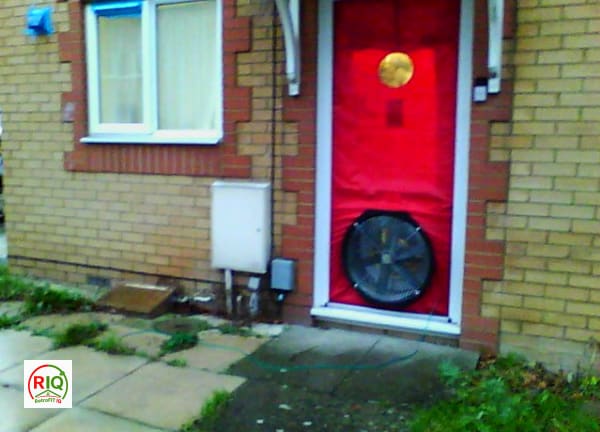
A blower door is a calibrated variable-speed fan fitted into an external doorway. It pressurises or depressurises the building to a known pressure differential (typically 50 Pa) and measures exactly how much airflow is required to hold that pressure. The more leaky the envelope, the more airflow needed — and that airflow figure is your measured air-leakage rate.
The four critical outputs
1. ACH₅₀ — air changes per hour at 50 Pa
The headline figure most people quote. It tells you how many times per hour the entire air volume of the building leaks through the envelope under a 50 Pa pressure differential. New-build target: ≤3 ACH₅₀. Passive House target: ≤0.6 ACH₅₀. Typical UK Victorian terrace: 8–15 ACH₅₀. Below 3 ACH₅₀ you are in genuinely airtight territory.
2. m³/h at 50 Pa — total airflow
The absolute volume of air leaking through the envelope at 50 Pa, expressed in cubic metres per hour. More useful than ACH₅₀ when comparing houses of different sizes. Often divided by the envelope area to give a permeability figure in m³/(h·m²) — the Part L compliance metric.
3. Smoke trails — leak location
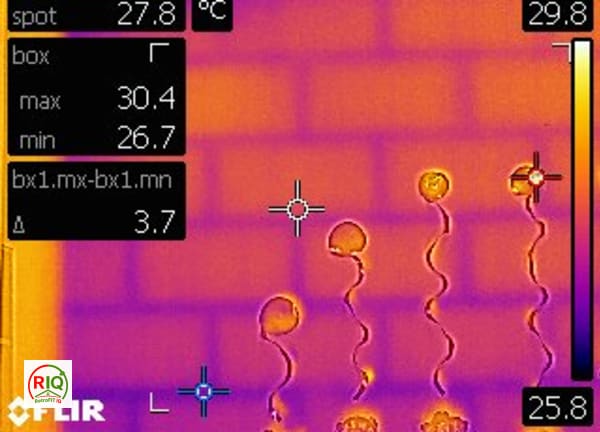
While the building is held under depressurisation, we use a smoke pen at suspected leakage points (skirtings, service penetrations, loft hatches, intermediate floors, window frames). Air rushing in pulls the smoke through the gap, making the leak path visible. This is how we turn 'your house leaks 7 ACH₅₀' into 'here are the 14 specific leak paths driving that number'.
4. Thermal-under-depressurisation imaging
With the blower door running depressurised, cold outside air rushes in through every gap. FLIR thermal imaging then shows those cold-air plumes as fingers of blue/purple pushing into the warm interior — turning the airtightness map into a thermal map. This is the single most diagnostic image you can produce of a leaky house.
When you need a blower door test
- Pre-retrofit baseline — before specifying IWI, EWI or MVHR
- Post-retrofit verification — to prove the airtightness target was achieved
- Part L compliance — required for new-build (and increasingly for major refurbishments)
- Passive House / EnerPHit certification
- Diagnostic — chronically cold or draughty rooms with no obvious cause
- MVHR commissioning — MVHR cannot work properly in a leaky envelope
What separates a useful test from a tick-box test
Many test providers run the fan, record the number, and leave. That is technically a blower door test, but it tells you almost nothing actionable. A useful test includes:
- Both pressurisation and depressurisation (single-point and multi-point)
- Simultaneous smoke tracing at every suspected leak path
- Thermal imaging under depressurisation
- A documented leak inventory with photos and locations
- A prioritised airtightness remediation plan
How RetrofitIQ runs a test
- Pre-test walkthrough — seal intentional openings (vents, flues, MVHR)
- Single-point depressurisation at 50 Pa — establish baseline
- Multi-point (25, 40, 55, 70 Pa) — characterise the leakage curve
- Smoke tracing + thermal imaging at every suspect leak path
- Pressurisation test — confirm the depressurisation result and find leaks not visible from the inside
- Document and photograph every leak with its location and severity
- Issue a written report with ACH₅₀, m³/h at 50 Pa, the leak inventory and a costed remediation plan