
Do I need a building survey before buying an older house?
Before buying an older house, a survey is almost always worthwhile — but it matters which survey you commission. A standard homebuyer report or mortgage valuation tells you about visible condition and broad value; it rarely tells you how the building actually performs — how much heat it loses, how airtight and well-ventilated it is, where it is at risk of condensation and damp, and what it will realistically cost to make warm, healthy and efficient. For a period or solid-wall property, those performance questions are exactly the ones that determine your running costs and the size of any retrofit bill. A building performance survey answers them with measurement, so you buy with your eyes open and can negotiate or budget accordingly.
 Reviewed by George Sora, Certified Passive House DesignerUpdated June 2026
Quick answer & key takeaways
8 min read- A mortgage valuation and standard homebuyer survey check condition, not performance.
- Older homes lose heat, leak air and risk damp in ways a visual survey misses.
- A building performance survey measures heat loss, airtightness, moisture and ventilation.
- It tells you the real running cost and likely retrofit bill before you commit.
- Biggest misconception: a homebuyer report covers efficiency and damp risk. It largely does not.
- Retrofit IQ's approach: measure how the home performs so you can negotiate and budget with facts.
What this usually means
When you buy a house, the lender's valuation confirms it is worth the loan, and a homebuyer or building survey assesses visible condition — the roof, the structure, obvious defects and disrepair. These are useful, but they are condition surveys, not performance surveys: they are not designed to quantify how the building behaves thermally. They will note an old boiler or single glazing, but they will not tell you how fast the house loses heat, how draughty it is, whether the walls are at risk of condensation, or what it would cost to bring it to a comfortable, efficient standard. For a newer, conventional home that may be enough; for an older property it leaves the most expensive questions unanswered.
Older and solid-wall houses behave very differently from modern construction. They typically have no cavity to insulate conventionally, breathable fabric that must stay able to dry, significant air leakage through floors, chimneys and joinery, and a tendency to cold surfaces that condense and grow mould. The EPC that comes with the sale is a modelled estimate using standardised assumptions, not a measurement of the actual building, and it frequently misjudges solid-wall and traditional homes — so relying on it to gauge running costs or retrofit needs can mislead. The result is that buyers regularly discover, after completion, that the home is far more expensive to heat, or far more prone to damp, than anything in the paperwork suggested.
A building performance survey closes that gap by measuring rather than assuming. It quantifies heat loss, tests airtightness, maps cold surfaces and thermal bridges with thermal imaging, logs moisture and ventilation, and translates the findings into the real cost of running the home and a sequenced, moisture-safe plan for improving it. For an older house this is decisive information at the point of purchase: it can justify a lower offer, reveal a hidden damp or insulation problem before you own it, and turn a vague worry about retrofit into a costed roadmap. The survey is most valuable precisely when the building is least conventional, which is why older properties are the strongest case for commissioning one before you buy.
Common causes
Valuation is for the lender
A mortgage valuation confirms loan security, not how the building performs or what it costs to run.
Homebuyer surveys check condition
Standard surveys assess visible disrepair, not heat loss, airtightness or condensation risk.
EPC is modelled, not measured
The EPC uses standard assumptions and often misjudges solid-wall and older homes.
Older fabric behaves differently
Solid walls, breathable construction and air leakage need performance, not just condition, assessment.
Hidden damp and cold surfaces
Condensation risk and thermal bridges are invisible to a visual inspection.
Signs and symptoms
Solid-wall or period construction
Traditional fabric makes performance and moisture behaviour the key unknowns.
An EPC that looks poor or implausible
A low or questionable rating signals the real performance needs measuring.
Signs of damp or past mould
Staining or fresh paint can hide moisture issues a performance survey would confirm.
Planning a renovation or extension
If you intend to improve the home, knowing its baseline avoids costly surprises.
High likely running costs
Worry about heating bills is best answered by measuring the heat loss before buying.
What most people check first
- Whether the property is solid-wall, period or otherwise non-standard construction.
- Whether the EPC and homebuyer report actually address running costs and damp risk.
- Whether there are signs of damp, mould or recent cosmetic cover-ups.
- Whether you plan to retrofit or extend, making a measured baseline valuable.
What most people miss
- That a homebuyer survey and valuation do not measure performance.
- That the EPC is a modelled estimate, often wrong for older homes.
- That the biggest costs after purchase are heating and retrofit, not visible repairs.
- That measuring before you buy gives you grounds to negotiate.
The building physics
Condition surveys and performance surveys answer different questions. A condition survey is an expert visual assessment of disrepair and defects; it does not quantify heat flow, air leakage or moisture risk because those require instruments — heat-loss measurement, a blower door test, thermal imaging and humidity logging. The standardised EPC, meanwhile, is generated from a reduced data model that assumes typical constructions and U-values; for an older or solid-wall home, whose real fabric properties deviate sharply from the defaults, the modelled figure can be materially wrong in either direction. As a guide to actual running cost or to what a retrofit must achieve, neither the condition survey nor the EPC is a substitute for measurement.
Older buildings make this gap consequential because their performance is dominated by features the visual surveys do not test. Solid masonry walls have no conventional cavity and behave breathably, so any insulation must keep the wall able to dry to avoid trapping moisture; air leakage through suspended floors, open chimneys and traditional joinery can be large and is invisible to the eye; and cold internal surfaces at junctions and behind fittings reach the dew point and sustain condensation and mould. These mechanisms set both the heating cost and the risk profile of the house, yet none of them is quantified by a valuation, a homebuyer report or an assumed EPC.
A building performance survey applies the right instruments to these unknowns and converts them into decisions. Measured heat loss gives the true running cost; airtightness testing reveals leakage that drives both cost and draughts; thermal imaging locates missing insulation and thermal bridges; and moisture logging exposes condensation risk before it is hidden by decoration. Interpreted together by a specialist, the results become a costed, moisture-safe improvement plan and an evidence base for negotiation. Because the uncertainty — and therefore the value of resolving it — is greatest in non-standard older homes, the performance survey delivers most precisely where buyers most often get caught out, which is why it is worth commissioning before, rather than after, you commit to the purchase.
How to survey an older house properly before buying
Keep the condition survey for disrepair, but add a building performance survey to measure heat loss, airtightness, moisture and ventilation — so you know the real running cost and retrofit bill before you commit.
- 01
Commission the condition survey
Use a homebuyer or building survey for structure and visible disrepair as usual.
- 02
Add a performance survey
Measure heat loss, airtightness, moisture and ventilation to quantify how the home actually performs.
- 03
Map cold surfaces and leakage
Use thermal imaging and a blower door test to find insulation defects, thermal bridges and air leakage.
- 04
Check moisture and ventilation
Log humidity and assess ventilation to expose condensation and damp risk before it is decorated over.
- 05
Get a costed retrofit roadmap
Turn the findings into the real running cost and a sequenced, moisture-safe improvement plan.
- 06
Use it to negotiate or budget
Apply the evidence to adjust your offer or plan the works with realistic figures.
How to prevent it coming back
- Do not rely on the valuation or EPC to judge running costs.
- Treat a homebuyer report as a condition check, not a performance one.
- Measure performance before buying, while you still have negotiating room.
- Identify damp and ventilation risk before cosmetic decoration hides it.
How Retrofit IQ investigates this
We measure how the older home actually performs and translate it into running cost, risk and a costed retrofit plan, so you buy with facts.
Do not spend money fixing symptoms before you understand the cause — investigate first, then build with confidence.
Do I need a professional investigation?
A building performance survey is worth commissioning before buying any older or solid-wall house, especially where running costs, damp risk or a planned retrofit are concerns. Measuring heat loss, airtightness, moisture and ventilation before you commit tells you the true cost of owning the home and gives you a costed plan — and the evidence to negotiate — rather than discovering the problems after completion.
Get an independent, product-neutral survey
We are paid for the diagnosis, not the cure — so the report finds the real cause and the cheapest correct fix, with nothing to sell you.
- Paid for the findings, no treatment to sell
- Thermal imaging, airtightness & moisture readings
- Written report with the least-cost remedy
Where to go next
Relevant services
Related comparisons
From the Academy
Related case studies
Related problems you may also have
Evidence from Real Projects (21)
Real project and investigation images from our own fieldwork, matched to this page — not stock photography.
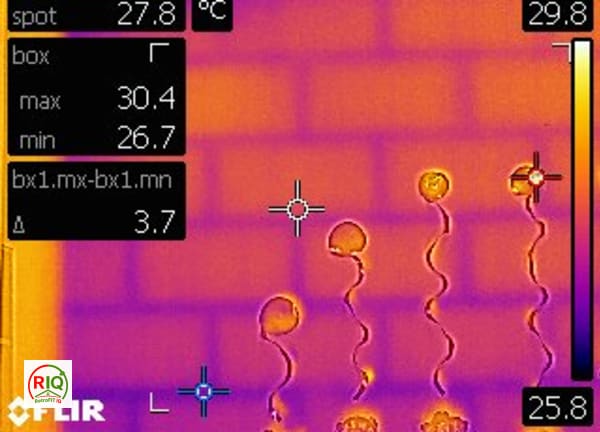
Thermal Bridging Visible Through Masonry Blockwork Wall

Sample Building Performance Investigation Report — Thermal Imaging

Thermal Bridge at Internal Corner Wall Junction

Thermal Bridge at Wall-Ceiling Junction Near Window

Airtightness Testing in a Stratford Victorian Terrace

Acoustic Floor Upgrades: Mineral Wool Insulation Between Joists
No related investigations yet.
Browse all investigationsFrequently asked questions
Do I need a building survey before buying an older house?+
A survey is almost always worthwhile, but for an older home a standard condition survey is not enough on its own. It checks visible disrepair, while the questions that determine your costs — heat loss, airtightness, damp risk and retrofit cost — need a building performance survey that measures how the home actually behaves.
Does the homebuyer survey cover energy efficiency and damp?+
Only superficially. It notes obvious things like single glazing or an old boiler and visible damp, but it does not measure heat loss, airtightness or condensation risk. Those are performance questions that require instruments, not a visual inspection.
Can I just rely on the EPC?+
No. The EPC is a modelled estimate using standard assumptions and frequently misjudges solid-wall and period homes, sometimes substantially. It is a rough guide, not a measurement of the actual building's running cost or retrofit needs.
What does a building performance survey tell me that others do not?+
It measures the real heat loss and running cost, tests airtightness, maps cold surfaces and thermal bridges, and logs moisture and ventilation — then turns it into a costed, moisture-safe improvement plan. For an older house, that is the information that actually drives your budget.
Will it help me negotiate the price?+
Often, yes. Measured evidence of high heat loss, air leakage or hidden damp gives you concrete grounds to adjust your offer or to budget realistically for the works, rather than discovering the problems after you have completed.
Why does it matter more for older homes?+
Because older and solid-wall homes behave very differently from modern construction and the standard surveys and EPC are least reliable for them. The uncertainty is greatest exactly where buyers most often get caught out, so measuring before you buy delivers the most value there.
Stop guessing — find the real cause
Do not spend money fixing symptoms before you understand the cause. Every home behaves differently, and the only reliable way to know what is happening in yours is professional building performance diagnostics. At RetrofitIQ we verify buildings using the right combination of investigations:
- Thermal imaging
- Blower door testing
- Moisture & dew point readings
- Ventilation review
- Building physics assessment
- Passive House methodology