
A house is a system: its fabric, airtightness, ventilation, heating and moisture behaviour are interdependent. Change one in isolation and you change the others — often for the worse. Insulate a wall without addressing ventilation and you can cause condensation; draught-proof without insulating cold spots and you concentrate mould at the junctions. Whole-house retrofit means understanding the building as a whole and planning the measures to work together, in the right order.
What PAS 2035 is
PAS 2035 (Retrofitting dwellings for improved energy efficiency — specification and guidance) is the overarching UK standard for domestic retrofit, sitting alongside PAS 2030 (which covers the installation work itself). It was introduced after widespread evidence that poorly-coordinated retrofit — particularly under earlier funding schemes — was causing damp, mould and underperformance. It mandates a whole-dwelling, risk-managed approach rather than bolting on single measures.
| Role | Responsibility |
|---|---|
| Retrofit Assessor | Surveys the dwelling — condition, occupancy, energy, moisture risk |
| Retrofit Coordinator | Oversees the whole project; manages risk; ensures the standard is met |
| Retrofit Designer | Specifies the measures and details (incl. moisture/ventilation) |
| Retrofit Installer | Installs to PAS 2030 |
| Retrofit Evaluator | Checks the outcome against the design |
The retrofit assessment and risk pathways
PAS 2035 starts with a proper assessment of the whole dwelling — its construction, condition, exposure, occupancy and existing moisture issues — not just an EPC. It then assigns a risk pathway (with more rigorous requirements for higher-risk buildings, such as traditional solid-wall or heritage construction), and requires that moisture risk specifically be assessed and managed throughout. This is a deliberate shift from 'install the measure' to 'understand the building, then design safely'.
The Medium-Term Improvement Plan
A central PAS 2035 concept is the Medium-Term Improvement Plan (MTIP): even if a homeowner only funds some measures now, the whole-house end state is designed first, so that today's works don't preclude or compromise tomorrow's. This avoids 'lock-in' — for example, installing a heating system sized for an un-insulated house, then insulating later and being left with oversized, inefficient plant; or insulating a wall in a way that makes a future airtightness or ventilation upgrade impossible.
Fabric first
Whole-house retrofit follows a 'fabric first, plant last' logic: reduce the heat demand through insulation, airtightness and good detailing before sizing the heating system. A heat pump fitted to a leaky, poorly-insulated house has to be large and runs inefficiently; reduce the demand first and the plant shrinks, cutting both capital and running cost. This sequencing is covered in depth in the fabric-first article in this guide.
How heat loss is reduced in a whole-house plan
The first job of any whole-house retrofit is to cut the rate at which the building loses heat. Heat escapes two ways: by conduction through the fabric (walls, roof, floor, windows) and by air movement (ventilation and uncontrolled leakage). A measured heat-loss assessment quantifies both, room by room, so the plan can attack the biggest losses first. In a typical solid-wall Victorian terrace, the walls might account for 30–40% of fabric heat loss, the roof 10–20%, the floor 10–15% and the windows 10–15% — but uncontrolled air leakage can add another 20–30% on top, which is why measuring it matters.
Reducing heat loss is not just about comfort and bills. It is the precondition for low-temperature heating: a heat pump can only run efficiently, at a low flow temperature, in a home whose heat demand has already been cut. This is the practical meaning of 'fabric first, plant last', and it is why the whole-house plan sequences the fabric work ahead of any heating change.
Airtightness within the retrofit plan
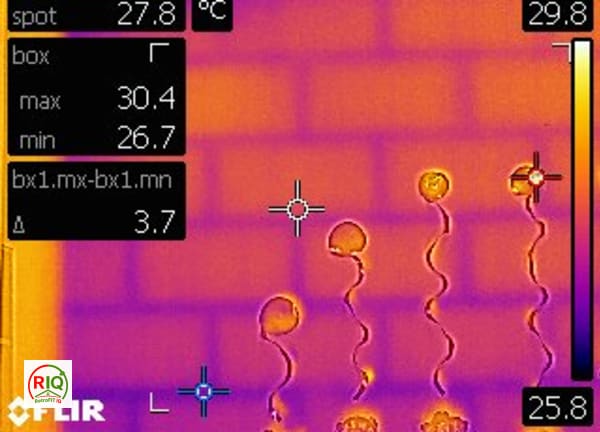
Airtightness is the most overlooked element of a whole-house retrofit, partly because leakage is invisible. Yet in many older homes, uncontrolled air leakage rivals the heat lost through the walls. Warm air rising in the heated rooms creates a 'stack effect' that pulls cold air in low down — through suspended-floor perimeters, gaps between floorboards, service penetrations and disused chimney flues — and pushes warm air out high up, through loft hatches and ceiling penetrations.
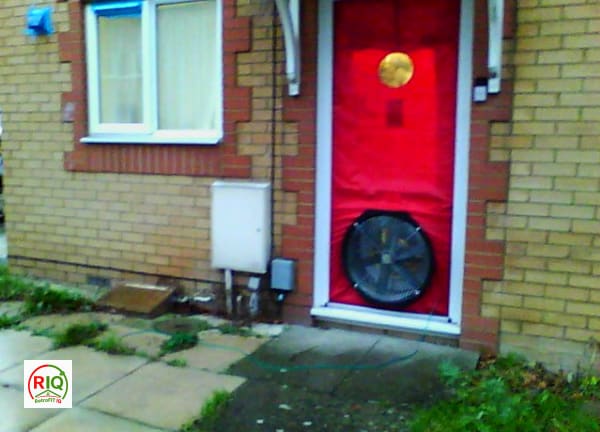
A whole-house plan designs a continuous air barrier — an unbroken line that can be traced around the heated envelope on a section drawing — and uses a blower door test to measure the starting point (ACH₅₀) and verify the improvement. Crucially, airtightness and ventilation are designed together: as the envelope is tightened, the accidental ventilation that used to control humidity disappears, so controlled ventilation must replace it. 'Build tight, ventilate right' is not a slogan but a design requirement.
Thermal bridges — the detail that undoes the headline U-values
A thermal bridge is a localised path where heat shortcuts through the envelope faster than the surrounding fabric — at junctions, reveals, lintels, balconies, embedded floor edges and wherever the insulation is interrupted. Two things follow. First, the bridge loses heat out of proportion to its area. Second, and more dangerously, its internal surface runs colder than the surrounding wall, so it can fall below the dew point and become a magnet for condensation and mould.
This is why internal wall insulation, which is interrupted at every internal wall and intermediate floor, carries more thermal-bridge risk than external insulation, which wraps the structure in a continuous warm blanket. A whole-house plan models the key junctions and details them to be thermal-bridge-free as far as practical — because a beautifully insulated wall with cold, mouldy reveals is a failure, not a success.
Moisture, dew point and condensation risk
More retrofits are spoiled by moisture than by any energy miscalculation. The mechanism is dew point: every batch of indoor air has a temperature below which it becomes saturated and water condenses out. Where warm, humid indoor air reaches a surface — or a layer inside a wall build-up — colder than its dew point, moisture condenses there. Surface condensation grows the visible mould homeowners see; interstitial condensation forms hidden inside a wall or floor build-up, where it can rot timber and ruin insulation unseen.
Adding insulation changes where the dew point sits within a build-up. Internal wall insulation, in particular, keeps the original masonry colder and can move the dew point into the wall, risking interstitial condensation. That is why any solid-wall internal insulation should be checked with hygrothermal modelling (Glaser or, better, transient WUFI analysis) against site-specific climate data before it is specified. PAS 2035's insistence on moisture-risk assessment exists precisely to catch this before it is built in.
Ventilation — the other half of a tight envelope
Every airtightness gain must be matched by a deliberate ventilation strategy, or the home traps the moisture from cooking, washing, drying and breathing. The options scale with how tight the home becomes: continuous mechanical extract (dMEV) from wet rooms suits moderately tight homes; mechanical ventilation with heat recovery (MVHR) suits airtight homes, supplying filtered fresh air while recovering up to ~90% of the heat from the air it extracts. Whichever is chosen, it must be commissioned and its airflows measured on completion — an uncommissioned system rarely delivers its rated performance.
Where MCS and heat pumps fit
A whole-house plan that ends in low-carbon heating treats the heat pump as the last step, not the first. Once the fabric has cut the heat demand and the emitters have been reviewed for low-temperature output, an MCS-certified installer can size and fit the heat pump to the reduced, measured load — usually a smaller, cheaper unit running at a low flow temperature and a high seasonal efficiency. Doing it in the wrong order (heat pump first, fabric later) leaves you with an oversized system sized for losses you are about to remove. The Boiler Upgrade Scheme grant rewards the installation, but only fabric-first planning makes that installation perform.
A worked example: phasing a solid-wall terrace
Consider a 1900s mid-terrace with solid walls, a part-insulated loft and original suspended timber floors, measured at around 9 kW design heat loss and 12 ACH₅₀. A homeowner with a limited budget cannot do everything at once — but a whole-house plan sequences it safely. Stage one: top up and air-seal the loft, insulate and seal the suspended floor, and draught-proof the worst leakage, with continuous extract added to the wet rooms. Stage two: internal wall insulation to the coldest walls, hygrothermally modelled and detailed at the reveals, with ventilation upgraded to suit the now-tighter home. Stage three: review emitters and fit a correctly sized heat pump. At every stage the home is warmer, drier and safe — never tightened without being ventilated, never insulated without a moisture check.
Common mistakes homeowners make
- Buying single measures from separate trades with no one coordinating the whole house
- Insulating before ventilating, then blaming the insulation when condensation appears
- Fitting a heat pump before reducing heat loss, leaving it oversized and inefficient
- Specifying internal wall insulation with no hygrothermal (moisture) check
- Treating airtightness as optional, so a well-insulated home is still cold and draughty
- Phasing works with no end-state plan, so early measures have to be undone later
The PAS 2035 process, step by step
PAS 2035 is best understood as a sequence of defined roles and stages that together manage risk across the whole dwelling. It begins with a Retrofit Assessment — a survey of the building's condition, fabric, services, occupancy and moisture risk — which feeds a whole-dwelling understanding rather than a single-measure view. A Retrofit Coordinator then takes overall responsibility for the project, ensuring the measures work together and the risks are managed end to end. Each home is placed on a risk path according to its complexity, exposure and heritage value, which sets how rigorous the assessment and design must be. Where the work is staged over time, a Medium-Term Improvement Plan (MTIP) records the intended end state so that each phase is compatible with the next and nothing has to be undone later. A Retrofit Designer specifies the measures and details — including the all-important moisture-risk assessment and ventilation strategy — and an evaluation stage checks the outcome. The point of this apparatus is not bureaucracy for its own sake; it exists because uncoordinated, single-measure retrofit is the documented cause of the damp, mould and interstitial condensation that PAS 2035 was written to prevent.