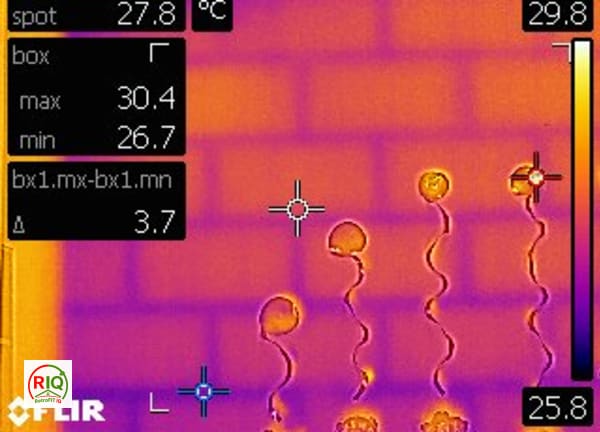

Traditional solid masonry walls — common in pre-1919 UK housing — are typically built of relatively soft, vapour-open materials (brick or stone with lime mortar) and manage moisture by absorbing rain and then drying out in both directions. They are 'moisture-open' systems. Insulating them interferes with that drying behaviour and with the temperature distribution through the wall, which is why solid-wall insulation needs careful, building-physics-led design rather than a standard product spec.
How insulation changes the moisture balance
Adding insulation makes part of the wall colder than before — the masonry outboard of internal insulation, or (less severely) the outer leaf behind external insulation. Colder masonry holds moisture longer (it dries more slowly and sits closer to the dew point), and the interfaces between new and old materials can become condensation planes. At the same time, if a vapour-closed insulation or finish is added, the wall's ability to dry is reduced — so it can accumulate moisture it used to shed.
Wind-driven rain — the dominant load
For solid walls, the biggest moisture load is usually wind-driven rain soaking into the outer face, not internal vapour. A wall that gets hammered by driving rain on an exposed elevation behaves very differently from a sheltered one — and this is exactly the factor that simple (Glaser) condensation calculations ignore. Assessing rain exposure (and managing it — good rendering, pointing, overhangs, rainwater goods) is central to insulating a solid wall safely, particularly with internal insulation where the wet outer wall is left cold.
The vapour-open ('breathable') strategy
For most traditional solid walls, the safest approach is to keep the build-up vapour-open, using materials (lime, wood-fibre, mineral wool, breathable membranes) that allow the wall to continue absorbing and releasing moisture and to dry out. This 'work with the wall' philosophy is more forgiving than a sealed, vapour-closed system, because any moisture that does get in can escape. It contrasts with the vapour-closed approach (foil-faced foams, polythene) that can work in new build but is unforgiving on an old, rain-loaded wall.
| Approach | Materials | Behaviour |
|---|---|---|
| Vapour-open ('breathable') | Lime, wood-fibre, mineral wool, breathable membrane | Wall buffers & dries; forgiving — preferred for traditional walls |
| Vapour-closed (sealed) | Foil-faced PIR/PUR, polythene VCL | Relies on a perfect barrier; unforgiving if breached or rain-loaded |
Why hygrothermal assessment is essential
Because the risks (interface condensation, slow drying, joist-end decay, rain accumulation) are invisible until they cause damage, solid-wall insulation should be assessed before installation. A simple Glaser check may suffice for low-risk, sheltered, vapour-open build-ups; but for internal insulation, exposed elevations, embedded timbers or any moisture-sensitive construction, a transient hygrothermal simulation (WUFI) — which models rain, capillarity, drying and real materials — is the right tool. It lets you test whether a proposed build-up stays safe over years, and compare options, before committing. (See the condensation-risk-analysis article in the Building Physics guide.)