
Thermal Imaging vs Blower Door Testing: Which Tells You What
Thermal imaging (infrared thermography) vs Blower door testing.
 Reviewed by George Sora, Certified Passive House DesignerUpdated June 2026
Quick answer & key takeaways
4 min read- Bottom line: They answer different questions.
- When Thermal imaging (infrared thermography) is enough: You need to find and prioritise cold spots and leakage paths
- When Blower door testing is the better choice: You need a certifiable airtightness number for modelling, Part L or Passive House
- When you need both: Running the camera while the blower door depressurises the house — locate and quantify the same defects together
- Biggest misconception: “A thermal camera measures heat loss in watts.” — It measures surface temperature. Quantifying heat loss needs U-values, areas and the airtightness figure from a blower door, combined in a calculation.
- Retrofit IQ’s approach: We run the camera while the house is depressurised, so the blower door quantifies the leakage and the infrared imagery locates it — turning a single airtightness number into a prioritised action list rather than a guess.
Quick answer
They answer different questions. Thermal imaging shows you where heat and air-leakage problems are located; a blower door test tells you how much air leaks overall. Used together — camera running while the house is depressurised — they pinpoint and quantify the same defects. For a meaningful airtightness figure you need the blower door; for locating faults you need the camera.
At a glance
| Attribute | Thermal imaging (infrared thermography) | Blower door testing |
|---|---|---|
| Primary purpose | Locate cold spots, missing insulation, thermal bridges and air paths | Measure total building air leakage (ach@50 / q50) |
| What it measures | Surface temperature patterns | Air flow at a known pressure difference |
| Gives a number? | Qualitative / relative (with context) | Yes — a single repeatable metric |
| Locates the defect? | Yes, precisely | Not on its own (needs the camera or smoke) |
| Best conditions | Temperature difference of ~10–15°C inside vs out | Any season; wind affects accuracy |
| Speed | 1–3 hours for a typical home | Set-up plus test, ~1–2 hours |
| Typical use | Diagnosis, insulation checks, damp triage | Airtightness verification, Passive House/EnerPHit, Part L |
What is Thermal imaging (infrared thermography)?
A thermal-imaging survey uses an infrared camera to map surface temperatures across walls, ceilings, floors and junctions. Cold patterns reveal missing insulation, thermal bridges, air movement and damp signatures — but the camera reads surface temperature, not air flow directly.
What is Blower door testing?
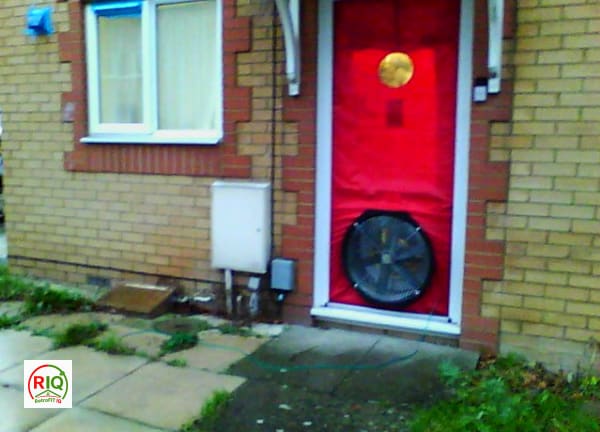
A blower door seals a calibrated fan into an external doorway and pressurises or depressurises the house, usually to 50 pascals. It measures the total air leakage of the building as an air change rate (ach@50) or permeability (q50), giving a single, repeatable number for the whole envelope.
What each method measures — and what it doesn’t
Thermal imaging (infrared thermography)
- Surface-temperature patterns that locate cold spots, missing insulation and bridges
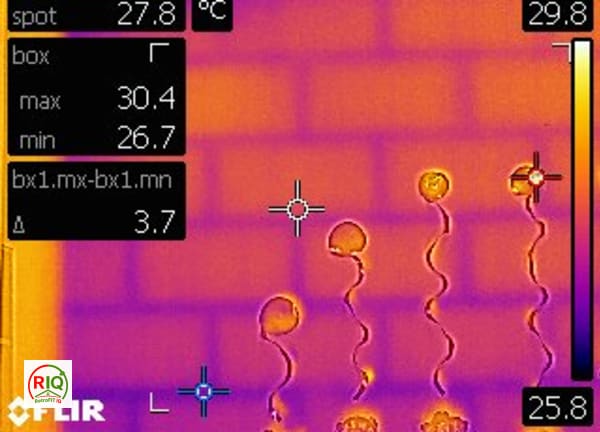
- Air-leakage paths, especially when the house is depressurised
- Damp signatures and where to investigate further
- A quantified airtightness figure — it shows location, not the number
- Heat loss in watts without U-values and areas
Blower door testing
- Total building air leakage as ach@50 or q50
- A single, repeatable airtightness figure for modelling and certification
- Where the leaks are — it gives the quantity, not the location
- Insulation quality, which is independent of airtightness
The building science
Heat moves through a building by conduction, convection and radiation, and air carries both heat and moisture with it. A thermal camera visualises the result of all three on a surface, but it cannot distinguish a genuinely under-insulated wall from a wall being chilled by a draught unless you change the pressure regime.
That is precisely why the two methods are complementary. Depressurising the house with a blower door exaggerates air leakage: cold outside air is pulled through every gap, cooling the surrounding surfaces. Run the infrared camera during that depressurisation and air-leakage paths light up as fast-moving cold plumes, clearly separated from static conductive cold spots.
The blower door alone gives the headline figure that matters for energy modelling and certification — air permeability feeds directly into heat-loss calculations and PHPP. Without it you are guessing at infiltration, which is often the single largest uncertainty in a heat-loss model.
Key differences
- Thermal imaging is a locating tool; the blower door is a measuring tool.
- The camera produces images and patterns; the blower door produces a calibrated number.
- Thermal imaging needs a temperature difference to work well; the blower door works year-round.
- Only the blower door gives the airtightness result required for Passive House, EnerPHit and Building Regulations.
- Neither replaces the other — the strongest diagnosis runs the camera while the blower door depressurises the house.
Common misconceptions
Myth: A thermal camera measures heat loss in watts.
It measures surface temperature. Quantifying heat loss needs U-values, areas and the airtightness figure from a blower door, combined in a calculation.
Myth: A blower door tells you where the leaks are.
It only tells you how much leaks. Finding the paths needs the camera, smoke or an anemometer during the test.
Myth: A low air-leakage number means the house is well insulated.
Airtightness and insulation are independent. A leaky house can be well insulated, and an airtight house can be poorly insulated.
Real-world situations
Cold, draughty rooms but no idea where the problem is
Thermal imaging first to locate the cold spots and air paths, ideally with the blower door running to amplify leakage.
You need an airtightness figure for a retrofit, heat pump sizing or Passive House
Blower door test — it is the only method that produces the required ach@50 / q50 number.
Suspected missing insulation in a recently converted loft
Thermal imaging on a cold day; the camera will show insulation gaps and slumping clearly.
Planning a deep retrofit and budgeting works
Both — the blower door quantifies the starting point and the camera prioritises which leaks and cold areas to address first.
Which do you actually need?
When Thermal imaging (infrared thermography) is enough
- You need to find and prioritise cold spots and leakage paths
- Diagnosing insulation gaps or triaging damp
When Blower door testing is the better choice
- You need a certifiable airtightness number for modelling, Part L or Passive House
- Establishing an honest airtightness baseline
When you need both
- Running the camera while the blower door depressurises the house — locate and quantify the same defects together
What Retrofit IQ checks on site
We run the camera while the house is depressurised, so the blower door quantifies the leakage and the infrared imagery locates it — turning a single airtightness number into a prioritised action list rather than a guess.
- Blower door test to establish the airtightness baseline
- Thermal imaging during depressurisation to amplify and locate leaks
- Smoke tracing of significant leakage paths
- Cross-reading imagery against the measured figure
- A prioritised sealing-and-insulation action list
What a Certified Passive House Designer recommends
On almost every diagnostic survey I carry out, I use the two together rather than choosing between them. The blower door establishes the honest baseline — you cannot improve what you have not measured — and the infrared camera turns that single number into an action list by showing exactly where the air and heat are escaping.
If budget forces a choice: when the question is "how airtight is my home?" the blower door is non-negotiable. When the question is "where is it going wrong?" the camera leads. For any project heading towards a heat pump or Passive House standard, plan for both from the outset.
— George Sora, Certified Passive House Designer, Founder, RetrofitIQ
Reviewed using current building physics principles and Passive House methodology.
Related services
Related comparisons
Related investigations
Compare another way
Closely related comparisons our clients read next.
Blower Door vs Smoke Testing for Air Leakage
The blower door measures the quantity of air leakage; smoke tracing reveals its location.
Read comparisonThermal Imaging vs Moisture Meter for Finding Damp
Thermal imaging finds where to look; a moisture meter confirms what is actually there.
Read comparisonU-values vs Thermal Bridging in Heat Loss
U-values describe heat loss through the flat area of walls, roofs and windows; thermal bridges describe extra heat loss at junctions and interruptions.
Read comparisonThermal Imaging vs Heat Loss Survey
Thermal imaging tells you where a home loses heat; a heat loss survey tells you how much it loses and where the biggest losses are in calculated terms.
Read comparisonEvidence from Real Projects (19)
Real project and investigation images from our own fieldwork, matched to this page — not stock photography.



No related investigations yet.
Browse all investigationsFrequently asked questions
Can thermal imaging replace a blower door test?+
No. Thermal imaging locates defects but does not measure total air leakage. If you need an airtightness figure, the blower door is essential.
Do I need a temperature difference for thermal imaging?+
Yes — ideally around 10–15°C between inside and outside. Without a temperature difference, surfaces look uniform and defects are hard to see.
What does ach@50 mean?+
Air changes per hour at 50 pascals: how many times the whole air volume of the house leaks out per hour when held at 50 Pa pressure. Lower is more airtight.
Is a blower door test destructive?+
No. The fan seals temporarily into a doorway and the test leaves no marks. It is entirely non-destructive.
Which should I book first?+
If you want a baseline and a number, the blower door; if you want to find specific faults, thermal imaging. We usually combine them in one visit.
Can you find damp with thermal imaging?+
The camera can show cool, evaporating damp signatures, but it does not measure moisture content. We confirm with a moisture meter — see our damp comparisons.
Does wind affect a blower door test?+
Strong, gusty wind reduces accuracy because it adds its own pressure on the building. We note conditions and retest if needed.
Are these tests worth it before a heat pump?+
Yes. Heat pump sizing depends on accurate heat loss, and airtightness plus insulation quality are major inputs. Both tests de-risk the design.
Need professional advice?
A comparison like this helps you understand the theory, but every property behaves differently. The only reliable way to establish the real cause in your home — rather than guessing — is professional building performance diagnostics. At RetrofitIQ we verify buildings using the appropriate combination of investigations:
- Thermal imaging
- Blower door testing
- Moisture investigation
- Building physics assessment
- Passive House methodology