
Blower Door vs Smoke Testing: Finding and Measuring Air Leakage
Blower door test vs Smoke tracing.
 Reviewed by George Sora, Certified Passive House DesignerUpdated June 2026
Quick answer & key takeaways
3 min read- Bottom line: The blower door measures the quantity of air leakage; smoke tracing reveals its location.
- When Blower door test is enough: You need a certified airtightness figure
- When Smoke tracing is the better choice: You need to target sealing to the worst paths
- When you need both: Measure with the blower door, then trace with smoke while depressurised to direct the sealing
- Biggest misconception: “Smoke testing gives you an airtightness score.” — It is purely diagnostic and visual. The score comes from the blower door's calibrated measurement.
- Retrofit IQ’s approach: We use the blower door to measure the leakage and smoke tracing to find exactly where it goes, so sealing effort targets the paths that actually matter — and we re-test to prove the improvement rather than assuming it.
Quick answer
The blower door measures the quantity of air leakage; smoke tracing reveals its location. Smoke testing is almost always carried out during a blower door test, because the pressure difference is what makes the smoke move through the leaks. One gives the number, the other gives the map.
At a glance
| Attribute | Blower door test | Smoke tracing |
|---|---|---|
| Primary purpose | Measure total leakage rate | Visualise individual leakage paths |
| Output | ach@50 / q50 number | Visible smoke movement at gaps |
| Needs the other? | Stands alone for the number | Needs the blower door pressure to work |
| Locates faults | No | Yes, precisely |
| Typical use | Verification, certification, modelling | Targeting sealing works, snagging |
| Equipment | Calibrated fan + gauge | Smoke pen / machine |
What is Blower door test?
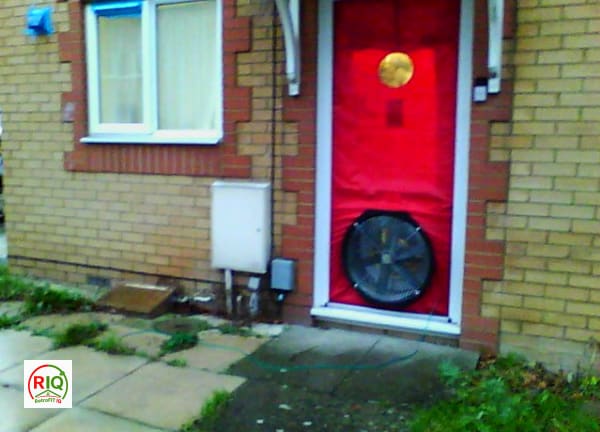
A calibrated fan pressurises or depressurises the building to a reference pressure (typically 50 Pa) and measures the resulting air flow, expressed as ach@50 or q50. It quantifies the whole-house leakage but does not, by itself, show where the air moves.
What is Smoke tracing?
With the house held under pressure by the blower door, controlled smoke (a pen or a smoke machine) is introduced near suspected leakage points. The smoke is dragged through gaps, making invisible air paths visible at skirtings, service penetrations, loft hatches and window junctions.
What each method measures — and what it doesn’t
Blower door test
- The total air-leakage rate as ach@50 or q50
- A calibrated, certifiable whole-house figure
- Where the air moves — only how much
- Individual leakage paths without the camera or smoke
Smoke tracing
- The exact paths air takes through the envelope
- Individual leaks at skirtings, penetrations, hatches and junctions
- An airtightness score — it is purely diagnostic and visual
- The quantity of leakage
The building science
Air leakage is driven by pressure difference. In normal use, wind and the stack effect create modest pressure differences that push air through gaps in the envelope, carrying heat out in winter and, crucially, carrying moist internal air into cold construction where it can condense.
A blower door standardises that pressure at 50 Pa so the result is repeatable and comparable. But a single number cannot tell a builder where to apply tape, grommets or sealant — and uncontrolled leakage is the enemy of both energy efficiency and durable, mould-free construction.
Smoke tracing closes that gap. Under depressurisation, smoke released near a leak is sucked inward along the exact path the air takes, so you can follow it to the root cause — often a service penetration, an unsealed joist end or a poorly fitted loft hatch — rather than guessing.
Key differences
- Blower door = quantity; smoke tracing = location.
- The blower door produces a certifiable metric; smoke produces an action list.
- Smoke needs the blower door's pressure regime to be meaningful.
- You can pass a blower door target and still benefit from smoke tracing to target the last few percent.
Common misconceptions
Myth: Smoke testing gives you an airtightness score.
It is purely diagnostic and visual. The score comes from the blower door's calibrated measurement.
Myth: If the number is good, there's no point tracing leaks.
Even compliant homes have concentrated leaks that cause draughts and condensation risk in specific spots; tracing finds them.
Myth: Smoke testing is messy or harmful.
We use small quantities of cool, non-staining tracer smoke and ventilate afterwards.
Real-world situations
You want to seal a draughty older home effectively
Blower door with smoke tracing — measure, then follow the smoke to the worst paths before sealing.
You only need a compliance figure
Blower door alone provides the certified number.
Recurring cold draught at a specific spot
Smoke tracing under depressurisation will reveal the exact path feeding that draught.
Which do you actually need?
When Blower door test is enough
- You need a certified airtightness figure
- Establishing a baseline before sealing works
When Smoke tracing is the better choice
- You need to target sealing to the worst paths
- Chasing a specific recurring draught
When you need both
- Measure with the blower door, then trace with smoke while depressurised to direct the sealing
What Retrofit IQ checks on site
We use the blower door to measure the leakage and smoke tracing to find exactly where it goes, so sealing effort targets the paths that actually matter — and we re-test to prove the improvement rather than assuming it.
- Blower door test for the calibrated leakage figure
- Smoke tracing room by room under depressurisation
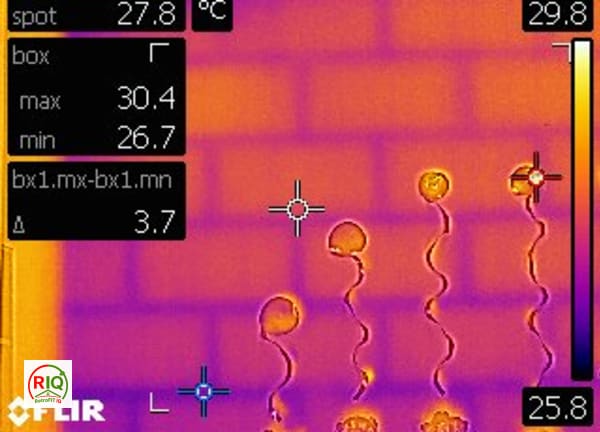
- Thermal imaging and anemometer readings to confirm paths
- Prioritising the worst leaks for sealing
- Re-testing after sealing to verify improvement
What a Certified Passive House Designer recommends
I treat smoke tracing as the natural partner to the blower door, not an optional extra. The number tells you whether you have a problem; the smoke tells you what to fix and in what order. On retrofit jobs that combination routinely saves money, because sealing effort goes where it actually counts.
For Passive House and EnerPHit work, where every path matters, I trace systematically room by room while the house is depressurised, and re-test after sealing to confirm the improvement.
— George Sora, Certified Passive House Designer, Founder, RetrofitIQ
Reviewed using current building physics principles and Passive House methodology.
Related comparisons
Related investigations
Compare another way
Closely related comparisons our clients read next.
Thermal Imaging vs Blower Door Testing
They answer different questions.
Read comparisonMVHR vs PIV (Positive Input Ventilation)
MVHR is a balanced, heat-recovering system best suited to airtight, well-insulated homes; PIV is a simpler, lower-cost system that dilutes humidity by pressurising the house but recovers no heat.
Read comparisonAirtightness Testing vs Ventilation Assessment
Airtightness testing measures the uncontrolled air leaking through gaps; a ventilation assessment checks the controlled fresh air the home deliberately provides.
Read comparisonBlower Door Test vs EPC
A blower door test measures the real airtightness of a building; an EPC is a simplified rating that assumes a default air-leakage value rather than measuring it.
Read comparisonEvidence from Real Projects (14)
Real project and investigation images from our own fieldwork, matched to this page — not stock photography.



No related investigations yet.
Browse all investigationsFrequently asked questions
Is smoke testing done separately from the blower door?+
No — it relies on the pressure difference the blower door creates, so they are carried out together.
Will smoke testing damage anything?+
No. We use cool tracer smoke in small amounts and ventilate the property afterwards.
Why bother tracing leaks if the test passes?+
Targeted leaks cause local draughts and condensation risk even when the overall figure is acceptable.
Can you trace leaks without smoke?+
Yes — thermal imaging and an anemometer also locate leaks during the test; smoke is simply the most visual.
How long does it take?+
Tracing adds roughly 30–60 minutes to a blower door test, depending on the size of the home.
Do you re-test after sealing?+
On airtightness-critical projects, yes — a follow-up test confirms the improvement is real.
What are the commonest leakage points?+
Service penetrations, joist ends, loft hatches, window and door junctions, and the wall-to-floor junction.
Is this useful for a heat pump?+
Yes — reducing uncontrolled leakage lowers heat demand and helps a heat pump run efficiently.
Need professional advice?
A comparison like this helps you understand the theory, but every property behaves differently. The only reliable way to establish the real cause in your home — rather than guessing — is professional building performance diagnostics. At RetrofitIQ we verify buildings using the appropriate combination of investigations:
- Thermal imaging
- Blower door testing
- Moisture investigation
- Building physics assessment
- Passive House methodology