
Thermal Imaging vs a Heat Loss Survey: Pictures or Numbers?
Thermal imaging (infrared survey) vs Heat loss survey (whole-house heat-loss assessment).
 Reviewed by George Sora, Certified Passive House DesignerUpdated June 2026
Quick answer & key takeaways
6 min read- Bottom line: Thermal imaging tells you where a home loses heat; a heat loss survey tells you how much it loses and where the biggest losses are in calculated terms.
- When Thermal imaging is enough: You need to locate and visualise defects
- When Heat loss survey is the better choice: You are sizing a heat pump or radiators
- When you need both: You want an accurate, located and prioritised retrofit plan
- Biggest misconception: “A thermal image shows how much heat my house loses.” — It shows where heat is leaving, as surface temperature. Quantifying the loss in watts needs U-values, areas and airtightness combined in a calculation.
- Retrofit IQ’s approach: We use the camera to find where heat is lost and the calculation to quantify how much, rather than relying on either alone — so the heat-loss figure that sizes systems is anchored to what the building is actually doing.
Quick answer
Thermal imaging tells you where a home loses heat; a heat loss survey tells you how much it loses and where the biggest losses are in calculated terms. The camera produces images and locates defects; the survey produces numbers you can act on for sizing and prioritisation. A rigorous heat loss survey usually uses thermal imaging as one of its inputs, so they are partners rather than rivals — but only the survey gives you the quantified heat-loss figure that heat pump sizing and retrofit budgeting depend on.
At a glance
| Attribute | Thermal imaging (infrared survey) | Heat loss survey (whole-house heat-loss assessment) |
|---|---|---|
| Primary output | Images and temperature patterns | Calculated heat loss (W or kWh) |
| Question answered | Where is heat escaping? | How much heat is being lost, and where most? |
| Locates defects | Yes, precisely | Identifies dominant elements, not pinpoint |
| Used for sizing | No | Yes — radiators, heat pump, system |
| Inputs needed | Temperature difference inside vs out | U-values, areas, airtightness, ventilation |
| Best conditions | ~10–15°C ΔT, dry weather | Any time; benefits from measured data |
| Typical use | Diagnosis, defect mapping, verification | Retrofit planning, heat pump readiness, prioritisation |
What is Thermal imaging (infrared survey)?
An infrared camera maps surface temperatures across the building, revealing where insulation is missing or slumped, where thermal bridges occur and where air is moving. It is a powerful locating and visualisation tool, producing images and patterns rather than a calculated heat-loss figure.
What is Heat loss survey (whole-house heat-loss assessment)?
A measured assessment that calculates how much heat the building loses — element by element and often room by room — combining U-values, areas, ventilation and airtightness into a heat-loss figure in watts or kWh. It is the basis for radiator and heat pump sizing and for prioritising fabric upgrades.
What each method measures — and what it doesn’t
Thermal imaging
- Surface temperatures across walls, ceilings and floors
- The location of missing or slumped insulation
- Thermal bridges at junctions, lintels and reveals
- Visible air-movement and draught paths (especially under depressurisation)
- How much heat is lost in watts or kWh
- U-values or the heat demand of a room
- What size of radiator or heat pump you need
Heat loss survey
- The whole-building heat-loss rate in watts
- The relative contribution of each element (walls, roof, floor, windows, ventilation)
- Room-by-room heat demand for emitter sizing
- The effect of airtightness and ventilation on total loss
- The exact location of every defect on a wall
- Workmanship faults you can only see on an image
- Live air-leakage paths as you watch them
The building science
Heat loss from a building is the sum of two flows: fabric loss (heat conducted through walls, roof, floor and glazing) and ventilation loss (heat carried out by air leaving the building, whether through deliberate ventilation or uncontrolled infiltration). A heat loss survey adds those up using U-values for each element, the areas involved, and an airtightness or ventilation figure, to produce a total in watts — the rate at which the home sheds heat for a given temperature difference.
Thermal imaging cannot perform that sum. The camera reads surface temperature, which is a symptom of heat flow rather than a measurement of it. A cold patch tells you heat is leaving there, but not how many watts; two walls that look equally cold on screen can lose very different amounts of heat depending on their area and construction. This is why an image, however striking, is not a substitute for a calculation.
Where the camera is invaluable is in making the calculation honest. Standard heat-loss assessments lean on assumed U-values and assumed airtightness, both of which can be badly wrong in a real, ageing building. Thermal imaging — ideally with a blower door running — exposes the gaps between assumption and reality: insulation that was specified but never properly installed, thermal bridges the standard model ignores, and air paths that inflate ventilation loss.
The strongest approach combines the two. A measured heat loss survey establishes the quantified picture and drives sizing decisions; thermal imaging and airtightness testing feed it real-world inputs and turn the headline numbers into a located, prioritised action list. That is the difference between a heat pump sized from a spreadsheet of assumptions and one sized from how the building actually behaves.
Key differences
- Thermal imaging is qualitative and visual; a heat loss survey is quantitative and calculated.
- The camera locates defects precisely; the survey quantifies and ranks them.
- Only the heat loss survey produces the figure used to size radiators and heat pumps.
- A good heat loss survey uses thermal imaging (and ideally airtightness data) as inputs.
- An image alone can mislead on scale; a calculation alone can miss real-world defects.
Common misconceptions
Myth: A thermal image shows how much heat my house loses.
It shows where heat is leaving, as surface temperature. Quantifying the loss in watts needs U-values, areas and airtightness combined in a calculation.
Myth: If I have a thermal survey I don't need a heat loss calculation.
They answer different questions. For sizing a heat pump or prioritising spend you need the calculated heat-loss figure.
Myth: Standard heat-loss figures are accurate enough.
Assumed U-values and airtightness are often wrong in real buildings. Measured inputs from thermal imaging and a blower door make the figure trustworthy.
Real-world situations
You are sizing a heat pump and want it to run efficiently
A measured heat loss survey is essential; pair it with thermal imaging and airtightness testing so the inputs reflect the real building, not assumptions.
You can feel cold spots but don't know where the insulation has failed
Thermal imaging first to locate the defects, then a heat loss assessment if you want to quantify and prioritise the fixes.
You are planning a phased retrofit on a budget
Both — the survey ranks where the watts are going, the camera shows exactly where to intervene, so each phase targets the biggest gains.
You want to verify that completed insulation works performed
Thermal imaging for before/after verification; a heat loss recalculation to confirm the predicted reduction in demand.
Which do you actually need?
When Thermal imaging is enough
- You need to locate and visualise defects
- You are diagnosing cold spots, draughts or damp signatures
- You want before-and-after verification of works
When Heat loss survey is the better choice
- You are sizing a heat pump or radiators
- You need to prioritise fabric upgrades by impact
- You are budgeting a retrofit and need the numbers
When you need both
- You want an accurate, located and prioritised retrofit plan
- You are heading towards a heat pump and want it sized on reality
- You want the calculation validated against how the building behaves
What Retrofit IQ checks on site
We use the camera to find where heat is lost and the calculation to quantify how much, rather than relying on either alone — so the heat-loss figure that sizes systems is anchored to what the building is actually doing.
- Whole-house and room-by-room heat-loss calculation using measured inputs
- U-value review of each major element against the real construction
- Thermal imaging of walls, roof, floors and junctions to validate assumptions
- Airtightness testing so ventilation loss is measured, not guessed
- Identification of the elements responsible for the largest share of loss
- A prioritised, costed sequence of fabric improvements
What a Certified Passive House Designer recommends
When a client asks whether they need 'a thermal survey or a heat loss survey', my answer is that they are asking for two different things. If the goal is to find faults, the camera leads. If the goal is to make a sizing or spending decision, you need the calculated heat-loss figure — and the camera and blower door make that calculation believable rather than theoretical.
The expensive mistakes I am asked to unpick almost always come from a number produced without measurement: a heat pump sized onto assumed U-values, or insulation prioritised from a glance rather than from where the watts are actually going. Measure the building, image it, calculate the loss properly, and the decisions look after themselves.
— George Sora, Certified Passive House Designer, Founder, RetrofitIQ
Reviewed using current building physics principles and Passive House methodology.
Related services
Related comparisons
Related investigations
Compare another way
Closely related comparisons our clients read next.
Thermal Imaging vs Blower Door Testing
They answer different questions.
Read comparisonThermal Imaging vs U-value Calculation
Thermal imaging shows where a building element is underperforming; a U-value calculation tells you how well that element conducts heat as a number.
Read comparisonU-values vs Thermal Bridging in Heat Loss
U-values describe heat loss through the flat area of walls, roofs and windows; thermal bridges describe extra heat loss at junctions and interruptions.
Read comparisonThermal Bridging vs Air Leakage as Heat Loss
Thermal bridging is conductive heat loss through interruptions in the insulation; air leakage is convective heat loss carried out by moving air.
Read comparisonEvidence from Real Projects (22)
Real project and investigation images from our own fieldwork, matched to this page — not stock photography.

Sample Building Performance Investigation Report — Thermal Imaging
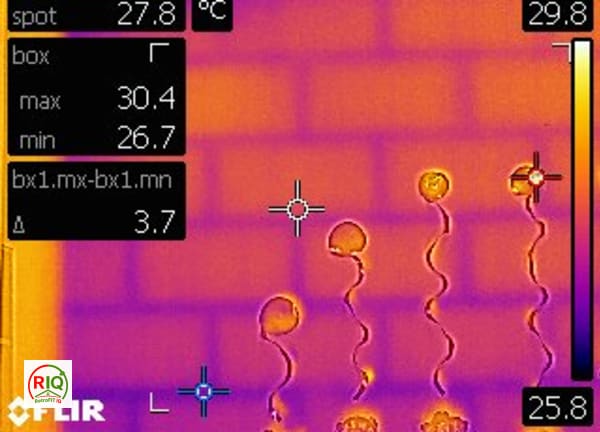
Thermal Bridging Visible Through Masonry Blockwork Wall
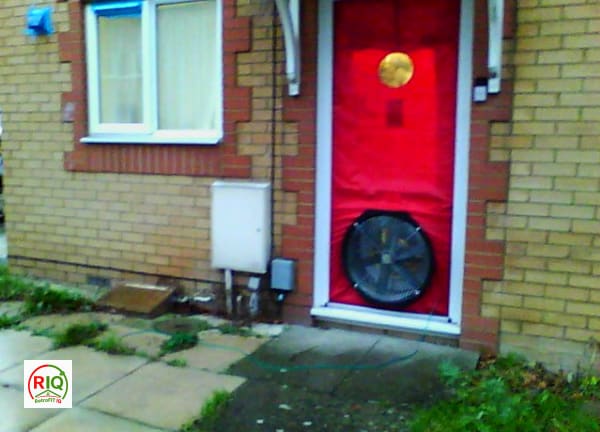
Blower Door Airtightness Test Setup

Thermal Bridge at Wall-Ceiling Junction Near Window

Thermal Bridge at Internal Corner Wall Junction

Airtightness Testing in a Stratford Victorian Terrace
No related investigations yet.
Browse all investigationsFrequently asked questions
What is the difference between thermal imaging and a heat loss survey?+
Thermal imaging maps surface temperatures to show where heat is escaping; a heat loss survey calculates how much heat the building loses and where the largest losses are. One produces images, the other produces numbers used for sizing and prioritisation.
Can a thermal image tell me my home's heat loss in watts?+
No. The camera reads surface temperature, not heat flow. Quantifying loss needs U-values, element areas and an airtightness figure combined in a calculation.
Do I need a heat loss survey before a heat pump?+
Yes. Heat pumps run at low flow temperatures and reward low heat loss, so an accurate, measured heat-loss figure is essential to size the unit and emitters correctly.
Is thermal imaging used within a heat loss survey?+
In a rigorous survey, yes. It validates assumed U-values, exposes thermal bridges and confirms whether insulation is actually present and continuous.
Why are standard heat-loss calculations sometimes wrong?+
Because they rely on assumed U-values and assumed airtightness. In an older building those assumptions can be far from reality; measured inputs correct them.
Can I just get a cheaper EPC instead?+
An EPC is a simplified rating, not a measured heat-loss assessment. It is not accurate enough to size a heat pump or to prioritise a retrofit reliably.
How long does a heat loss survey take?+
It varies with the size and complexity of the home, but allow a half day to a full day on site for measurement and imaging, plus calculation time afterwards.
What conditions does thermal imaging need?+
A temperature difference of roughly 10–15°C between inside and outside, dry surfaces and no direct sun on the area being surveyed, ideally with the house depressurised to amplify air leakage.
Will the survey tell me which improvements to do first?+
Yes — a proper heat loss survey ranks elements by their share of the loss, so you can target the measures that cut demand the most for the money.
Is a heat loss survey the same as a thermal bridging assessment?+
No, though they overlap. A heat loss survey totals the losses; a thermal bridging assessment models specific junctions in detail for heat flow and condensation risk.
Can you survey just one cold room?+
We can image and assess a single room, but heat-loss figures are most useful whole-house, because losses and ventilation interact across the building.
Does furniture or weather affect the thermal images?+
Yes. Furniture against external walls, recent sun, rain and wind all affect surface temperatures, which is why interpretation by a trained surveyor matters.
Do you provide a report I can give to an installer?+
Yes — a documented heat-loss assessment with the room-by-room figures and assumptions, suitable for a heat pump or heating designer to work from.
Can the survey verify insulation that was already installed?+
Yes. Thermal imaging shows whether insulation is continuous and effective, and a recalculation confirms whether the expected reduction in heat loss was achieved.
Who carries out the assessment?+
A Certified Passive House Designer, so the calculation and the imaging are interpreted against how the building should genuinely perform.
Need professional advice?
A comparison like this helps you understand the theory, but every property behaves differently. The only reliable way to establish the real cause in your home — rather than guessing — is professional building performance diagnostics. At RetrofitIQ we verify buildings using the appropriate combination of investigations:
- Thermal imaging
- Blower door testing
- Moisture investigation
- Building physics assessment
- Passive House methodology