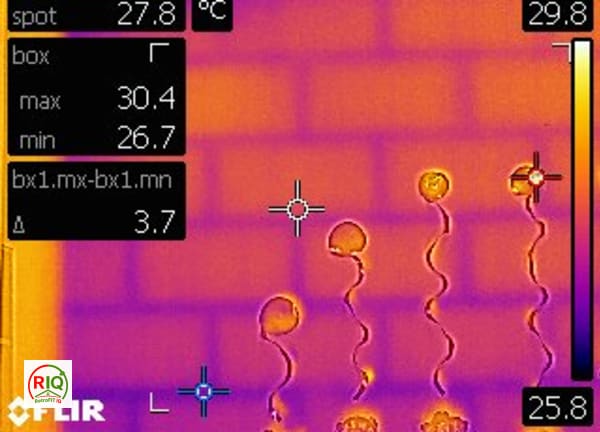

Every object above absolute zero emits infrared (thermal) radiation, and the hotter it is, the more it emits. A thermal imaging camera contains a detector (a microbolometer) sensitive to long-wave infrared; it measures the radiation arriving from each point in the scene and, applying some physics and a few corrections, converts that into a map of surface temperature displayed as a false-colour image. Crucially, it measures surface temperature only — it cannot see inside or through a wall.
Emissivity — the number that makes or breaks a reading
The radiation a surface emits depends not only on its temperature but on its emissivity (ε) — how efficiently that material radiates compared to a perfect 'black body' (ε = 1.0). Most ordinary building surfaces — plaster, brick, render, painted wood, paper — are good emitters, with ε around 0.90–0.95, which is why thermography works well on buildings. But low-emissivity surfaces wreck the measurement:
| Surface | Approx. emissivity (ε) | Thermography reliability |
|---|---|---|
| Plaster, brick, render, paint | 0.90–0.95 | Reliable |
| Wood, paper, most matt finishes | 0.90–0.95 | Reliable |
| Glass | ~0.85–0.90 (but reflective at angles) | Usable with care |
| Bare/shiny metal, foil | 0.05–0.30 | Unreliable — mostly reflects |
| Gloss / polished surfaces | Variable, often low | Unreliable |
Reflected apparent temperature
Because no real surface is a perfect black body, some of the radiation the camera receives is reflected from other objects, not emitted by the target. To measure accurately, the surveyor sets the camera's reflected apparent temperature (the temperature of the surroundings being reflected) as well as the emissivity. On a typical interior survey of high-emissivity surfaces the correction is small, but on cooler or more reflective surfaces it matters — and getting it wrong shifts the measured temperatures.
Spatial vs thermal resolution
Two different 'resolutions' govern what a thermal camera can reveal:
- Spatial resolution (detector pixels, e.g. 160×120 up to 640×480) — how much fine detail the image shows. Too few pixels and a narrow thermal bridge or a small leak averages out with its warmer surroundings and disappears. Higher resolution resolves smaller features and lets you survey larger areas from a usable distance.
- Thermal resolution / sensitivity (NETD, measured in milli-kelvin) — the smallest temperature difference the camera can distinguish. A sensitive camera (low NETD) reveals subtle thermal patterns; a poor one only shows gross differences.
A cheap clip-on phone camera with low spatial and thermal resolution will show only the most obvious patterns and miss the subtle, important ones — which is why building thermography needs a proper radiometric instrument, not a gadget.
Qualitative vs quantitative thermography
There are two levels of survey, and conflating them is a common error:
- Qualitative — reading the pattern. Comparing relative temperatures across a surface to spot anomalies (a cold streak, a warm patch). Most building-defect surveys are primarily qualitative: the pattern tells you where the problem is.
- Quantitative — measuring actual temperatures. Reporting real surface temperatures (e.g. to compare against the dew point, or to calculate an fRsi temperature factor) requires correct emissivity, reflected-temperature compensation, known distance and a properly calibrated radiometric camera.
The infrared spectrum and what the camera detects
Building thermal cameras work in the long-wave infrared band, roughly 8–14 micrometres, because that is where surfaces at ordinary building temperatures emit most strongly and where the atmosphere is reasonably transparent over the short distances of a survey. This matters for interpretation. The camera is not detecting visible light, so darkness is irrelevant — a survey can be done at night, which is often preferable for avoiding solar interference. It is also not detecting the inside of the wall: long-wave infrared does not penetrate plaster, brick or glass, so the camera only ever reads the outermost surface. The common belief that a thermal camera 'sees heat escaping' is a useful shorthand but technically wrong; it sees the temperature of a surface, from which an interpreter infers what is happening behind it.
Distance, field of view and the spot-size ratio
How small a feature a camera can actually measure depends on the distance to the target and the camera's spatial resolution, expressed as the instantaneous field of view or spot-size ratio. Each detector pixel sees a small cone of the scene; at a given distance that cone covers a real area on the surface, and any feature smaller than that area is averaged with its surroundings and under-read. A narrow thermal bridge or a small leak viewed from too far away will appear weaker than it really is, or vanish entirely. This is why building thermographers work close enough — and with enough resolution — that the spot size is comfortably smaller than the defects they need to measure, and why a high-resolution radiometric camera resolves problems a low-resolution clip-on simply cannot. For accurate temperature measurement, the target must over-fill several pixels, not sit at the edge of the camera's reach.