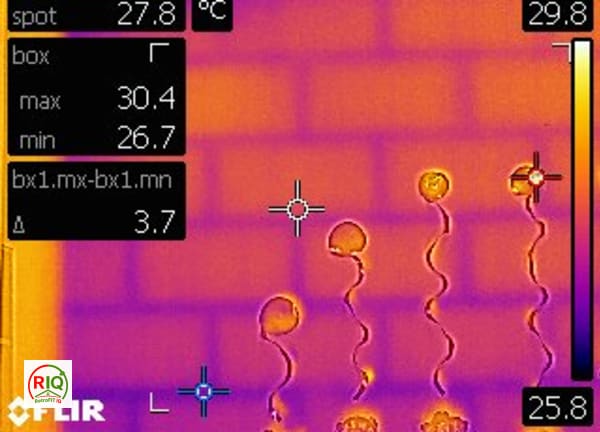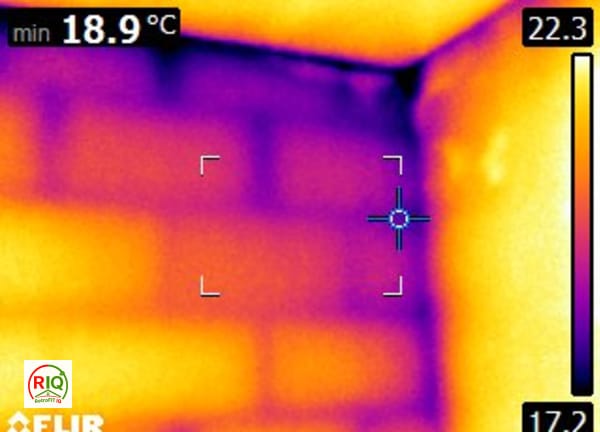

A thermal camera detects where a surface is warmer or cooler than its surroundings. For a building defect — missing insulation, a thermal bridge, air leakage — to show up, heat has to be flowing through the envelope, which only happens when it is warmer inside than out (or vice versa). The driving force for that heat flow is the temperature differential, ΔT, between inside and outside. No ΔT, no heat flow, no thermal pattern, no survey.
How much ΔT is enough?
There is no single magic number, but practical and standardised guidance converges:
| ΔT (inside − outside) | Survey quality |
|---|---|
| < 5 °C | Inadequate — defects won't reliably show |
| 5–10 °C | Marginal — only gross defects visible |
| 10–15 °C | Good — most envelope defects show clearly |
| > 15 °C | Ideal — subtle thermal bridges and leakage visible |
In practice this means UK building thermography is largely a winter activity — heating season, when the inside is warm and the outside is cold. A survey attempted on a mild spring afternoon, with only a couple of degrees of difference, will be a waste of time however good the camera.
Conditioning the building
It is not enough for the air to be warm at the moment of the survey — the structure needs to have been in a steady, heated state long enough for the temperature patterns to establish through the fabric. Best practice is to have the building heated to a stable internal temperature for several hours (often overnight) before the survey, and to maintain that ΔT throughout. Heavyweight masonry buildings, with their thermal mass and lag, need longer conditioning than lightweight timber-frame ones.
Weather, solar loading and timing
External surveys especially are sensitive to recent weather, because the sun, wind and rain all leave thermal fingerprints that can mask or mimic defects:
- Solar loading — sunshine warms surfaces unevenly and stores heat in the fabric, which then re-radiates for hours; a sun-warmed wall can completely hide (or fake) a thermal pattern. External surveys are therefore best done before dawn or after dark, and on overcast days, to avoid solar effects.
- Wind — convective cooling flattens surface temperature differences and disperses the warm air plumes that reveal leakage. Strong wind degrades a survey (and a co-located blower door test).
- Rain and surface wetness — evaporative cooling of a wet surface masks the underlying thermal pattern; surfaces should be dry, with no recent rain.
- Time of day — early morning (after a cold night, before the sun loads the fabric) is often ideal for external work; internal surveys are less time-sensitive but still need the ΔT and no solar gain through glazing onto the surveyed surfaces.
Internal vs external surveys
The two viewpoints reveal different things and are best used together:
- Internal survey — looking at the inside surfaces of the warm envelope, defects appear as cold patches/streaks (heat is escaping, so the inside surface is cooler there). Internal surveys are generally more reliable for locating defects precisely, are unaffected by solar loading, and are essential for measuring surface temperatures against the dew point. They also pair with a blower door for air-leakage detection.
- External survey — looking at the outside surfaces, defects show as warm patches (heat escaping warms the outer surface). Useful for whole-elevation overviews and access, but far more vulnerable to solar loading, reflections and surface wetness, so timing and interpretation are critical.
The standards
Building thermography is guided by standards including BS EN 13187 (thermographic detection of irregularities in building envelopes) and related guidance, which set out the required conditions — adequate temperature difference, stable conditioning, avoidance of solar and weather effects — and the survey methodology. A competent surveyor records the conditions (ΔT, weather, emissivity, time) in the report, so the results can be judged and trusted. A report that omits the conditions is hiding whether the survey was even valid.
Thermal mass and the conditioning lag
The temperature difference has to have been present long enough for the heat flow through the fabric to reach a quasi-steady state, and how long that takes depends on the construction's thermal mass. A lightweight timber-frame wall responds quickly — a few hours of stable heating establishes the patterns. A heavyweight solid-masonry or concrete element has high thermal mass and a long time lag: it can take many hours, sometimes the best part of a day, of steady conditioning before the surface temperatures settle and the defects show truthfully. Survey a heavyweight building too soon after the heating comes on, or after a swing in outdoor temperature, and the fabric is still in transition — the image shows the lag, not the defects. This is why best practice conditions the building overnight and avoids surveying during or just after rapidly changing weather.
Reverse-ΔT and warm-climate surveys
The principle is the temperature difference, not the direction of it. In hot climates (or a UK summer with air-conditioning), the building is cooler inside than out, so heat flows inward and the thermal patterns reverse: insulation defects that show cold internally in winter show warm internally in summer, because heat is leaking in there. This 'reverse-ΔT' surveying is standard practice where cooling dominates, and it is occasionally useful in the UK for air-conditioned spaces. For ordinary UK heat-loss surveys, though, the reliable window remains the heating season, when the natural inside-to-outside difference is largest and most stable, without needing to actively cool the building to manufacture a ΔT.