
Thermal Imaging vs U-value Calculation: Pattern vs Performance Figure
Thermal imaging vs U-value calculation.
 Reviewed by George Sora, Certified Passive House DesignerUpdated June 2026
Quick answer & key takeaways
5 min read- Bottom line: Thermal imaging shows where a building element is underperforming; a U-value calculation tells you how well that element conducts heat as a number.
- When Thermal imaging is enough: You need to locate defects or variation in an element
- When U-value is the better choice: You are designing or modelling and need a number
- When you need both: You want a U-value you can trust against reality
- Biggest misconception: “A thermal camera gives you a U-value.” — It does not. It shows temperature patterns; a U-value is calculated from the build-up or measured with a heat-flux kit.
- Retrofit IQ’s approach: We calculate U-values from the actual build-up and check them against the camera and, where it matters, in-situ heat-flux readings — so the thermal figures reflect the wall as built, not just as drawn.
Quick answer
Thermal imaging shows where a building element is underperforming; a U-value calculation tells you how well that element conducts heat as a number. The camera reveals defects and variation across a surface; the U-value quantifies the designed or actual thermal performance of the build-up. They answer different questions — and the most reliable assessments use imaging (and in-situ measurement) to check whether the real U-value matches the calculated one, because real walls rarely match the textbook.
At a glance
| Attribute | Thermal imaging | U-value calculation |
|---|---|---|
| Output | Image / temperature pattern | Number in W/m²K |
| Question | Where does the element underperform? | How well does the build-up conduct heat? |
| Covers whole surface | Yes | Represents a typical build-up |
| Reveals defects | Yes | No — assumes as-built quality |
| Feeds heat-loss model | As a validator | Directly |
| Affected by workmanship | Shows it | Often assumes ideal |
| Best for | Locating variation and faults | Quantifying element performance |
What is Thermal imaging?
An infrared survey that reveals where a wall or roof is colder or warmer than its surroundings, exposing missing insulation, thermal bridges and air paths as visible patterns — but it does not output a U-value.
What is U-value calculation?
A calculated figure (W/m²K) describing how readily heat passes through a given build-up of materials. It is derived from the construction layers and their thermal properties, and can be refined with measured data such as in-situ heat-flux readings.
What each method measures — and what it doesn’t
Thermal imaging
- Surface temperature variation across an element
- Localised defects: gaps, bridges, slumping
- Whether performance is uniform or patchy
- The actual U-value in W/m²K
- The designed thermal performance of the build-up
U-value
- The calculated heat-transfer rate of a build-up
- The relative performance of different constructions
- The expected effect of adding insulation layers
- Whether the wall was actually built as specified
- Localised defects, gaps or thermal bridges
- Real-world workmanship and moisture effects
The building science
A U-value is a property of a build-up: list the layers, their thicknesses and conductivities, apply the surface resistances, and you get a figure for how many watts cross each square metre per degree of temperature difference. It is the currency of heat-loss calculation and Building Regulations, and it is essential for design — but on its own it assumes the element was built exactly as drawn, with insulation continuous and undamaged.
Real construction rarely lives up to that assumption. Insulation slumps, batts are cut short, cavities are bridged, and thermal bridges route heat around the insulated zone. A calculated U-value cannot see any of this; it describes the intended performance, not necessarily the achieved one. This gap is a major reason buildings underperform their paper specification.
Thermal imaging is the reality check. It shows whether the surface temperature is uniform — as it should be if the build-up performs as calculated — or patchy, betraying gaps, bridges and defects. Where doubt remains, an in-situ heat-flux measurement can establish the actual U-value of the element as built, which often differs markedly from the calculated value in older buildings.
So the calculation and the camera are partners. The U-value gives the number you design and model with; thermal imaging (and, where needed, in-situ measurement) verifies whether the real element matches that number. Using one without the other either produces a confident figure that may be wrong, or a vivid image with no quantified meaning.
Key differences
- A U-value is a calculated number; a thermal image is a measured pattern.
- The U-value assumes ideal construction; the camera reveals real-world defects.
- U-values feed heat-loss models directly; imaging validates them.
- In-situ heat-flux measurement bridges the two by measuring the real U-value.
Common misconceptions
Myth: A thermal camera gives you a U-value.
It does not. It shows temperature patterns; a U-value is calculated from the build-up or measured with a heat-flux kit.
Myth: If the U-value is calculated, the wall performs that well.
Only if it was built and remains exactly as assumed. Defects and ageing routinely worsen real performance.
Myth: Calculated U-values are accurate for old buildings.
Often not — unknown construction and defects mean the as-built U-value can be very different. Measurement is more reliable.
Real-world situations
Designing a retrofit and modelling improvements
U-value calculations to compare build-ups, validated with thermal imaging of the existing element to check assumptions.
A wall feels colder than its calculated U-value suggests
Thermal imaging to find the defect, and in-situ heat-flux measurement to establish the real U-value.
Proving performance for a heat-loss model
Both — calculated U-values for the model, imaging and measurement to confirm they reflect reality.
Checking insulation added to a solid wall
Thermal imaging to confirm continuity, with a recalculated U-value to quantify the improvement.
Which do you actually need?
When Thermal imaging is enough
- You need to locate defects or variation in an element
- You are verifying whether a wall performs uniformly
- You want before/after evidence of an upgrade
When U-value is the better choice
- You are designing or modelling and need a number
- You are comparing construction build-ups
- You need a figure for a heat-loss or compliance calculation
When you need both
- You want a U-value you can trust against reality
- You are assessing an old building of uncertain construction
- You are verifying a fabric upgrade properly
What Retrofit IQ checks on site
We calculate U-values from the actual build-up and check them against the camera and, where it matters, in-situ heat-flux readings — so the thermal figures reflect the wall as built, not just as drawn.
- U-value calculation of each major element from the actual build-up
- Thermal imaging to check whether performance is uniform or defective
- In-situ heat-flux measurement where the real U-value is in doubt
- Identification of thermal bridges that the standard U-value ignores
- Comparison of as-designed versus as-built performance
- Recalculated U-values to quantify the effect of proposed upgrades
What a Certified Passive House Designer recommends
A U-value is only as good as the assumption behind it. In a new, well-built element the calculation is trustworthy; in an old building of uncertain construction it can be wishful thinking. That is why I pair the calculation with thermal imaging and, where it matters, in-situ measurement — to find out what the wall actually does rather than what the spreadsheet hopes it does.
For retrofit and heat pump work this matters financially: a heat-loss model built on optimistic U-values undersizes the problem and oversizes the disappointment. Measure the reality, calculate from it, and the numbers become decisions you can rely on.
— George Sora, Certified Passive House Designer, Founder, RetrofitIQ
Reviewed using current building physics principles and Passive House methodology.
Related services
Related comparisons
Related investigations
Compare another way
Closely related comparisons our clients read next.
U-values vs Thermal Bridging in Heat Loss
U-values describe heat loss through the flat area of walls, roofs and windows; thermal bridges describe extra heat loss at junctions and interruptions.
Read comparisonThermal Imaging vs Heat Loss Survey
Thermal imaging tells you where a home loses heat; a heat loss survey tells you how much it loses and where the biggest losses are in calculated terms.
Read comparisonPHPP vs SAP / RdSAP Energy Modelling
PHPP is a design tool that predicts real energy performance accurately; SAP and RdSAP are compliance and EPC tools, simplified for consistency rather than precision.
Read comparisonBuilding Physics Assessment vs a Standard Survey
A standard survey inspects condition; a building physics assessment predicts performance.
Read comparisonEvidence from Real Projects (21)
Real project and investigation images from our own fieldwork, matched to this page — not stock photography.
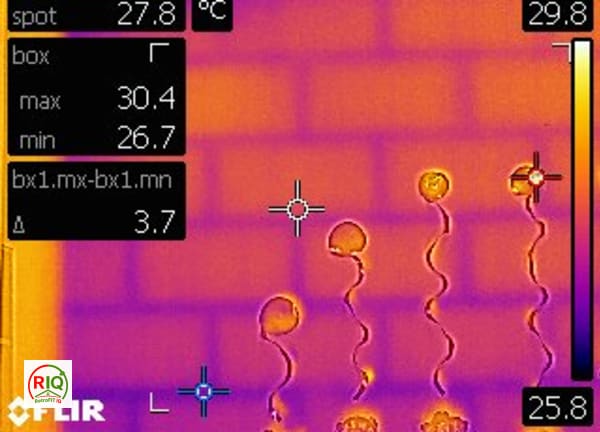
Thermal Bridging Visible Through Masonry Blockwork Wall

Thermal Bridge at Internal Corner Wall Junction

Sample Building Performance Investigation Report — Thermal Imaging

Thermal Bridge at Wall-Ceiling Junction Near Window

Acoustic Floor Upgrades: Mineral Wool Insulation Between Joists
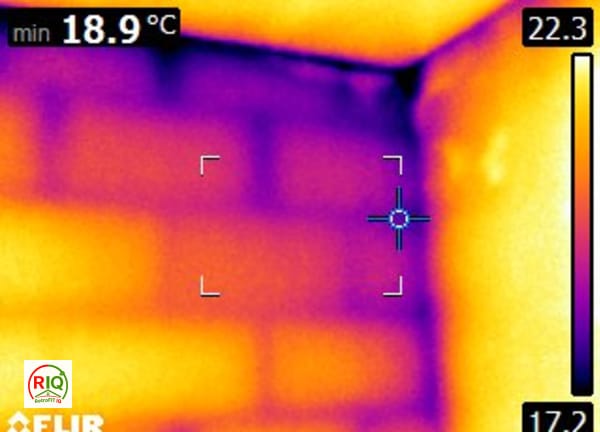
Cold wall surface vs warm ceiling
No related investigations yet.
Browse all investigationsFrequently asked questions
Can thermal imaging measure a U-value?+
No. Thermal imaging shows surface-temperature patterns. A U-value is calculated from the build-up, or measured with an in-situ heat-flux sensor.
What is a U-value?+
It is the rate at which heat passes through a building element, in watts per square metre per degree (W/m²K). Lower is better — less heat lost.
Why might my real U-value differ from the calculated one?+
Because the calculation assumes ideal construction. Slumped or missing insulation, bridging and thermal bridges all worsen the real, as-built performance.
How is an as-built U-value measured?+
With an in-situ heat-flux plate and temperature sensors over a period of time, giving the actual heat transfer of the element as it really performs.
Do I need both for a retrofit?+
Usually yes. U-value calculations let you design and model; thermal imaging and measurement confirm the existing element really performs as assumed.
Are calculated U-values reliable for old houses?+
Less so, because the construction is often uncertain and defects are common. Measurement gives a far more dependable figure.
Does a thermal bridge affect the U-value?+
Thermal bridges are normally accounted for separately, as linear or point losses, because a plane U-value alone does not capture them.
Can imaging show if insulation is missing?+
Yes — missing or slumped insulation shows as a colder area on the image, which is exactly where the real U-value will be worse than calculated.
Will adding insulation improve the U-value predictably?+
The calculation predicts the improvement, but only if the insulation is installed continuously. Imaging afterwards confirms it was.
Is a single U-value enough for a whole wall?+
It represents the typical build-up. Real walls vary, which is why imaging is used to check whether performance is uniform across the element.
How does this feed a heat-loss survey?+
U-values and areas are core inputs to the heat-loss calculation; imaging and measurement make sure those inputs reflect the real building.
Can you compare insulation options for me?+
Yes — we calculate U-values for alternative build-ups so you can see the performance and the cost trade-offs before committing.
Does moisture affect U-values?+
Yes. Wet insulation and damp masonry conduct more heat, so moisture worsens the real U-value — another reason to measure rather than assume.
Is in-situ measurement disruptive?+
No — the sensors are taped to the surface and logged over time; nothing is opened up.
Who carries out the assessment?+
A Certified Passive House Designer, so calculations and measurements are interpreted against genuine building-physics performance.
Need professional advice?
A comparison like this helps you understand the theory, but every property behaves differently. The only reliable way to establish the real cause in your home — rather than guessing — is professional building performance diagnostics. At RetrofitIQ we verify buildings using the appropriate combination of investigations:
- Thermal imaging
- Blower door testing
- Moisture investigation
- Building physics assessment
- Passive House methodology