The symptoms
- Internal wall surfaces that feel noticeably cold, especially on external and north-facing walls
- A chill near the wall even when the room air feels warm
- Mould or damp patches appearing on the coldest wall sections and corners
- Condensation beading on the wall in winter
The building physics: surface temperature and U-value
How cold a wall feels depends on its U-value — the rate at which it conducts heat. An uninsulated solid brick wall (around 2.1 W/m²K) lets heat pour out, so its internal surface sits cold; an insulated wall (0.3 W/m²K or better) keeps the inside surface much warmer. The colder the surface, the more heat you lose to it by radiation, and the closer it gets to the dew point at which moisture condenses.
Most cold walls in UK homes are solid masonry with no cavity to insulate, or cavity walls where the fill has slumped or was never installed. Where insulation is fitted with dot-and-dab plasterboard, gaps behind the board let warm room air circulate against cold brick, bypassing the insulation. And even an insulated wall stays cold at its thermal bridges — lintels, reveals, floor junctions and corners — where the geometry or materials let heat short-circuit through.
The likely causes
- Solid brick or stone walls with no insulation layer
- Failed, slumped or missing cavity-wall insulation
- Air gaps behind dot-and-dab plasterboard bypassing the insulation
- Thermal bridges at reveals, lintels, floor junctions and corners
Why one wall can be far colder than the others
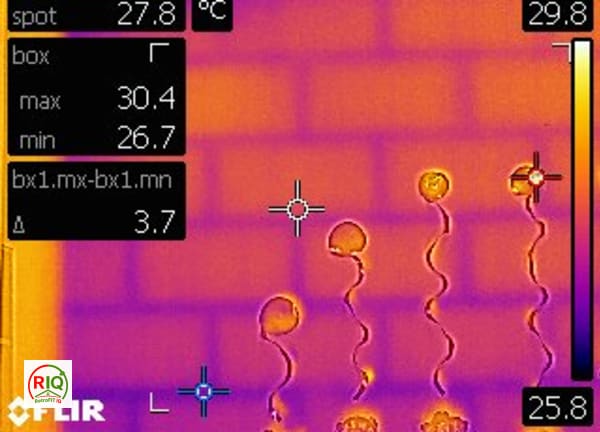
An exposed gable, a north-facing wall that never sees the sun, or a wall against an unheated passage or neighbouring void will always run colder. Wind-driven rain also cools an exposed wall by evaporation. Thermal imaging shows these differences instantly, and explains why mould often concentrates on one particular wall.
Common mistakes homeowners make
- Painting over mould on a cold wall without raising the surface temperature
- Fitting internal wall insulation with no hygrothermal (moisture) check, risking hidden condensation
- Treating the wall for 'rising damp' when the real issue is a cold surface and condensation
- Insulating the main wall but leaving cold reveals and lintels untreated
How RetrofitIQ investigates cold walls
- FLIR thermal imaging to map exactly where the wall is coldest and whether insulation is missing or bypassed
- Surface-temperature and humidity logging to calculate the dew-point margin and condensation risk
- Moisture readings on multiple substrates to rule penetrating or rising damp in or out
- Where internal insulation is proposed, WUFI/Glaser hygrothermal modelling to keep the build-up moisture-safe
- A targeted remediation plan to lift surface temperature without trapping moisture