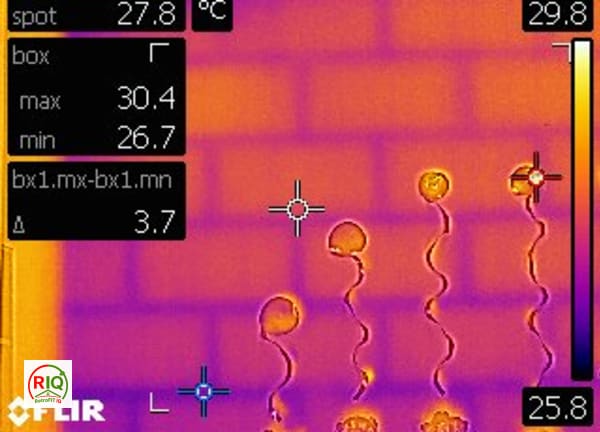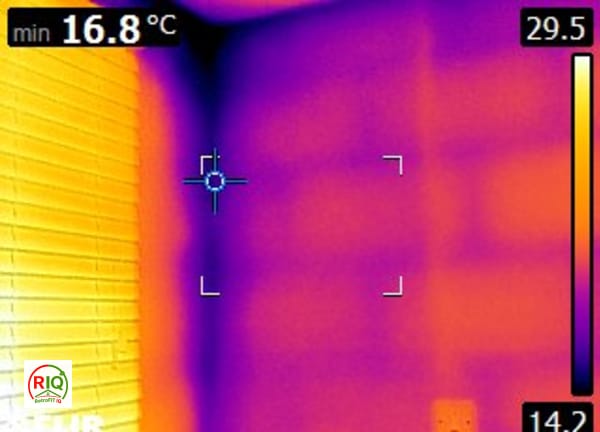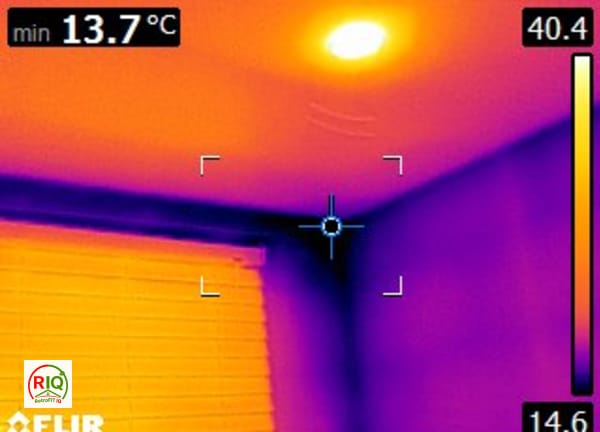

Insulation only works if it is continuous. Wherever it is interrupted — by structure, by geometry, by a poorly-detailed junction — heat takes the path of least resistance and short-circuits the insulation. That short-circuit is a thermal bridge. In a well-insulated building, thermal bridges become proportionally more significant: as you reduce the losses through the main fabric, the losses concentrated at the junctions dominate.
The two consequences: heat loss and cold surfaces
Thermal bridges do two harmful things, and the second is usually the more serious for a homeowner:
- Extra heat loss — concentrated at the junction, disproportionate to its area.
- A cold internal surface — because heat is being drawn away locally, the inside face at that point runs colder than the surrounding wall.
That cold internal surface is the real problem. If it drops below the dewpoint of the room air, water vapour condenses on it. If it stays above the dewpoint but below roughly the temperature at which the surface relative humidity reaches ~80%, it becomes a mould-friendly surface even without visible water. This is why mould appears in the same predictable places — wall-to-ceiling junctions, behind kitchen units on external corners, around window reveals, and at the base of external walls.
The four types of thermal bridge
Repeating thermal bridges
Regularly-spaced bridges within an element — timber studs in a stud wall, joists, wall ties, rafters. These are already accounted for in a correctly-calculated U-value, so they are not 'extra' losses, but they explain why the as-built U-value of a stud wall is worse than the insulation alone implies.
Geometric (geometrical) thermal bridges
Created by the shape of the building itself — most obviously external corners, where there is more cold external surface than warm internal surface to lose heat to. Even a perfectly-insulated building has geometric bridges at its corners, which is why corners run colder and mould most often starts there.
Linear thermal bridges (ψ-value)
Continuous bridges that run along a line — a concrete floor slab edge, a window-to-wall junction, a parapet, a balcony. These are quantified by the linear thermal transmittance ψ (psi), in W/m·K, multiplied by the length of the junction. Linear bridges are where most of the design effort goes.
Point thermal bridges (χ-value)
Localised penetrations — a steel column passing through the envelope, a balcony support, a fixing. Quantified by the point transmittance χ (chi), in W/K. Individually small, but a façade peppered with steel brackets adds up fast.
How thermal bridges are quantified — the ψ-value
The linear thermal transmittance ψ is calculated using two-dimensional steady-state heat-flow modelling (to BS EN ISO 10211) of the junction geometry and materials. It represents the extra heat loss along a junction over and above what the plain U-values of the adjoining elements already account for.
| Junction quality | ψ-value (W/m·K) | Outcome |
|---|---|---|
| Passive House 'thermal-bridge-free' | ≤ 0.01 | Negligible loss, warm surface, no mould risk |
| Good modern practice | 0.04–0.10 | Modest loss, generally safe surface temperature |
| Typical un-modelled junction | 0.15–0.40 | Significant loss, cold surface, condensation risk |
| Continuous concrete slab / steel | 0.5–1.0+ | Severe loss, cold bridge, near-certain mould |
Designing thermal bridges out
The Passive House 'pen rule' is the simplest test: on a section drawing, you should be able to trace the insulation layer continuously around the entire building without lifting your pen, and likewise the airtight layer. Wherever you must lift the pen, you have a thermal bridge (or an air leak) to design out.
- Carry insulation continuously around external corners and over/under junctions — never butt it up and stop.
- Insulate the reveals, head and cill of every window opening, and set the window in the insulation plane (covered in the windows article).
- Use proprietary load-bearing thermal breaks (e.g. for balconies, parapets and steel penetrations) instead of letting structure bridge the insulation.
- Insulate the perimeter of ground-floor slabs and the base of walls, where the geometric and linear bridge is worst.
- Model awkward junctions in 2D heat-flow software rather than guessing — ψ-values are not intuitive.
Thermal bridges in retrofit — where it gets hard
Existing buildings are full of unavoidable thermal bridges: party walls, intermediate floors built into external walls, projecting bays, and points where you simply cannot get insulation. Internal wall insulation (IWI) in particular creates a new risk — the junction between the newly-insulated wall and an un-insulated party wall or floor becomes a cold spot, because the warm side has been moved inboard of it.