

Thermal Imaging Surveys in South London
Professional infrared thermography using FLIR equipment to visualise heat-loss, missing insulation, thermal bridges, air leakage and hidden moisture. Specialist building-performance diagnostics across South London — SE1-SE28 · SW (south) · CR (Croydon) · BR (Bromley) · KT (Kingston).
What we typically diagnose across South London.
Across South London we work on everything from the bay-windowed Victorian terraces of Clapham and Battersea through the Edwardian housing of Dulwich and Forest Hill to the modern apartments of Bermondsey and Bankside. The common thread is solid-wall construction and lightweight conversion flats needing a measured, building-science-led retrofit approach.
- Victorian terrace party walls in Clapham, Brixton, Camberwell and Peckham with no cavity to insulate
- Wandsworth / Battersea conversion flats with cold ground-floor suspended timber decks
- North-facing bedrooms in Brixton, Streatham and Tooting bay-window Victorian terraces
- Bathroom and kitchen mould in Wimbledon and Earlsfield conversion flats
- Suspended floor perimeters in SW4, SW8, SW11, SE5 Victorian terraces
One process — every service is a stage of it.
We never jump to a fix. We investigate and measure, diagnose the real cause, design the solution, carry out the works and verify the result.


Real FLIR thermal images from completed surveys — see the full set in the gallery.
Thermal Imaging Surveys — in plain English.
A thermal imaging survey uses a calibrated FLIR infrared camera to measure the surface temperature of every wall, ceiling, floor, window and reveal in your home. Cold patches, missing insulation, thermal bridges and hidden air leakage become visible — exactly where they are, at the temperature they are.
Why thermal imaging surveys is important.
Thermal imaging is the fastest, least invasive way to see how a building is actually behaving — but its real value is interpretation, not pretty pictures. A calibrated survey, read against measured humidity and dew point, separates missing insulation from air leakage from hidden moisture from thermal bridging: four problems that look identical to the naked eye but need completely different solutions. Used as the diagnostic foundation, it ensures every pound of subsequent insulation, airtightness or damp work is spent on the real fault rather than a guess.
The right time to bring us in.
- As the first step in any building-performance investigation, before invasive opening up
- Before retrofit, to map where insulation, air-sealing and bridge correction are actually needed
- When damp or mould needs separating into condensation, leakage or moisture mechanisms
- After works, to verify insulation continuity and air-sealing were achieved
- For insurance, party-wall or new-build defect evidence requiring measured proof
The symptoms that bring people to this service.
- 01Cold rooms and uneven heating performance
- 02Persistent damp patches and mould in cold corners
- 03Drafts, cold reveals and uncomfortable rooms in winter
- 04Sky-high heating bills with no obvious cause
- 05Suspected missing or compressed insulation in walls, lofts or floors
- 06Hidden thermal bridges driving condensation risk
What you tend to notice first.
- Cold rooms and uneven heating you cannot explain
- Persistent damp patches or mould in cold corners
- Draughts, cold reveals and uncomfortable rooms in winter
- High heating bills with no obvious cause
- Suspected missing or slumped insulation in walls, lofts or floors
- Hidden moisture you can feel or smell but cannot locate
Our diagnostic approach
- 01On-site walkthrough with the homeowner to map symptoms room by room
- 02Internal FLIR thermal imaging under a stabilised indoor/outdoor temperature differential (≥10 °C)
- 03External thermal scans (where line-of-sight allows) to corroborate insulation gaps
- 04Surface temperature probe checks against measured dewpoint
- 05All findings cross-referenced with construction type, age and previous works
What we bring on site
- FLIR thermal imaging camera (calibrated, radiometric, with emissivity correction)
- Surface temperature probe & infrared spot thermometer
- Humidity / dewpoint logger for condensation-risk assessment
- High-resolution visual camera for paired thermal + visual reporting
- Blower door fan (depressurisation enhances air-leakage visibility on the thermal image)
The science behind the diagnosis.
Heat moves from warm to cold by conduction, convection and radiation. A thermal camera measures the radiation emitted by every surface and converts it to a temperature reading. Insulation gaps, wet plaster, air leakage and thermal bridges all show up as colder (or warmer) patches than the surrounding surface — that's how we read the building.
Measured benefits — not vague promises.
- Identify the root cause of cold spots, damp and high energy bills
- Pinpoint missing or compressed insulation without invasive work
- Quantify thermal bridge risk and condensation hotspots
- Provide measured evidence for insurance claims, party wall disputes or new-build defects
- Inform a focused, building-physics-led retrofit specification
What we design and deliver next.
Every recommendation follows our methodology — Investigate → Design → Verify — so the diagnosis on this page leads directly into an engineered, buildable and independently verified solution.
- A measured, prioritised plan distinguishing insulation, air-leakage, moisture and bridging faults
- Targeted insulation or reveal upgrades aimed precisely at the cold surfaces found
- Air-sealing of the leakage paths revealed under blower-door depressurisation
- Thermal-bridge correction where surfaces sit near or below dew point
- A baseline survey to plan retrofit and to verify the improvement afterwards
- Evidence-grade imagery for insurance, disputes or new-build defect claims
What goes wrong on site — and why it matters.
Our diagnoses are grounded in real site experience. These are the workmanship and detailing failures we repeatedly find on this kind of work — the difference between a building that should perform and one that actually does.
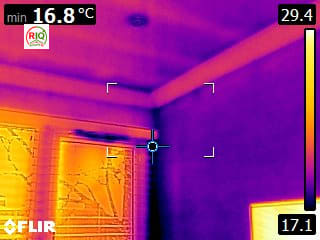
Blown insulation that has settled leaves the top of the wall uninsulated — a clear cold band across the upper wall on the thermal image.
Rigid boards cut loosely, with gaps at edges and around services, show as a cold lattice behind the plaster.
Cold air drawn in at the skirting and floor-to-wall junction reads as cold fingers creeping up the wall under blower-door depressurisation.
Uninsulated window surrounds appear far colder than the surrounding wall — the surfaces where condensation appears first.
Damp areas evaporate and cool, showing as darker zones that, cross-checked with a moisture meter, reveal water you cannot see.
What we look for
- Missing or compressed insulation in walls, lofts and floors
- Thermal bridges at junctions, lintels and reveals
- Cold walls vulnerable to condensation and mould
- Air-leakage signatures around windows, doors and service penetrations
- Underfloor heating circuits, leaks and hidden moisture
Survey conditions
- Carried out with sufficient temperature differential between inside and outside
- Combined with surface temperature, humidity and dewpoint analysis
- Calibrated, measured imagery — not 'pretty pictures'
What we commonly discover during thermal imaging surveys investigations
- 01Cold spots behind picture frames, wardrobes and sofas — early condensation risk
- 02Thermal bridges along door-head lintels and wall/ceiling reveals
- 03Missing or compressed insulation in lofts, eaves and dormers
- 04Air leakage paths visible as cold streams from skirtings and service penetrations
- 05Cold corners in bathrooms and external-wall reveals (condensation hotspots)
- 06Evaporative cooling signatures indicating hidden moisture in wall fabric
Findings reflect patterns observed across completed RetrofitIQ projects — every survey is interpreted in the building’s specific context.
See this service applied on real investigations
Thermal Imaging Surveys — common questions
What is a thermal imaging survey?+
A thermal imaging survey uses a calibrated FLIR infrared camera to measure the surface temperature of every wall, ceiling, floor, window reveal and roof line in a building. Heat radiates from every surface; cold spots reveal missing insulation, air leakage, thermal bridges, moisture issues and condensation hot-spots — diagnostic information you cannot get any other way without invasive opening up.What can thermal imaging detect that the eye cannot?+
Missing or compressed insulation in walls and lofts; thermal bridges at lintels, reveals, slab edges and intermediate floors; air leakage paths under blower-door depressurisation; surfaces below dewpoint where condensation will form; hidden moisture in walls (evaporation cools the surface); overheating electrical components and incorrectly routed underfloor heating loops. Every finding is a measured surface temperature, not an opinion.Can thermal imaging find missing insulation in cavity or solid walls?+
Yes. Missing or slumped cavity insulation shows as continuous cold patches on the interior surface compared with insulated areas. On solid walls, areas of degraded internal lining or compressed lofts show as much colder surfaces than expected. The pattern is diagnostic — a randomly scattered cold patch usually indicates a moisture issue, whereas a uniformly cold zone indicates a missing-insulation zone.Can thermal imaging identify cold bridges (thermal bridges)?+
Yes — this is one of its highest-value uses. Cold bridges around concrete lintels, structural steel, intermediate floor zones, balcony slabs and uninsulated reveals show as distinct linear or geometric cold bands on the thermal image. We pair these images with measured surface temperatures and dewpoint analysis to assess condensation risk and specify a thermal-bridge correction (typically additional internal or external insulation at the affected detail).Can thermal imaging detect damp?+
Indirectly, yes. Water in a wall or ceiling evaporates from the surface, cooling it; that cooling is visible on the thermal image as a darker, colder zone. Thermal imaging by itself cannot distinguish surface condensation from penetrating damp or rising damp — but combined with moisture-meter readings, surface temperatures and dewpoint analysis, it becomes a powerful damp-diagnostic tool that separates the three mechanisms.Why is the indoor-outdoor temperature difference important?+
Thermal imaging works by measuring temperature gradients across surfaces. A 10 °C minimum indoor-outdoor differential (ideally 15 °C+) is needed for reliable diagnostic readings. In a 5 °C differential the thermal patterns are washed out and false readings become possible. This is why we typically survey October to April in the UK — and why a meaningful thermal report always notes the differential at the time of the survey.What is the best time of year for thermal imaging in London?+
October to April. The colder the external air relative to the heated interior, the sharper every defect appears. We can run useful surveys in mild weather provided the heating has been on for 24+ hours before the visit and the differential is ≥10 °C; we avoid bright sunny days on external walls because solar gain creates false-hot readings that can mask real defects.Can thermal imaging be combined with blower door testing?+
Yes — and this is the single most powerful diagnostic combination in our toolkit. With the blower door fan depressurising the building to 50 Pa, cold outside air is drawn in through every air leakage path; thermal imaging then shows those incoming cold-air plumes as distinct fingers of blue/purple pushing into the warm interior. This is how we locate every meaningful air leakage path with measured evidence.Can thermal imaging explain why I get condensation on the walls?+
Yes. Condensation forms when a surface drops below the dewpoint of the indoor air. The thermal camera measures the actual surface temperature; we then measure the indoor relative humidity and calculate the dewpoint. If the surface is below dewpoint (or within 2 °C of it), condensation is inevitable on that surface under those internal conditions. This produces a quantified, condensation-risk explanation — not a guess.Can thermal imaging detect heat loss around windows?+
Yes. Single-glazed and old double-glazed units show as cold flat areas. More usefully, the thermal image shows the *reveal* and *lintel* around the window — areas that are often colder than the glazing itself because of unfilled cavities or uninsulated jambs. Heat loss around the window is typically far worse than through the window. We use this evidence to specify reveal-insulation and air-sealing details before window replacement is even considered.Can thermal imaging see through walls?+
No — and any provider claiming otherwise is misleading you. The camera measures the surface temperature of whatever it can see; conditions inside the wall can be *inferred* from the surface pattern (missing insulation creates a visible cold patch) but the camera does not 'see through'. This is one of the most common misconceptions and one we correct on every survey.What are the limitations of thermal imaging?+
Shiny / reflective surfaces (glass, polished metal, foil-faced membranes) reflect the surrounding temperature instead of showing their own — these need a specific emissivity correction. Direct sunlight on external surfaces produces false-hot solar-gain readings. Wet external surfaces produce false-cold evaporative readings. And, importantly, thermal imaging is a snapshot — conditions inside the wall over time can only be assessed with longer-term humidity and dewpoint logging.Do I receive annotated thermal images and a written report?+
Yes — every survey includes a written report containing paired visual + calibrated FLIR images, surface temperature readings at each finding, the diagnostic mechanism (heat loss / thermal bridge / air leakage / moisture) and a prioritised, costed remedial plan. The report is yours to share with architects, surveyors, insurers or other contractors.Is thermal imaging useful for landlords?+
Extremely. For Awaab's Law / Homes (Fitness for Human Habitation) Act compliance, thermal imaging combined with moisture and dewpoint data provides measured evidence of whether mould is condensation-driven (a landlord's responsibility to remediate the building) or behaviour-driven (an occupancy / ventilation issue) — and what the right intervention is in either case. We work regularly with London landlords and HMO operators.Is thermal imaging useful before retrofit or insulation works?+
Yes — it is the single most important pre-retrofit step. Without a baseline thermal survey you do not know which walls actually need insulation, which junctions are thermal bridges, where the air leakage is, or where to prioritise budget. A measured baseline also lets us produce a post-works comparison thermal report to verify the improvement.Can thermal imaging be used to verify works after completion?+
Yes — and we do this on every project where the client wants verified outcomes. A post-works thermal survey under matched internal/external conditions provides documented evidence of the improvement: surface temperatures lifted by X °C, thermal bridges eliminated, air leakage paths sealed. This is the 'Verify' stage of our Investigate → Diagnose → Design → Remediate → Verify process.Are your thermal imaging surveys carried out by a Passive House Designer?+
Yes. Every RetrofitIQ thermal survey is carried out by George Sora, a Certified Passive House Designer (PHI accredited). The diagnostic interpretation is grounded in Passive House building-physics principles — heat loss, thermal bridging, airtightness, ventilation and moisture transport — not just 'pretty pictures'.
Weighing this up against the alternatives?
Independent, building-physics-led comparisons from our knowledge base — written to help you understand the difference before you decide which survey or approach you actually need.
- Thermal Imaging vs Blower Door TestingThermal Imaging
- Blower Door vs Smoke Testing for Air LeakageBlower Door & Airtightness
- Thermal Imaging vs Moisture Meter for Finding DampThermal Imaging
- Condensation vs Penetrating Damp vs Rising DampDamp & Moisture
Common problems we diagnose
The symptoms that most often lead homeowners to a thermal imaging surveys. Each guide explains the building physics behind the problem — and how we diagnose the real cause before any work begins.
- Why is my house always cold?
- Why is one room colder than the others?
- Why are my walls cold?
- Why is my bedroom always cold?
- Why do I feel cold even when the room is warm?
- Why is the room above my garage always cold?
Part of one connected building-performance journey.
Every Retrofit IQ service is one stage of a single methodology — Investigate → Design → Verify. Explore how this service connects to the wider network of diagnostics, engineering and quality assurance.
The engineering and quality-assurance services that most often follow this one.
One company. One process. One point of responsibility.
We don’t simply identify problems. We investigate, diagnose, design solutions, carry out the work and verify the results. Book a Home Health Diagnostic Survey and we’ll tell you exactly which remedial works (if any) are actually needed.
Commission a Retrofit IQ Building Physics Assessment
After this investigation, you can commission a Building Physics Assessment for an advanced engineering analysis. A standard survey identifies the problems; this uses advanced building physics modelling to predict how your building is expected to perform after the proposed upgrade — before any work begins.
Most contractors recommend insulation. Retrofit IQ predicts how your building is expected to perform first.
Investigate → Diagnose → Design → Remediate → Verify
RetrofitIQ is not only a diagnostics company. We take projects from first investigation through to verified improvement — and you decide how far we go. Engage us for an investigation on its own, an investigation plus targeted remedial works, or a complete building-performance and retrofit project.
A measured diagnosis — thermal imaging, blower door testing, moisture and building-physics analysis — with a clear, costed report you can act on however you choose.
We investigate, then carry out targeted remedial works — airtightness, insulation, ventilation or thermal-bridge corrections — and verify the result.
A full fabric-first, Passive House-informed retrofit from diagnosis through design, installation and verification — one accountable team, one point of responsibility.
- Airtightness improvements & draught-proofing
- Internal wall insulation (IWI)
- External wall insulation (EWI)
- Loft & roof insulation
- Suspended floor & underfloor insulation
- Thermal-bridge detailing & correction
- Extract ventilation & MVHR installation
- Soundproofing & acoustic upgrades
- General building-fabric improvements
Evidence from Real Projects (14)
Real project and investigation images from our own fieldwork, matched to this page — not stock photography.

Sample Building Performance Investigation Report — Thermal Imaging
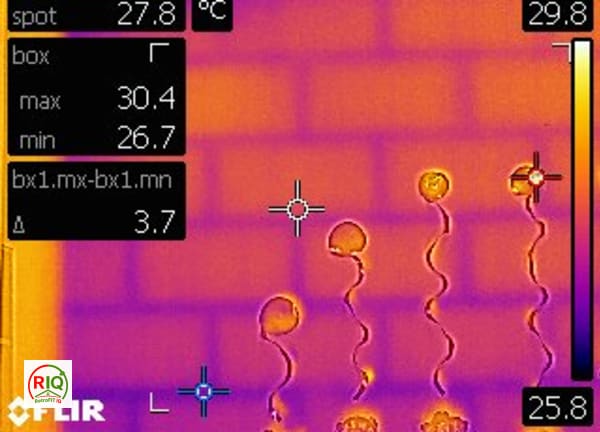
Thermal Bridging Visible Through Masonry Blockwork Wall

Thermal Bridge at Internal Corner Wall Junction

Thermal Bridge at Wall-Ceiling Junction Near Window
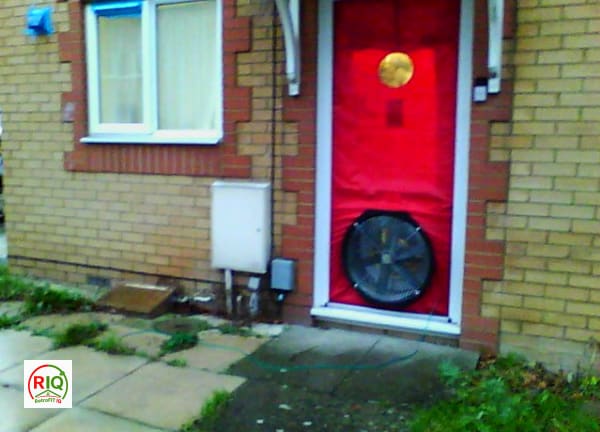
Blower Door Airtightness Test Setup

Loft / eaves zone
No related investigations yet.
Browse all investigationsThermal Imaging Surveys across London & the surrounding areas.
Explore building performance diagnostics, damp and condensation investigations, airtightness testing and retrofit advice in your area. We cover London, Greater London, East London, Essex, Kent, Surrey, Hertfordshire and the surrounding counties.