
Why is there damp or cold where my extension joins the house?
Damp, cold or mould at the line where an extension meets the original house is almost always a junction problem: the insulation and airtightness of the new build do not connect continuously with the old, leaving a thermal bridge and often an air-leakage path right at the join. That cold, leaky line then runs colder than the surrounding surfaces, so it attracts condensation and mould and feels cold. It is a detailing issue at the interface between old and new, not a coincidence, and it is fixed by making the junction continuous.
 Reviewed by George Sora, Certified Passive House DesignerUpdated July 2026
Quick answer & key takeaways
8 min read- Damp or cold at the join is usually a thermal bridge and air-leakage path at the junction.
- The new extension's insulation and airtightness don't connect continuously with the old house.
- The cold, leaky line runs colder than its surroundings, attracting condensation and mould.
- The fix is to make the insulation and air barrier continuous across the junction.
- Biggest misconception: it's a coincidental damp patch. It's a predictable junction detailing fault.
- Retrofit IQ's approach: find the bridge and leakage at the interface, then make it continuous.
What this usually means
When an extension is built onto a house, two separately constructed envelopes have to be joined, and the join is where things commonly go wrong. The extension's wall, roof and floor insulation must connect continuously with the original house's, and the air barrier of the new must seal continuously to the old — but in practice the detailing at this interface is awkward and often imperfect, leaving a gap in the insulation (a thermal bridge) and a path for air leakage exactly along the line where the two structures meet. That line then behaves differently from the surfaces either side of it.
A thermal bridge at the junction conducts heat out and runs colder on the inside than the surrounding wall or ceiling, so when warm, moist indoor air meets that colder line it condenses, and over time mould grows along it. If there is also an air-leakage path at the join — very common where new meets old — cold draughts add to the chill and carry moisture into the junction. So the symptoms cluster along the join: a cold strip, condensation, mould, sometimes staining, and occasionally cracking where the two structures move differently. It looks like a mysterious damp patch but is a predictable consequence of a discontinuous junction.
Because the cause is discontinuity at the interface, the fix is to restore continuity. That means identifying exactly where the insulation is bridged and where air leaks at the junction, then making the insulation continuous across the join and sealing the air barrier between the new and old structures — typically by carrying insulation across the interface and sealing the gaps internally. Treating only the symptom (wiping the mould, repainting) fails because the cold, leaky line remains. Diagnosing the junction with thermal imaging and air-leakage testing locates the bridge and the leak precisely, so the detailing can be corrected and the join brought up to the temperature of the surrounding surfaces.
Common causes
Thermal bridge at the junction
Insulation that does not connect continuously across the join leaves a cold line that attracts condensation.
Air leakage at the interface
Gaps where new meets old let cold draughts and moisture into the junction.
Discontinuous air barrier
The extension's airtightness not sealing to the original house's leaves a leakage path.
Differential movement
New and old structures moving differently can open cracks along the join, admitting moisture.
Poor interface detailing
Awkward detailing where two envelopes meet often leaves the junction the weakest point.
Signs and symptoms
Cold strip along the join
A cold line where the extension meets the house indicates a thermal bridge at the junction.
Condensation or mould on the join
Moisture and mould following the join line confirm a cold, leaky junction.
Draught at the interface
Cold air felt along the join reveals an air-leakage path between new and old.
Staining or cracking at the line
Stains or cracks along the junction can indicate moisture and differential movement.
Mould returning after cleaning
Mould recurring on the join despite cleaning shows the cold, leaky line is untreated.
What most people check first
- Whether the damp, cold or mould follows the line of the join.
- Whether the insulation is continuous across the junction or bridged.
- Whether air leaks along the interface between new and old.
- Whether there is cracking from differential movement at the join.
What most people miss
- That damp at the join is a predictable junction detailing fault, not a coincidence.
- That a thermal bridge there runs colder and attracts condensation and mould.
- That an air-leakage path at the interface adds to the problem.
- That the fix is making insulation and airtightness continuous across the join.
The building physics
A junction between an extension and the existing house is a classic site for a thermal bridge, because continuity of the insulation layer across the interface is geometrically and practically difficult to achieve. Where the insulation is interrupted at the join, heat takes the more conductive path through the bridge, lowering the internal surface temperature along that line. Condensation forms wherever a surface falls below the dew point of the adjacent air, so the colder junction line reaches the dew point before the surrounding surfaces and accumulates moisture, with mould following once surfaces are repeatedly damp.
Air leakage frequently coincides at the same location. Joining the air barrier of a new structure to that of an existing one is one of the hardest details to execute, so the interface commonly leaks; the resulting draughts both chill the junction further and transport humid air into the cold zone, accelerating condensation. The combination of a thermal bridge and an air-leakage path along the join is why the symptoms concentrate so tightly on the line where the two structures meet, rather than spreading evenly across a wall.
Correcting it requires restoring both continuities. Thermally, the insulation must be carried across the junction so there is no interrupted path — which may mean overlapping or returning insulation at the interface to keep the internal surface above the dew point. For airtightness, the air barriers of the new and old construction must be sealed together along the join to close the leakage path. Diagnosis with thermal imaging under a temperature difference locates the cold bridge, and smoke or a blower door test locates the leakage, so the specific detailing failure can be targeted. Treating the surface alone leaves the underlying cold, leaky line, which is why symptom-only repairs recur; making the junction continuous is what permanently raises the join to the temperature of its surroundings and stops the condensation and mould.
How to fix damp where an extension joins the house
Restore continuity at the junction: locate the thermal bridge and air-leakage path, then make the insulation and air barrier continuous across the interface between new and old.
- 01
Confirm it follows the join
Establish that the damp, cold or mould runs along the line where the extension meets the house.
- 02
Locate the bridge and leakage
Use thermal imaging and air-leakage testing to find the cold bridge and the leak at the junction.
- 03
Make the insulation continuous
Carry insulation across the junction so there is no interrupted path leaving a cold line.
- 04
Seal the air barrier
Seal the extension's airtightness to the original house's along the join to close the leakage path.
- 05
Address any movement cracks
Repair and detail cracks from differential movement so they do not re-open and admit moisture.
- 06
Verify the join warms up
Confirm the junction line is no longer cold or damp and the mould does not return.
How to prevent it coming back
- Detail the junction for continuous insulation and airtightness when extending.
- Carry insulation across the interface between new and old.
- Seal the new air barrier to the existing one along the join.
- Allow for differential movement so cracks do not open at the join.
How Retrofit IQ investigates this
We locate the thermal bridge and air-leakage path at the extension-to-house junction, then specify continuous insulation and airtightness.
Do not spend money fixing symptoms before you understand the cause — investigate first, then build with confidence.
Do I need a professional investigation?
Damp, cold or mould along the line where an extension meets the house is worth investigating as a junction detailing fault rather than a random damp patch. Locating the thermal bridge and air-leakage path with thermal imaging and air testing ensures the insulation and airtightness are made continuous, so the join stops attracting condensation and mould.
Where to go next
Relevant services
Related comparisons
From the Academy
Related problems you may also have
Evidence from Real Projects (27)
Real project and investigation images from our own fieldwork, matched to this page — not stock photography.
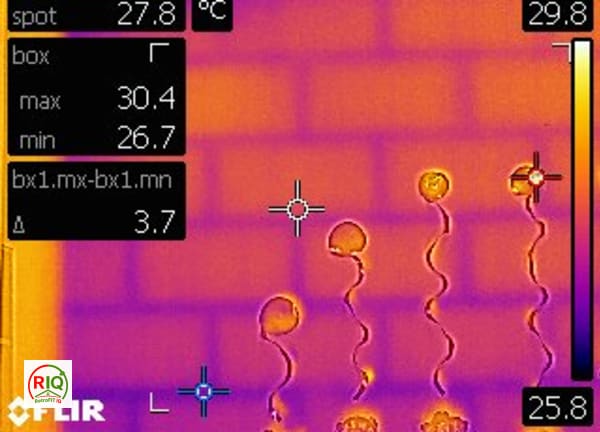
Thermal Bridging Visible Through Masonry Blockwork Wall

Thermal Bridge at Internal Corner Wall Junction

Sample Building Performance Investigation Report — Thermal Imaging

Thermal Bridge at Wall-Ceiling Junction Near Window
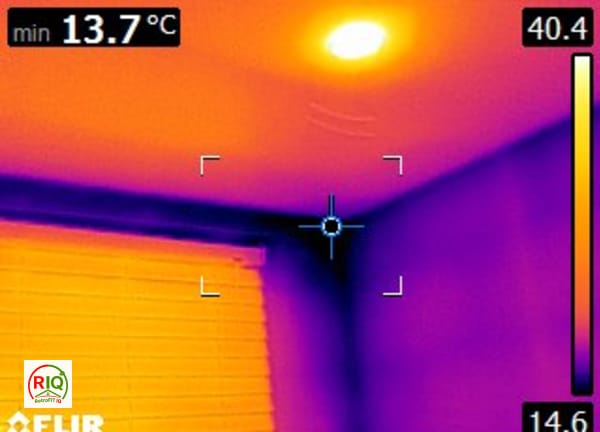
Wall / ceiling corner showing cold spot at the junction line
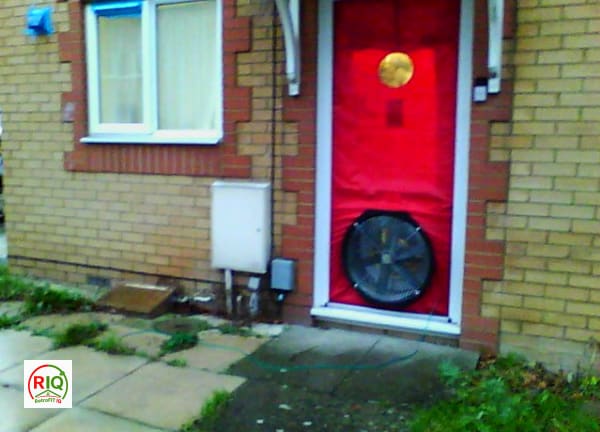
Blower Door Airtightness Test Setup
No related investigations yet.
Browse all investigationsFrequently asked questions
Why is there damp where my extension joins the house?+
Almost always because the insulation and airtightness of the new extension don't connect continuously with the original house, leaving a thermal bridge and an air-leakage path along the join. That cold, leaky line runs colder than its surroundings, so it attracts condensation and mould.
Is it a coincidence that it's right on the join?+
No — it's a predictable junction detailing fault. Joining two separately built envelopes is awkward, so the insulation is often interrupted and the air barriers don't seal together at the interface, which is exactly why the symptoms cluster along that line.
Why does mould keep coming back on the join?+
Because the cold, leaky line itself hasn't been fixed. Wiping the mould or repainting treats the symptom while the thermal bridge and air leakage remain, so the junction stays cold and damp and the mould returns.
What is a thermal bridge at the junction?+
It's a place where the insulation is interrupted across the join, so heat takes a more conductive path and the inside surface along that line runs colder than the surrounding wall — cold enough for moist air to condense and mould to grow.
How is it fixed properly?+
By restoring continuity: carrying the insulation across the junction so there's no cold line, and sealing the extension's air barrier to the original house's along the join. This raises the junction to the temperature of its surroundings and stops the condensation.
Could it be a leak instead?+
It can be, so diagnosis matters — but damp that follows the junction line and worsens with cold weather usually indicates a thermal bridge and air leakage rather than a rainwater leak. Thermal imaging and moisture readings confirm which it is.
How do you diagnose a junction problem?+
We confirm the damp follows the join, locate the thermal bridge with thermal imaging and the air leakage with a blower door test and smoke, and specify continuous insulation and airtightness across the junction so the join warms up.
Stop guessing — find the real cause
Do not spend money fixing symptoms before you understand the cause. Every home behaves differently, and the only reliable way to know what is happening in yours is professional building performance diagnostics. At RetrofitIQ we verify buildings using the right combination of investigations:
- Thermal imaging
- Blower door testing
- Moisture & dew point readings
- Ventilation review
- Building physics assessment
- Passive House methodology