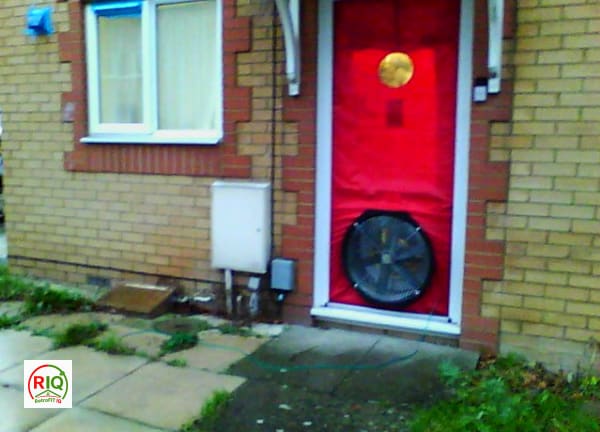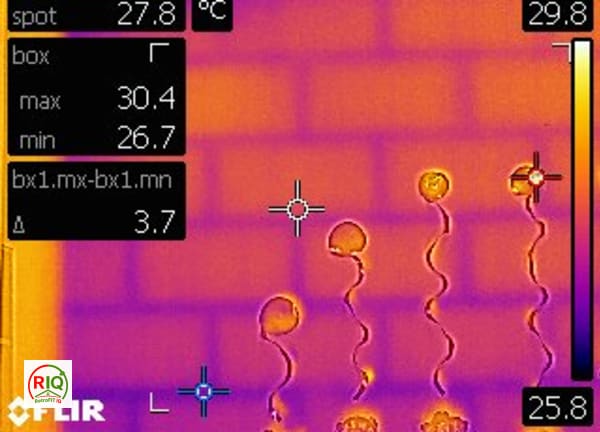

Under a blower door test in depressurisation, you can literally feel cold air streaming in at the leaks. After locating thousands of them, clear patterns emerge: leakage concentrates at junctions, penetrations and changes of material — anywhere the air barrier is interrupted or was never continuous in the first place. Here is where to look, element by element.
| Building zone | Typical leakage paths | Significance |
|---|---|---|
| Service penetrations | Soil/waste pipes, incoming services, ducts, downlights | Often the largest single contributors |
| Loft / ceiling plane | Loft hatch, downlights, wall-head junction, risers | High — stack-effect escape route |
| Ground floor | Suspended timber voids, skirting gaps, wall-floor junction | High in older homes |
| Windows & doors | Frame-to-structure gap, worn seals, letterboxes | Moderate; concentrated at openings |
| Electrical | Sockets/switches on external walls, dot-and-dab voids | Small individually, large collectively |
| Chimneys / flues | Open or disused chimneys | Very high — direct hole to sky |
| Hidden bypasses | Intermediate floor voids, party-wall cavity, behind-bath panels | Significant and easily missed |
Service penetrations — the worst offenders
Every pipe, cable, duct and waste that passes through the envelope is a potential leak, and they're often the largest single contributors:
- Soil and waste pipes passing through floors and external walls.
- Incoming services — water, gas, electricity, broadband — at the point of entry.
- Extract ducts, flue penetrations and boiler/heat-pump pipework.
- Kitchen and bathroom plumbing penetrating floor decks into joist voids.
- Recessed downlights puncturing the ceiling air barrier into a cold loft — dozens of small holes that add up dramatically.
The loft and ceiling plane
- The loft hatch — frequently un-gasketed and a major warm-air escape route via the stack effect.
- Downlights and ceiling-mounted fittings penetrating into a cold loft.
- The wall head / ceiling-to-wall junction, where the ceiling air barrier meets the wall.
- Service risers, soil-vent pipes and extract ducts passing up through the ceiling into the roof void.
Floor-to-wall junctions and suspended timber floors
Ground floors are a classic leakage zone, especially older suspended timber floors:
- Suspended timber ground floors with an underfloor void open to outside air via airbricks — air leaks up between floorboards and around the perimeter.
- The skirting-to-floor and skirting-to-wall junction, where shrinkage gaps run the length of every wall.
- The wall-to-floor junction at the base of external walls, where the wall air barrier meets the floor.
- Gaps around radiator pipes, where they drop through the floor.
Windows, doors and openings
- The gap between the window/door frame and the structural opening — often only foam-filled, not sealed airtight.
- Worn or missing weatherseals on opening lights and doors.
- Letterboxes, cat flaps, keyholes and trickle vents (the latter are intentional, but should be closable).
- Bay windows, with their complex junctions and multiple frame-to-structure interfaces.
Electrical and wall penetrations
- Socket and switch boxes set into external walls — air leaks through and around the back box, especially on dot-and-dab plasterboard.
- Dot-and-dab (drylined) plasterboard itself, where air can circulate in the void behind the board and escape at any unsealed edge — the so-called 'perimeter sealing' problem.
- Consumer units, meter boxes and external lighting fittings.
Chimneys, flues and the stack effect
Open or disused chimneys are direct holes to the sky and a powerful driver of the stack effect — warm air rises and escapes up the flue, drawing cold air in elsewhere. Capping (with controlled ventilation to keep the flue dry) is often one of the highest-impact single measures in an old house.
Hidden bypasses — intermediate floors and party walls
The trickiest leaks are the ones you can't see, where air moves through concealed voids:
- Intermediate (first) floor voids open at the perimeter into the external wall cavity or build-up — air enters the floor zone and escapes through the external wall.
- Party-wall bypass — the cavity within a party wall can act as a chimney, with air entering at the bottom and leaking out at the eaves (a significant, often-ignored heat-loss path in terraces and semis).
- Cavity walls open at the top into the roof void.
- Behind-the-bath and behind-kitchen-unit panels, where boxed-in areas hide unsealed penetrations.
Why leakage clusters at junctions — the physics
It is no accident that leaks concentrate at junctions, penetrations and changes of material. Within a single sheet of plasterboard, a pane of glass or a length of unbroken plaster, the air barrier is continuous and effective. It is where two materials or two elements meet — wall to floor, ceiling to wall, frame to opening, pipe through deck — that someone has to deliberately make the air barrier continuous across the join, and that is the step most often skipped or botched. Differential movement makes it worse: timber shrinks, materials expand and contract with temperature and humidity, and a once-tight junction opens a hairline gap that runs the length of a wall. Understanding this is what lets a surveyor predict where to look before the smoke even comes out: follow the air barrier on the drawing, and wherever it has to jump from one element to another, expect a leak.
Not all leaks are equal — prioritising by impact
A long list of leaks is only useful once it is ranked, because the effort to seal a leak and the benefit of doing so vary enormously. Two factors set a leak's importance: its size (how much air it passes, measured with an anemometer) and its position in the stack-effect pressure field. High-level leaks (loft hatch, ceiling downlights, wall head) and low-level leaks (floor perimeter, suspended-floor void) are driven hardest by the stack effect and matter most; leaks near the neutral pressure plane in the middle of the building leak far less even if they are physically large. A disused chimney combines both — a large opening at high level — which is why capping one is so often the single highest-impact measure in an old house. Sealing a dozen trivial mid-wall gaps while ignoring the open flue is effort spent in the wrong place.
| Position | Stack-effect drive | Priority |
|---|---|---|
| High level (loft hatch, downlights, chimney) | Strong (warm air escaping) | Highest |
| Low level (floor perimeter, suspended void) | Strong (cold air entering) | High |
| Mid-height (neutral plane) | Weak | Lower |