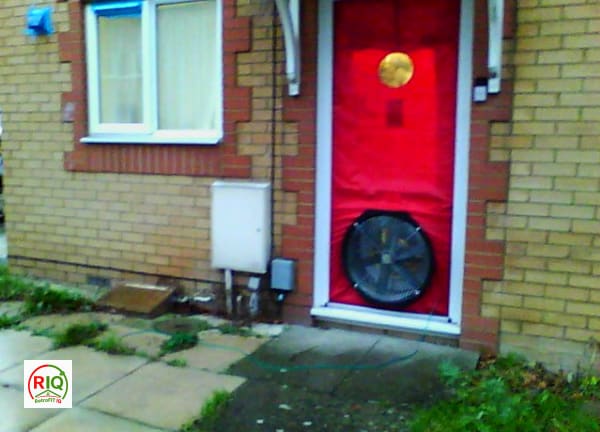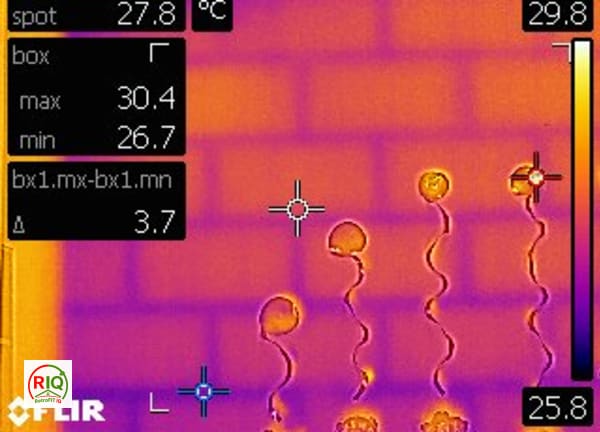

The most valuable part of an airtightness survey isn't the headline figure — it's the map of where the air actually moves. Leak detection is carried out while the blower door holds the building under a steady pressure difference (usually depressurisation, around 50 Pa), which exaggerates the leaks and makes otherwise-imperceptible airflow obvious to the eye, the hand and the camera.
| Method | Best used for | What it tells you |
|---|---|---|
| Smoke pencil / puffer | Pinpointing individual leaks at a junction | Exact location and path of a single leak |
| Smoke fogger (pressurisation) | Whole-envelope survey from outside | Every leak streaming out, photographable |
| Anemometer | Quantifying a located leak | Air velocity / how significant the leak is |
| Thermal imaging (depressurised) | Scanning whole surfaces quickly | Cold streaks where air enters; separates leaks from missing insulation |
| Blower door | Providing the controlled pressure + the number | Whole-building leakage for context |
Why depressurisation is ideal for finding leaks
When the blower door depressurises the building, the higher-pressure outdoor air is forced in through every leak. That means: you can feel cold draughts streaming in at each leak with your hand; smoke introduced near a suspected leak is sucked toward (or in from) the gap; and a thermal camera sees the incoming cold air chilling the internal surfaces around the leak. Pressurisation does the reverse and is useful for tracing leaks with smoke from the outside, but depressurisation is the workhorse of internal leak hunting.
The toolkit
Smoke pencils and puffers
A smoke pencil or puffer releases a fine, neutrally-buoyant stream of visible smoke. Held near a junction, penetration or crack while the building is depressurised, the smoke is visibly drawn into the leak — pinpointing it precisely. This is the classic, high-resolution method for confirming and locating individual leaks at sockets, skirtings, window frames, loft hatches and service penetrations.
Smoke foggers (theatrical foggers)
For pressurisation leak detection, the building is filled with dense (non-toxic) theatrical fog and then pressurised, so smoke streams out of every leak and can be photographed from outside — dramatic and comprehensive for whole-envelope surveys, new-build commissioning and demonstrating leakage to clients. (Care and notification are needed, as fog can trigger alarms.)
Anemometer
A vane or hot-wire anemometer measures the actual air velocity at a leak, quantifying how significant it is. This helps prioritise: a fast jet of air at a floor junction matters more than a barely-moving wisp at a tidy window seal.
Thermal imaging under depressurisation
This is the technique that elevates leak detection from anecdote to evidence. With the building depressurised in cold weather, incoming outdoor air chills the internal surfaces it passes over, producing characteristic cold 'streaks' and 'fingers' on the thermal image that fan out from the leak. Crucially, thermal imaging on its own can't always distinguish a cold spot caused by missing insulation from one caused by air leakage — but doing it under depressurisation makes air leaks 'bloom' and move, which separates the two. We cover this in the Thermal Imaging guide.
How a leak survey runs
- Set up the blower door and establish a stable depressurisation (typically ~50 Pa).
- Sweep each room with the thermal camera to identify cold streaks and leak zones quickly.
- Confirm and pinpoint each suspect with smoke at the surface, watching it draw into the leak.
- Quantify the more significant leaks with the anemometer.
- Photograph and annotate each leak — location, type, apparent severity — building a documented register.
- Optionally repeat in pressurisation with a fogger for an external whole-envelope view and to catch direction-dependent leaks.
Documenting and prioritising — the deliverable
Raw observations are only useful once they're turned into a plan. A good leak survey produces a prioritised register: each leak located on a plan or photo, classified by type (penetration, junction, glazing, drylining, floor void, etc.), with an indication of significance and a recommended remediation. The point is to direct the sealing budget at the leaks that will actually move the airtightness figure, rather than chasing trivial ones.
When to do it — and why early matters
On new build and deep retrofit, the most valuable leak survey happens while the air barrier is still accessible — before plasterboard, screeds and finishes bury it. Finding and fixing a leaking junction at first-fix stage costs minutes; finding it after decoration costs a ripped-out wall. On occupied homes, a leak survey of the finished building still delivers a prioritised plan of accessible improvements — it just can't reach the buried paths as easily.
Beyond smoke — tracer gas and acoustic methods
Smoke and thermal imaging cover most domestic work, but other techniques exist for harder cases. Tracer-gas methods release a measured quantity of a harmless tracer (historically gases such as sulphur hexafluoride or, increasingly, lower-impact alternatives) and measure its decay or concentration to quantify air change and inter-zone airflow directly, without a blower door — valuable for measuring real, in-use ventilation rates and leakage between flats. Acoustic leak detection uses a loud sound source on one side of the envelope and a sensitive microphone on the other to find paths that pass sound (and therefore air), useful where a fan cannot conveniently pressurise a space. These are specialist tools rather than everyday domestic kit, but they fill the gaps where the standard blower-door-plus-smoke approach struggles.
Reading cold streaks correctly
The skill in thermal leak detection is interpretation, because not every cold patch is an air leak. Under depressurisation, a genuine air leak produces a characteristic moving, fan-shaped or finger-like cold streak that spreads from the leak point and intensifies as the fan runs and recovers when it stops — the surface is being actively chilled by incoming air. A static, evenly-shaped cold area that does not respond to the fan is more likely missing or slumped insulation or a thermal bridge. A surveyor watches the surface respond to the pressure change, and cross-checks with smoke, before attributing a cold patch to leakage. Calling every blue patch a 'draught' is exactly the kind of sloppy interpretation that wastes a client's sealing budget on the wrong problem.