

Home Health Diagnostic Survey in East London
A comprehensive whole-home diagnostic assessment combining visual inspection, thermal imaging, moisture, humidity and airflow measurements to identify the root cause of building problems. Specialist building-performance diagnostics across East London — E1-E20 · IG (Ilford, Woodford, Loughton) · RM (Romford, Hornchurch, Dagenham).
What we typically diagnose across East London.
From the converted Victorian terraces of Walthamstow and Leyton through the warehouse conversions of Hackney Wick and Bow to the new-build estates of Stratford and Canary Wharf — East London has one of the most varied building stocks in the capital. Our diagnostics-led approach matches the remedy to the actual construction, not a generic assumption.
- Solid-wall Victorian terraces in Stratford, Bethnal Green, Hackney, Leyton and Walthamstow with no cavity to fill
- Warehouse conversions with single-glazed industrial windows and no perimeter thermal break
- Bow and Hackney warehouse conversions with chronic mould on inside faces of single-skin brick walls
- High-occupancy HMOs across Newham and Waltham Forest with persistent kitchen and bathroom condensation
- Warehouse conversions with original cast-iron column-to-floor junctions left open
One process — every service is a stage of it.
We never jump to a fix. We investigate and measure, diagnose the real cause, design the solution, carry out the works and verify the result.
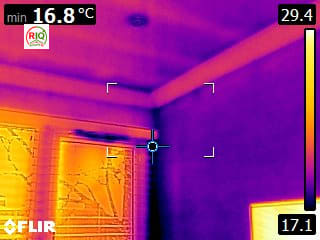


Real FLIR thermal images from completed surveys — see the full set in the gallery.


Real photos from a recent blower door airtightness test.
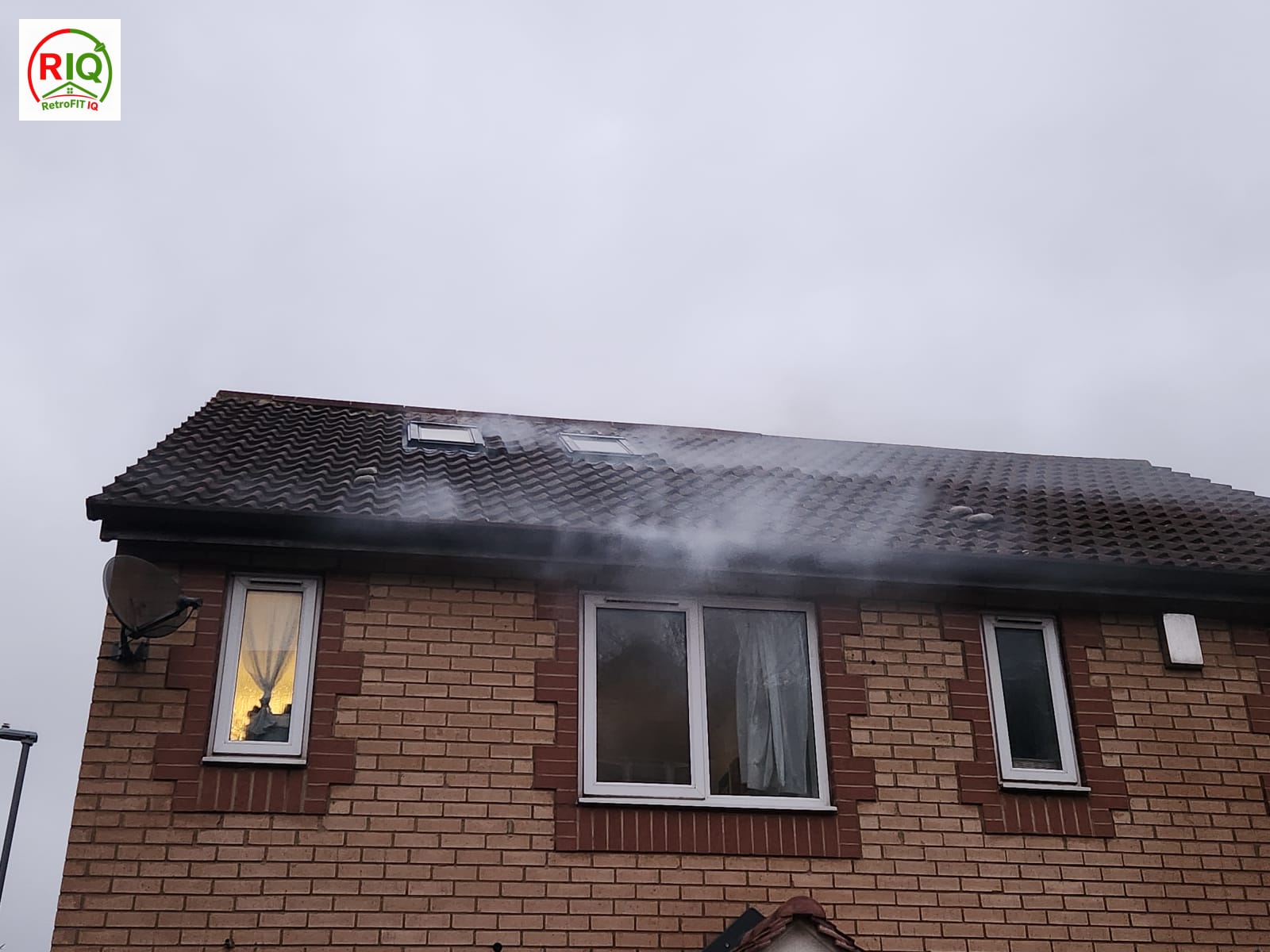
Smoke escaping at the eaves during a real blower door test — air-leakage path made visible.
Home Health Diagnostic Survey — in plain English.
A Home Health Diagnostic Survey is our complete, whole-building investigation. Rather than chasing one symptom, we combine calibrated FLIR thermal imaging, blower-door airtightness testing, moisture and humidity logging, ventilation checks and a room-by-room inspection to build a measured picture of how the entire home performs — and to pinpoint the root causes of cold, damp, condensation, draughts and poor air quality.
Why home health diagnostic survey is important.
Most building problems are misdiagnosed because they are treated as isolated symptoms — a damp patch, a cold room, a stuffy bedroom — rather than as connected outcomes of how the whole building performs. A whole-home diagnostic looks at heat loss, airtightness, moisture and ventilation together, because in building physics they are inseparable: a cold surface plus high humidity plus poor ventilation is exactly the recipe for condensation and mould. Measuring the whole picture once, properly, prevents the expensive cycle of partial fixes that never address the real cause.
The right time to bring us in.
- When several problems occur together and no single trade can explain them
- Before a whole-house retrofit, to set the baseline the design will be built on
- Before buying a property, to understand its true performance and likely upgrade cost
- When previous works (windows, insulation, a new boiler) did not deliver the expected result
- When a landlord needs an independent, evidence-based investigation of tenant complaints
The symptoms that bring people to this service.
- 01Several symptoms at once — cold rooms, damp, draughts and high bills — with no single cause
- 02Mould or condensation appearing in more than one room
- 03Previous works (windows, insulation, a new boiler) that did not deliver
- 04A property being bought, let or retrofitted where real performance is unknown
- 05Tenant complaints needing independent, evidence-based investigation
- 06A home that simply never feels comfortable however it is heated
What you tend to notice first.
- A combination of cold rooms, draughts, damp and high bills with no single obvious cause
- Mould or condensation in more than one room or on more than one wall
- Stuffy, stale bedrooms and rising humidity alongside cold surfaces
- Previous works that did not deliver the expected result
- A property being bought, let or retrofitted where the real performance is unknown
- Tenant complaints requiring independent, evidence-based investigation
Our diagnostic approach
- 01Room-by-room walkthrough and occupant interview to map every reported symptom
- 02FLIR thermal imaging across walls, ceilings, floors, reveals and junctions
- 03Blower-door airtightness test with smoke tracing of leakage paths (where applicable)
- 04Moisture-meter readings and surface-temperature checks against measured dew point
- 05Indoor humidity, temperature and (where relevant) CO₂ logging
- 06Findings interpreted against construction type, age and previous works
What we bring on site
- Calibrated FLIR thermal imaging camera (radiometric)
- Minneapolis-style calibrated blower door fan and manometer
- Pin and pinless moisture meters for multiple substrates
- Temperature, humidity and dew-point data loggers
- Smoke pen / fogger for air-leakage visualisation
- IAQ logger (CO₂, PM2.5, VOC) where air quality is a concern
The science behind the diagnosis.
Heat loss, air leakage, moisture and ventilation are not separate problems — they are one interacting system. A cold surface, high indoor humidity and poor ventilation together produce condensation and mould; air leakage carries both heat and moisture into the fabric. Measuring all four at once is the only way to see how they combine in your specific building, which is why a whole-home diagnostic finds causes that single-issue surveys miss.
Measured benefits — not vague promises.
- One measured picture of how the whole home performs
- Root causes identified, not just the visible symptoms
- A single prioritised, costed schedule of improvements
- A fabric-first roadmap that can be staged across budgets
- An independent report for architects, installers, surveyors or landlords
- Optional verification after works to prove the improvement
What we design and deliver next.
Every recommendation follows our methodology — Investigate → Design → Verify — so the diagnosis on this page leads directly into an engineered, buildable and independently verified solution.
- A single prioritised, costed schedule of improvements addressing root causes, not symptoms
- A fabric-first plan coordinating insulation, airtightness and ventilation as one system
- Targeted remediation for the specific damp, cold or air-quality issues identified
- A staged roadmap so works can be delivered in order of impact and budget
- An independent report you can hand to an architect, installer, surveyor or landlord
- Optional verification after works to confirm the building now performs as intended
What goes wrong on site — and why it matters.
Our diagnoses are grounded in real site experience. These are the workmanship and detailing failures we repeatedly find on this kind of work — the difference between a building that should perform and one that actually does.
Bathroom and kitchen fans terminated in the loft rather than outside simply move moisture into the roof space, where it condenses on cold timbers.
Loft insulation pushed tight into the eaves blocks the cross-ventilation path, trapping moisture against the rafters.
An undraught-sealed hatch and open service penetrations let warm moist air leak upward, driving both heat loss and loft condensation.
Insulation added with no continuous air barrier underperforms and can move the condensation risk into the build-up.
Wet rooms relying on a weak intermittent fan never clear the moisture load, so humidity stays high across the whole home.
What's included
- On-site visual inspection of the property and reported issues
- Thermal imaging survey of suspect areas (walls, ceilings, junctions, windows)
- Moisture readings on affected substrates
- Indoor relative humidity and surface temperature analysis
- Smoke tracing of suspected air-leakage paths (where required)
- Optional blower door test for whole-house airtightness
- Written diagnostic report with findings, photographs and recommendations
Who it's for
- Homeowners experiencing damp, mould, cold or high bills
- Landlords and housing associations investigating tenant complaints
- Architects and developers commissioning pre-purchase or pre-retrofit surveys
- Property managers needing evidence-based investigation reports
What we commonly discover during home health diagnostic survey investigations
- 01Cold reveals around windows and external door heads
- 02Air leakage through unsealed loft hatches and service penetrations
- 03Localised thermal bridges at wall/ceiling and wall/floor junctions
- 04Hidden moisture trapped within wall or floor build-ups
- 05Inadequate extract ventilation in bathrooms and kitchens
- 06Indoor humidity above 65% RH driving condensation on cold surfaces
- 07Previous retrofit insulation installed with workmanship gaps
Findings reflect patterns observed across completed RetrofitIQ projects — every survey is interpreted in the building’s specific context.
See this service applied on real investigations
Home Health Diagnostic Survey — common questions
What is a Home Health Diagnostic Survey?+
It is our complete building-performance investigation of a property — combining FLIR thermal imaging, blower-door airtightness testing, moisture and humidity logging, ventilation checks and a room-by-room visual inspection. Rather than diagnosing a single symptom in isolation, it builds a measured picture of how the whole home performs and pinpoints the root causes of heat loss, cold, damp, condensation, draughts and poor air quality.How is it different from an EPC or a standard homebuyer survey?+
An EPC is a modelled energy rating based on standard assumptions, and a homebuyer survey checks structural condition. Neither measures how your building actually performs. A Home Health Diagnostic Survey is evidence-based: we measure real surface temperatures, real air-leakage rates and real humidity, then explain the building physics behind each finding and how to fix it.What equipment do you use during the survey?+
A calibrated FLIR thermal imaging camera, a calibrated blower door for airtightness testing (where applicable), pin and pinless moisture meters, temperature and humidity data loggers, and where relevant IAQ instruments (CO₂, PM2.5, VOC). Every finding is recorded as measured data, not opinion.How long does a survey take?+
A focused single-issue diagnostic typically takes around 2 hours on site. A full whole-house Home Health Diagnostic with thermal imaging, airtightness testing and moisture logging usually takes half a day or more depending on the property size, followed by the written report.What do I receive afterwards?+
A clear written report with annotated photographs, calibrated thermal images, measured data (surface temperatures, humidity, air-leakage figures where tested), a diagnosis of the root cause of each issue, and a prioritised, costed schedule of recommended improvements you can budget against and implement in stages.Do you cover London and the surrounding areas?+
Yes. We are based in East London (E15) and carry out Home Health Diagnostic Surveys across Greater London, Essex, Kent, Surrey, Hertfordshire and the wider South East.How much does a Home Health Diagnostic Survey cost?+
It depends on the property size and the scope (single-room diagnostic vs whole-house with a blower-door test). We provide a clear fixed price before any work begins. Send us a short description of the issue and your postcode and we will recommend the most cost-effective survey and quote it.Can you carry out the recommended works afterwards?+
Yes. We follow one process — Investigate → Diagnose → Design → Remediate → Verify — so we can design and carry out the recommended insulation, airtightness, ventilation, damp or soundproofing works ourselves and then verify the outcome with measurement. One company, one point of responsibility.Is the survey useful before buying a property or before a retrofit?+
Very. Before a purchase it reveals hidden performance problems and the likely cost to put them right. Before a retrofit it provides the baseline measurements needed to design the right insulation, airtightness and ventilation strategy — and to verify the improvement afterwards.
Weighing this up against the alternatives?
Independent, building-physics-led comparisons from our knowledge base — written to help you understand the difference before you decide which survey or approach you actually need.
- Thermal Imaging vs Blower Door TestingThermal Imaging
- Blower Door vs Smoke Testing for Air LeakageBlower Door & Airtightness
- Thermal Imaging vs Moisture Meter for Finding DampThermal Imaging
- Airborne vs Impact SoundproofingSoundproofing & Acoustics
Common problems we diagnose
The symptoms that most often lead homeowners to a home health diagnostic survey. Each guide explains the building physics behind the problem — and how we diagnose the real cause before any work begins.
- Why do I feel cold even when the room is warm?
- How do I find heat loss in my house?
- Where does most heat escape from a house?
- Is an EPC enough to plan a retrofit, or do I need a proper survey?
- Why do I have condensation on my windows?
- Why are my windows wet in the morning?
Part of one connected building-performance journey.
Every Retrofit IQ service is one stage of a single methodology — Investigate → Design → Verify. Explore how this service connects to the wider network of diagnostics, engineering and quality assurance.
The engineering and quality-assurance services that most often follow this one.
One company. One process. One point of responsibility.
We don’t simply identify problems. We investigate, diagnose, design solutions, carry out the work and verify the results. Book a Home Health Diagnostic Survey and we’ll tell you exactly which remedial works (if any) are actually needed.
Commission a Retrofit IQ Building Physics Assessment
After this investigation, you can commission a Building Physics Assessment for an advanced engineering analysis. A standard survey identifies the problems; this uses advanced building physics modelling to predict how your building is expected to perform after the proposed upgrade — before any work begins.
Most contractors recommend insulation. Retrofit IQ predicts how your building is expected to perform first.
Investigate → Diagnose → Design → Remediate → Verify
RetrofitIQ is not only a diagnostics company. We take projects from first investigation through to verified improvement — and you decide how far we go. Engage us for an investigation on its own, an investigation plus targeted remedial works, or a complete building-performance and retrofit project.
A measured diagnosis — thermal imaging, blower door testing, moisture and building-physics analysis — with a clear, costed report you can act on however you choose.
We investigate, then carry out targeted remedial works — airtightness, insulation, ventilation or thermal-bridge corrections — and verify the result.
A full fabric-first, Passive House-informed retrofit from diagnosis through design, installation and verification — one accountable team, one point of responsibility.
- Airtightness improvements & draught-proofing
- Internal wall insulation (IWI)
- External wall insulation (EWI)
- Loft & roof insulation
- Suspended floor & underfloor insulation
- Thermal-bridge detailing & correction
- Extract ventilation & MVHR installation
- Soundproofing & acoustic upgrades
- General building-fabric improvements
Evidence from Real Projects (6)
Real project and investigation images from our own fieldwork, matched to this page — not stock photography.
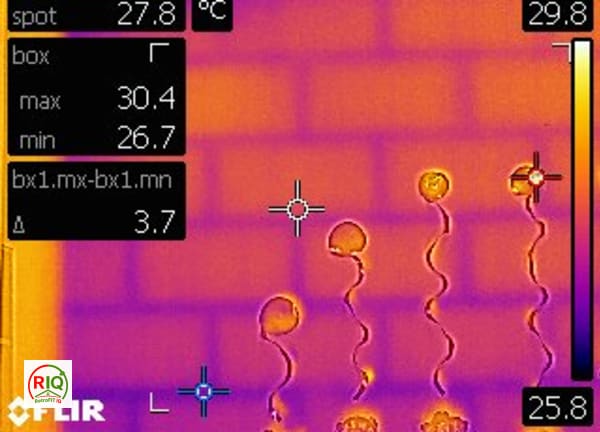
Thermal Bridging Visible Through Masonry Blockwork Wall

Thermal Bridge at Wall-Ceiling Junction Near Window

Sample Building Performance Investigation Report — Thermal Imaging

Thermal Bridge at Internal Corner Wall Junction

Airtightness Testing in a Stratford Victorian Terrace

Loft Thermal Investigation — Thermal Imaging Findings
No related investigations yet.
Browse all investigationsHome Health Diagnostic Survey across London & the surrounding areas.
Explore building performance diagnostics, damp and condensation investigations, airtightness testing and retrofit advice in your area. We cover London, Greater London, East London, Essex, Kent, Surrey, Hertfordshire and the surrounding counties.