

Damp, Moisture & Condensation in East London
Forensic investigation of damp, condensation and mould problems. We measure before we recommend — no guesswork, no over-treatment. Specialist building-performance diagnostics across East London — E1-E20 · IG (Ilford, Woodford, Loughton) · RM (Romford, Hornchurch, Dagenham).
What we typically diagnose across East London.
From the converted Victorian terraces of Walthamstow and Leyton through the warehouse conversions of Hackney Wick and Bow to the new-build estates of Stratford and Canary Wharf — East London has one of the most varied building stocks in the capital. Our diagnostics-led approach matches the remedy to the actual construction, not a generic assumption.
- Solid-wall Victorian terraces in Stratford, Bethnal Green, Hackney, Leyton and Walthamstow with no cavity to fill
- Warehouse conversions with single-glazed industrial windows and no perimeter thermal break
- Bow and Hackney warehouse conversions with chronic mould on inside faces of single-skin brick walls
- High-occupancy HMOs across Newham and Waltham Forest with persistent kitchen and bathroom condensation
- Warehouse conversions with original cast-iron column-to-floor junctions left open
One process — every service is a stage of it.
We never jump to a fix. We investigate and measure, diagnose the real cause, design the solution, carry out the works and verify the result.
Damp, Moisture & Condensation — in plain English.
A damp, moisture and condensation investigation is a forensic, measurement-led diagnosis of why a wall, ceiling or room is wet or growing mould. Because surface condensation, penetrating damp, interstitial condensation and rising damp look identical but need completely different remedies, we measure before we recommend — combining thermal imaging, moisture readings, humidity and dew-point analysis and an external envelope inspection to identify the true mechanism.
Why damp, moisture & condensation is important.
Damp is the most misdiagnosed problem in UK housing: surface condensation, penetrating damp, interstitial condensation and the genuinely rare rising damp all look identical but need entirely different — and incompatible — remedies. Treating the wrong mechanism wastes money and often makes the problem worse, as injected damp-proof courses on condensation walls and anti-mould paint over cold bridges demonstrate every day. A measured diagnosis, combining surface temperatures, moisture readings and dew-point analysis, identifies the true cause so the remediation is correct the first time. It is also increasingly a legal necessity for landlords under Awaab's Law.
The right time to bring us in.
- When mould returns after cleaning, painting or a previous 'damp-proofing' treatment
- Before lining or insulating a wall, to confirm there is no trapped or entering moisture
- When a landlord needs evidence-grade reporting for Awaab's Law / HHSRS compliance
- When a survey has recommended chemical injection and you want an independent second opinion
- When the cause of a damp patch is genuinely unknown and needs measuring, not guessing
The symptoms that bring people to this service.
- 01Black mould that returns after every clean or repaint
- 02Streaming windows and wet, cold wall surfaces in winter
- 03Damp patches behind furniture against external walls
- 04A musty smell with no visible source
- 05Peeling paint, blown plaster or low-level tide marks
- 06A previous 'damp-proofing' treatment that did not work
What you tend to notice first.
- Black mould returning after every clean or repaint
- Streaming windows and wet, cold wall surfaces in winter
- Damp patches behind wardrobes and sofas against external walls
- A musty smell with no visible source
- Peeling paint, blown plaster or low-level tide marks
- Mould concentrated in bathrooms, north-facing corners and cold reveals
Our diagnostic approach
- 01Visual inspection inside and out, plus occupant interview
- 02FLIR thermal imaging of every affected room to map cold surfaces
- 03Surface-temperature readings compared against measured indoor dew point
- 04Moisture-meter readings on plaster, masonry, skirting and floor junctions
- 05Indoor humidity and temperature logging (often over 7–14 days for chronic cases)
- 06External-envelope inspection for water-entry paths (pointing, render, gutters, airbricks)
What we bring on site
- Calibrated FLIR thermal imaging camera
- Pin-type and pinless / capacitance moisture meters
- Surface-temperature probe and infrared spot thermometer
- Humidity / dew-point data loggers
- Borescope for non-invasive build-up inspection
- Salts test kit to identify hygroscopic false readings
The science behind the diagnosis.
Condensation forms when a surface falls below the dew point of the indoor air — air at 20 °C and 60% RH condenses on any surface below about 12 °C. Cold walls, single glazing, lintels and thermal bridges routinely fall below dew point in winter, especially when occupant moisture loads are high and ventilation is poor. Penetrating and interstitial damp are different mechanisms entirely, driven by water entry and vapour movement through the build-up. Separating them requires measuring surface temperature, moisture and dew point together — no single reading is diagnostic on its own.
Measured benefits — not vague promises.
- A clear diagnosis of which damp mechanism is responsible, and where
- Measured evidence rather than a sales-led product recommendation
- Independent advice — we do not sell injected damp-proof courses
- A prioritised, costed remediation plan that fixes the cause
- Evidence-grade reporting for landlords, insurers and disputes
- Optional follow-up verification once remediation is complete
What we design and deliver next.
Every recommendation follows our methodology — Investigate → Design → Verify — so the diagnosis on this page leads directly into an engineered, buildable and independently verified solution.
- A clear diagnosis identifying which damp mechanism is responsible, and where
- Surface-temperature upgrades (insulation, bridge correction) to lift walls above dew point
- Controlled ventilation to bring indoor humidity into a safe 45–55% RH band
- Repair of genuine water-entry paths where penetrating damp is confirmed
- Moisture-safe, vapour-open build-ups where insulation is part of the fix
- An independent, product-neutral report suitable for landlords, insurers and disputes
What goes wrong on site — and why it matters.
Our diagnoses are grounded in real site experience. These are the workmanship and detailing failures we repeatedly find on this kind of work — the difference between a building that should perform and one that actually does.
Internal insulation fitted with no VCL, or a punctured one, lets warm moist air reach the now-cold masonry and condense inside the build-up — hidden interstitial condensation.
Vinyl wallpaper, gloss paint and foil-backed boards trap moisture in the wall so it cannot dry, concentrating damage behind an apparently sound surface.
Reveals, lintels and junctions left cold drop below dew point and become the first surfaces to condense and grow mould.
Moist air vented into the roof space rather than outside relocates the condensation problem instead of solving it.
Airbricks rendered or boxed over stop the underfloor void breathing, raising moisture beneath suspended floors.
Common findings
- Surface condensation from cold bridging and poor ventilation
- Interstitial condensation within wall build-ups
- Penetrating damp through cracked render, pointing or roofs
- Rising damp confirmed by deep moisture readings (rare in practice)
- Plumbing leaks misdiagnosed as 'rising damp'
Our process
- Visual inspection and client interview
- Surface and deep moisture mapping
- Humidity & dewpoint logging where appropriate
- Thermal imaging to confirm cold surfaces
- Written report with diagnosis and prioritised remedial options
What we commonly discover during damp, moisture & condensation investigations
- 01Cold internal wall surfaces below dewpoint of indoor air
- 02Condensation behind wardrobes and sofas positioned against external walls
- 03Interstitial condensation risk within retrofit insulation build-ups
- 04Moisture trapped behind impermeable finishes (gloss paint, vinyl wallpaper)
- 05Penetrating damp at failed pointing, blocked airbricks or cracked rendering
- 06High indoor humidity from indoor laundry drying or inadequate kitchen extract
Findings reflect patterns observed across completed RetrofitIQ projects — every survey is interpreted in the building’s specific context.
See this service applied on real investigations
Damp, Moisture & Condensation — common questions
Is it damp or condensation?+
This is the single most-misdiagnosed question in UK homes. The visible symptom — black mould and water on a wall — is identical for surface condensation, penetrating damp and the (genuinely rare) rising damp. Each has a completely different remediation. We diagnose by combining FLIR thermal imaging (surface temperatures), moisture meter readings (on multiple substrates), indoor humidity and dewpoint logging, and inspection of the external envelope for water-entry paths.What causes condensation on walls and windows?+
Condensation forms when warm moist indoor air contacts a surface colder than the dewpoint of that air. Indoor air at 20 °C and 60% RH has a dewpoint of around 12 °C — so any surface below 12 °C will condense water. Cold walls, single glazing, lintels, reveals, north-facing corners and uninsulated thermal bridges all routinely fall below dewpoint in winter, especially when occupant moisture loads (cooking, drying clothes, showering, breathing) are high.Why does mould keep coming back after cleaning or painting?+
Because cleaning and painting treat the symptom, not the cause. As long as the surface remains below dewpoint and the room humidity stays high, condensation will reform and mould will return — anti-mould paint included. The only durable fix is to (a) raise the surface temperature above dewpoint (insulation, thermal-bridge correction) and (b) reduce indoor humidity (controlled ventilation, source-control). We diagnose which lever needs pulling on your specific surface.Can thermal imaging identify condensation risk?+
Yes — it is the primary tool. We measure surface temperatures across every internal wall, ceiling, reveal and lintel, then compare against the measured indoor dewpoint. Surfaces below dewpoint, or within 2 °C of it, are quantified condensation risks. The output is a condensation-risk map of your property — not a guess.Can moisture meters prove whether a wall is damp?+
Only partially. Pin-type moisture meters measure electrical resistance and are easily fooled by hygroscopic salts (which conduct electricity and produce false-high readings) and by surface moisture (which gives elevated readings without proving deep damp). Pinless / capacitance meters scan the first 20-40 mm of substrate. We use both *plus* surface temperature and dewpoint data — the combination is diagnostic; either reading alone is not.What is the difference between surface moisture and trapped moisture?+
Surface moisture sits on a finish (paint, plaster, render) and dries when conditions change; trapped or interstitial moisture is held inside the build-up (between the brick and the plaster, inside the cavity, between an internal liner and a vapour barrier) and cannot dry because vapour cannot escape. Trapped moisture is far more damaging because it slowly destroys the substrate — and it is invisible from inside the room. Diagnosing it requires opening up or borescope inspection in addition to surface readings.Can poor ventilation cause mould?+
Yes. Ventilation removes the indoor moisture generated by cooking, washing, drying clothes and simply breathing (a sleeping adult exhales around 40 g of water per hour). Without adequate ventilation the indoor humidity climbs, the dewpoint rises, and more cold surfaces fall below it. Many of the mould problems we diagnose are not 'damp' problems at all — they are ventilation problems with cold-surface co-factors.Can insulation make condensation worse if installed incorrectly?+
Yes — this is one of the most common building-physics failures we see. Internal Wall Insulation installed without continuous airtightness and proper vapour control creates *interstitial* condensation behind the new lining: the masonry behind the IWI is now colder than before, warm moist room air sneaks past at the edges, and condensation forms on the cold side of the insulation where you cannot see it. The result is hidden mould and joist-end rot. Done correctly with the right materials and detailing, IWI eliminates condensation; done incorrectly it creates a hidden mould factory.Can cold bridges (thermal bridges) cause mould?+
Yes — and they are the single most common cause of localised mould in an otherwise dry room. Concrete lintels, structural steel, uninsulated reveals and slab edges produce localised cold patches well below the rest of the wall. When the room dewpoint rises in winter, those cold patches are the first surfaces to drop below dewpoint and start condensing. The pattern is diagnostic — mould in regular geometric stripes or patches almost always indicates a cold bridge.How do you investigate damp properly?+
Our protocol: (1) visual inspection inside and outside; (2) FLIR thermal imaging of every affected room; (3) measured surface temperatures of suspect areas; (4) moisture meter readings on multiple substrates; (5) indoor humidity + room temperature logging (often over 7-14 days for chronic cases); (6) external envelope inspection for water-entry paths; (7) written diagnosis identifying which mechanism (condensation / penetrating / rising / interstitial) is responsible and where; (8) prioritised costed remediation plan.Do you check humidity and dewpoint as part of the investigation?+
Yes — every damp survey. Without dewpoint analysis you cannot tell condensation from other damp mechanisms. We log indoor temperature and RH; calculate the dewpoint; and compare it against measured cold-surface temperatures. The dewpoint margin (how close the surface is to condensing) is the single most diagnostic measurement for condensation-related damp.Do you provide written recommendations after the survey?+
Yes — every damp / moisture / condensation investigation is delivered with a written report containing the diagnosis, the measured evidence, photographs (with thermal imagery where relevant) and a prioritised costed remediation plan. We do not sell damp-proofing products and we are not tied to any chemical-injection contractor — the recommendations are independent.Can RetrofitIQ also repair the problem after diagnosis?+
Yes — the parent company (G.A.S General Building Services Ltd) carries out the remediation works as a single accountable team. This is the 'one company, one process, one point of responsibility' model: the same Certified Passive House Designer who diagnoses the problem oversees the works that fix it, and verifies the result afterwards with a re-test or follow-up thermal survey.Is rising damp always the cause of damp in older homes?+
Almost never. Genuine rising damp — groundwater wicking up porous masonry by capillary action — is a real but rare mechanism, typically responsible for less than 1 in 20 'damp' diagnoses in modern London terraces. The much more common causes are condensation, penetrating damp (failed pointing, blocked airbricks, defective rendering, leaking downpipes) and interstitial condensation behind failed retrofits. A chemical damp-proof course injected into a wall with condensation will not solve the problem.When should a landlord request a diagnostic damp / condensation survey?+
As soon as a tenant reports persistent mould or damp, or when applying for HHSRS / Awaab's Law compliance evidence. The Homes (Fitness for Human Habitation) Act 2018 and the Social Housing Regulation Act 2023 (Awaab's Law) require landlords to investigate and remediate damp and mould properly — chemical paint and a dehumidifier are no longer acceptable responses. Our independent measured report provides the evidence base for both diagnosis and remediation works.Do you investigate damp in HMOs and multi-occupancy flats?+
Yes. HMOs and conversion flats present particular challenges: high occupancy loads raise indoor humidity quickly, and party-wall thermal bridges in conversions are routinely overlooked. We work regularly with HMO landlords and managing agents across London to provide independent diagnostic reports and remediation specifications.Do you work with insurance claims for damp and mould?+
Yes — our reports include the measured evidence, photographs and diagnostic reasoning needed to support a buildings-insurance claim or a defect dispute. We do not work for the insurer; we work for you, and our report is independent.
Weighing this up against the alternatives?
Independent, building-physics-led comparisons from our knowledge base — written to help you understand the difference before you decide which survey or approach you actually need.
- Thermal Imaging vs Moisture Meter for Finding DampThermal Imaging
- Condensation vs Penetrating Damp vs Rising DampDamp & Moisture
- Internal vs External Wall InsulationRetrofit & Insulation
- Building Performance Diagnostic vs a Standard SurveyBuilding Performance Diagnostics
Common problems we diagnose
The symptoms that most often lead homeowners to a damp, moisture & condensation. Each guide explains the building physics behind the problem — and how we diagnose the real cause before any work begins.
- Why are my walls cold?
- Is it worth getting cavity wall insulation?
- Should I get external or internal wall insulation?
- Why do I have condensation on my windows?
- Why are my windows wet in the morning?
- Why is there moisture on my walls?
Part of one connected building-performance journey.
Every Retrofit IQ service is one stage of a single methodology — Investigate → Design → Verify. Explore how this service connects to the wider network of diagnostics, engineering and quality assurance.
The engineering and quality-assurance services that most often follow this one.
One company. One process. One point of responsibility.
We don’t simply identify problems. We investigate, diagnose, design solutions, carry out the work and verify the results. Book a Home Health Diagnostic Survey and we’ll tell you exactly which remedial works (if any) are actually needed.
Commission a Retrofit IQ Building Physics Assessment
After this investigation, you can commission a Building Physics Assessment for an advanced engineering analysis. A standard survey identifies the problems; this uses advanced building physics modelling to predict how your building is expected to perform after the proposed upgrade — before any work begins.
Most contractors recommend insulation. Retrofit IQ predicts how your building is expected to perform first.
Investigate → Diagnose → Design → Remediate → Verify
RetrofitIQ is not only a diagnostics company. We take projects from first investigation through to verified improvement — and you decide how far we go. Engage us for an investigation on its own, an investigation plus targeted remedial works, or a complete building-performance and retrofit project.
A measured diagnosis — thermal imaging, blower door testing, moisture and building-physics analysis — with a clear, costed report you can act on however you choose.
We investigate, then carry out targeted remedial works — airtightness, insulation, ventilation or thermal-bridge corrections — and verify the result.
A full fabric-first, Passive House-informed retrofit from diagnosis through design, installation and verification — one accountable team, one point of responsibility.
- Airtightness improvements & draught-proofing
- Internal wall insulation (IWI)
- External wall insulation (EWI)
- Loft & roof insulation
- Suspended floor & underfloor insulation
- Thermal-bridge detailing & correction
- Extract ventilation & MVHR installation
- Soundproofing & acoustic upgrades
- General building-fabric improvements
Evidence from Real Projects (6)
Real project and investigation images from our own fieldwork, matched to this page — not stock photography.
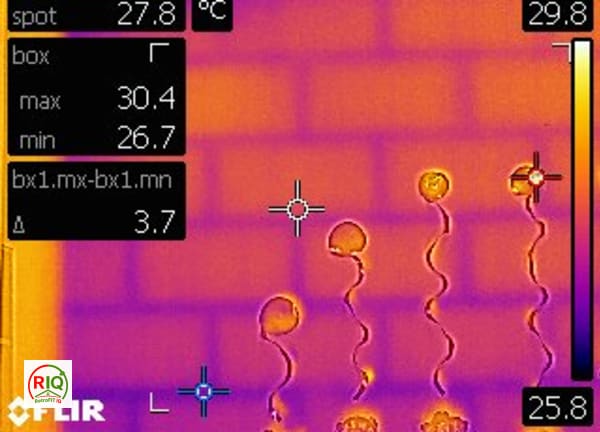
Thermal Bridging Visible Through Masonry Blockwork Wall

Sample Building Performance Investigation Report — Thermal Imaging

Thermal Bridge at Internal Corner Wall Junction

Thermal Bridge at Wall-Ceiling Junction Near Window

Airtightness Testing in a Stratford Victorian Terrace

Brick-slip panels being installed onto the metal rail system over the mineral wool insulat
No related investigations yet.
Browse all investigationsDamp, Moisture & Condensation across London & the surrounding areas.
Explore building performance diagnostics, damp and condensation investigations, airtightness testing and retrofit advice in your area. We cover London, Greater London, East London, Essex, Kent, Surrey, Hertfordshire and the surrounding counties.