
What does a damp and mould survey involve?
A damp and mould survey should do one thing above all: establish why the home is damp, so the right treatment follows. Done well, that means more than running a damp meter over a wall and naming a problem — it involves measuring the moisture, temperature and ventilation, distinguishing condensation from penetrating and rising damp, and identifying the cold surfaces and moisture sources that actually drive the mould. A survey that skips this diagnosis and recommends a single proprietary treatment can lead to money spent on the wrong fix. Knowing what a thorough survey involves helps you commission one that finds the cause rather than just confirming there is damp.
 Reviewed by George Sora, Certified Passive House DesignerUpdated June 2026
Quick answer & key takeaways
8 min read- The purpose is to diagnose the cause of the damp, not just confirm it exists.
- It should distinguish condensation from penetrating and rising damp.
- A handheld damp meter alone is not a diagnosis — measurement and context are needed.
- It maps cold surfaces, moisture levels and ventilation to find the real driver.
- Biggest misconception: a damp survey means a damp-proofing quote. The cause comes first.
- Retrofit IQ's approach: measure moisture, temperature and ventilation, then identify the cause.
What this usually means
Damp in a home is not one problem but several — condensation forming on cold surfaces, water penetrating from outside through a defect, or moisture rising from the ground — and each has a completely different cause and remedy. A damp and mould survey worth its name is therefore primarily a diagnostic exercise: its job is to work out which mechanism (or combination) is at work in your home, because treating condensation as if it were rising damp, or vice versa, wastes money and leaves the problem unsolved. The visible mould or staining is the symptom; the survey exists to find what produces it.
A thorough survey gathers evidence rather than relying on a single reading. It records the indoor temperature and humidity, often over time, to see whether the air is generally too humid; it measures moisture in the affected materials and compares it against unaffected areas; it uses thermal imaging to find the cold surfaces and thermal bridges where condensation forms; and it assesses the ventilation and the building fabric for leaks, defects and rising-damp indicators. Crucially, it interprets these together and in context — a high reading on a handheld meter, for instance, can be caused by salts or surface moisture and does not by itself prove rising damp. The pattern of the evidence, not one instrument, identifies the cause.
The output should be a diagnosis and a proportionate plan, not a sales quote for a single treatment. A common pitfall is a 'free' damp survey from a contractor whose business is selling chemical damp-proof courses or proprietary treatments: the incentive is to find a problem that the product solves, and condensation — by far the most common cause of household damp and mould — is frequently mislabelled as rising damp and treated with injections that do nothing for it. An independent, building-physics survey instead tells you whether the cause is condensation, penetrating or rising damp, what is actually driving it, and the right remedy — warming cold surfaces and improving ventilation, fixing a leak, or addressing genuine rising damp — so the money goes to the real problem.
Common causes
Condensation on cold surfaces
The most common cause of household damp and mould — humid air meeting surfaces below the dew point.
Penetrating damp
Water entering through a defect — a leak, failed pointing, render or flashing — wetting the fabric.
Rising damp
Genuine rising damp is less common than assumed and needs confirming, not presuming.
Inadequate ventilation
Poor moisture removal lets indoor humidity build and condense, feeding mould.
Misdiagnosis from a single meter
A handheld reading alone can mislead, so context and multiple measurements matter.
Signs and symptoms
Recurring mould after cleaning
Mould that returns shows an unaddressed moisture source the survey must find.
Damp patches of unclear origin
Staining that could be condensation, a leak or rising damp needs proper diagnosis.
Tide marks low on walls
Marks near the floor may suggest rising damp but must be confirmed, not assumed.
Damp worse after rain
Damp that tracks rainfall points to penetrating damp from a defect.
Condensation and high humidity
Misted windows and damp air indicate condensation as the likely driver.
What most people check first
- Whether the damp is condensation, penetrating or rising — the survey must distinguish them.
- Whether the survey measures moisture, temperature and ventilation, not just one meter reading.
- Whether the surveyor is independent or selling a single treatment.
- Whether the output is a diagnosis and plan, not just a damp-proofing quote.
What most people miss
- That condensation, not rising damp, is the commonest cause of household damp.
- That a handheld damp meter alone is not a diagnosis.
- That a 'free' survey tied to a product can be biased toward that product.
- That the cause must be found before any treatment is chosen.
The building physics
Damp diagnosis is a matter of distinguishing moisture mechanisms that present similarly but arise differently. Condensation occurs when air at a given moisture content meets a surface below its dew point, so it correlates with cold surfaces, high indoor humidity and poor ventilation, and concentrates on thermal bridges and in unventilated corners. Penetrating damp is the ingress of liquid water through a defect in the external envelope, so it correlates with rainfall, the location of the defect and the wetting of the fabric from outside in. Rising damp is the capillary movement of ground moisture up a wall in the absence of an effective damp-proof course, limited in height and accompanied by characteristic salt bands. A survey identifies the mechanism by reading which of these signatures the evidence fits.
The instruments only inform that judgement when used and interpreted correctly. A handheld conductance 'damp meter' responds to surface moisture and to soluble salts, so a high reading can be produced by condensation, hygroscopic salts or surface wetting and does not, on its own, demonstrate rising damp — a frequent source of misdiagnosis. Reliable diagnosis combines several lines of evidence: temperature and relative-humidity logging to establish whether the air and surfaces are at condensation risk; thermal imaging to locate the cold surfaces and bridges; comparative and, where needed, deep moisture measurement to distinguish surface from in-depth wetting; and inspection of the external fabric for defects. The cause is inferred from the consistent pattern across these, not from any single number.
Because the remedies are mutually exclusive in effect, the diagnostic step is where the value lies. Condensation is resolved by warming surfaces and improving ventilation; penetrating damp by repairing the external defect and allowing the fabric to dry; genuine rising damp by addressing the damp-proof course — and applying the wrong one achieves nothing while costing money, as injecting a damp-proof course into a wall suffering condensation famously does. An independent building-physics survey is structured to reach the correct diagnosis first and then specify the proportionate remedy, in contrast to a product-led inspection whose conclusion tends to match whatever treatment the inspector sells. This is why what a damp and mould survey involves matters as much as the fact of having one.
What a thorough damp and mould survey should involve
Look for a survey that diagnoses the cause with measurement and context — distinguishing condensation, penetrating and rising damp — and produces a proportionate plan, not a single-treatment quote.
- 01
Measure temperature and humidity
Log the indoor conditions, ideally over time, to assess whether the air is at condensation risk.
- 02
Map cold surfaces
Use thermal imaging to find the cold surfaces and thermal bridges where condensation forms.
- 03
Measure moisture in context
Take comparative moisture readings rather than relying on a single handheld meter result.
- 04
Inspect the fabric and ventilation
Check for external defects, leaks and rising-damp indicators, and assess the ventilation.
- 05
Diagnose the cause
Interpret the evidence together to identify condensation, penetrating or rising damp.
- 06
Get a proportionate plan
Receive a remedy matched to the cause, not a default damp-proofing recommendation.
How to prevent it coming back
- Commission an independent survey, not one tied to a single treatment.
- Insist the cause is diagnosed before any treatment is chosen.
- Treat a single damp-meter reading with caution.
- Address condensation as the most likely cause of household mould.
How Retrofit IQ investigates this
We diagnose the cause of the damp and mould with measurement and context, then specify a proportionate remedy — not a single default treatment.
Do not spend money fixing symptoms before you understand the cause — investigate first, then build with confidence.
Do I need a professional investigation?
A damp and mould survey is worth commissioning whenever the cause is unclear, the problem keeps returning, or you have been quoted for damp-proofing without a proper diagnosis. A survey that measures the moisture, temperature and ventilation and distinguishes condensation from penetrating and rising damp ensures the money goes to the real cause rather than a default treatment that may do nothing.
Get an independent, product-neutral survey
We are paid for the diagnosis, not the cure — so the report finds the real cause and the cheapest correct fix, with nothing to sell you.
- Paid for the findings, no treatment to sell
- Thermal imaging, airtightness & moisture readings
- Written report with the least-cost remedy
Where to go next
Relevant services
Related comparisons
From the Academy
Related case studies
Related problems you may also have
Evidence from Real Projects (10)
Real project and investigation images from our own fieldwork, matched to this page — not stock photography.
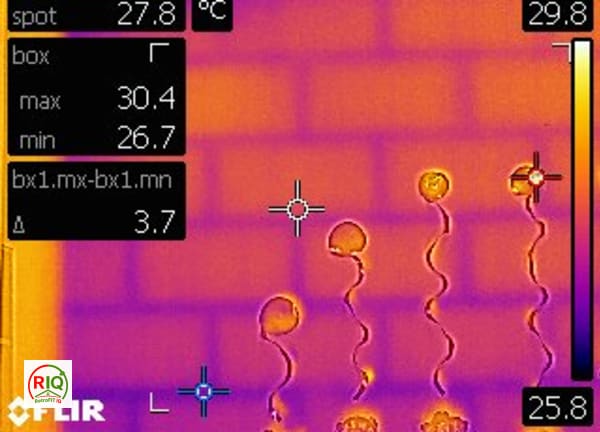
Thermal Bridging Visible Through Masonry Blockwork Wall

Sample Building Performance Investigation Report — Thermal Imaging

Thermal Bridge at Internal Corner Wall Junction

Thermal Bridge at Wall-Ceiling Junction Near Window

Airtightness Testing in a Stratford Victorian Terrace

Bathroom
No related investigations yet.
Browse all investigationsFrequently asked questions
What does a damp and mould survey involve?+
A proper survey diagnoses the cause: it measures the indoor temperature and humidity, takes moisture readings in context, uses thermal imaging to find cold surfaces, and inspects the fabric and ventilation — then distinguishes condensation from penetrating and rising damp and recommends a remedy matched to the cause, rather than just confirming damp is present.
Is a damp meter reading enough to diagnose damp?+
No. A handheld damp meter responds to surface moisture and salts, so a high reading can be caused by condensation, salts or surface wetting and does not by itself prove rising damp. Reliable diagnosis combines several measurements and the context of the building.
Why are some damp surveys free?+
Often because they are offered by contractors who sell a particular treatment, such as chemical damp-proof injections. The incentive can be to find a problem the product solves — which is why condensation is so frequently mislabelled as rising damp. An independent survey avoids that conflict.
What is the most common cause of damp and mould?+
Condensation — humid indoor air meeting cold surfaces below the dew point — is by far the most common cause of household damp and mould. It is fixed by warming surfaces and improving ventilation, not by damp-proofing, which is why correct diagnosis matters.
Will the survey tell me how to fix it?+
A good survey produces a proportionate plan matched to the diagnosed cause: warming cold surfaces and ventilating for condensation, repairing a defect for penetrating damp, or addressing the damp-proof course for genuine rising damp. The remedy follows the diagnosis.
Should I get a survey before accepting a damp-proofing quote?+
Yes. If you have been quoted for damp-proofing without a proper diagnosis, an independent survey is worth commissioning first — it confirms whether that treatment is even the right one, and frequently shows the real cause is condensation, which damp-proofing would not address.
Stop guessing — find the real cause
Do not spend money fixing symptoms before you understand the cause. Every home behaves differently, and the only reliable way to know what is happening in yours is professional building performance diagnostics. At RetrofitIQ we verify buildings using the right combination of investigations:
- Thermal imaging
- Blower door testing
- Moisture & dew point readings
- Ventilation review
- Building physics assessment
- Passive House methodology