

External Wall Insulation & Cladding in London
External wall insulation (EWI), ventilated façades and cladding systems delivered by a specialist with 10+ years of envelope-systems experience. Specialist building-performance diagnostics across London — E1-E20 · N1-N22 · NW1-NW11 · SE1-SE28 · SW1-SW20 · W1-W14 · WC1-WC2 · EC1-EC4.
What we typically diagnose across London.
RetrofitIQ provides Building Performance Diagnostics & Remediation across Greater London — Investigate, Diagnose, Design, Remediate and Verify. From the solid-wall Victorian terraces of Hackney and Camden to the warehouse conversions of Wapping and the new-build estates of Stratford and Canary Wharf, we deliver measured, building-physics-led results.
- Single-skin solid masonry walls with U-values around 2.0-2.2 W/m²K — typically 60-70% of the total heat-loss budget
- Uninsulated concrete lintels driving cold band around every window
- North-facing rooms and corners falling below dewpoint in winter
- Single-glazed and early double-glazed bay windows with chronic surface condensation
- Original suspended timber floor perimeters leaking through skirting gaps
One process — every service is a stage of it.
This is engineering-led work, so our process adds a Predict stage — building-physics modelling, heat-loss and condensation-risk calculation and performance forecasting before anything is built.
The Predict stage is where engineering decisions are made on calculations, not assumptions — see the Building Physics Assessment.

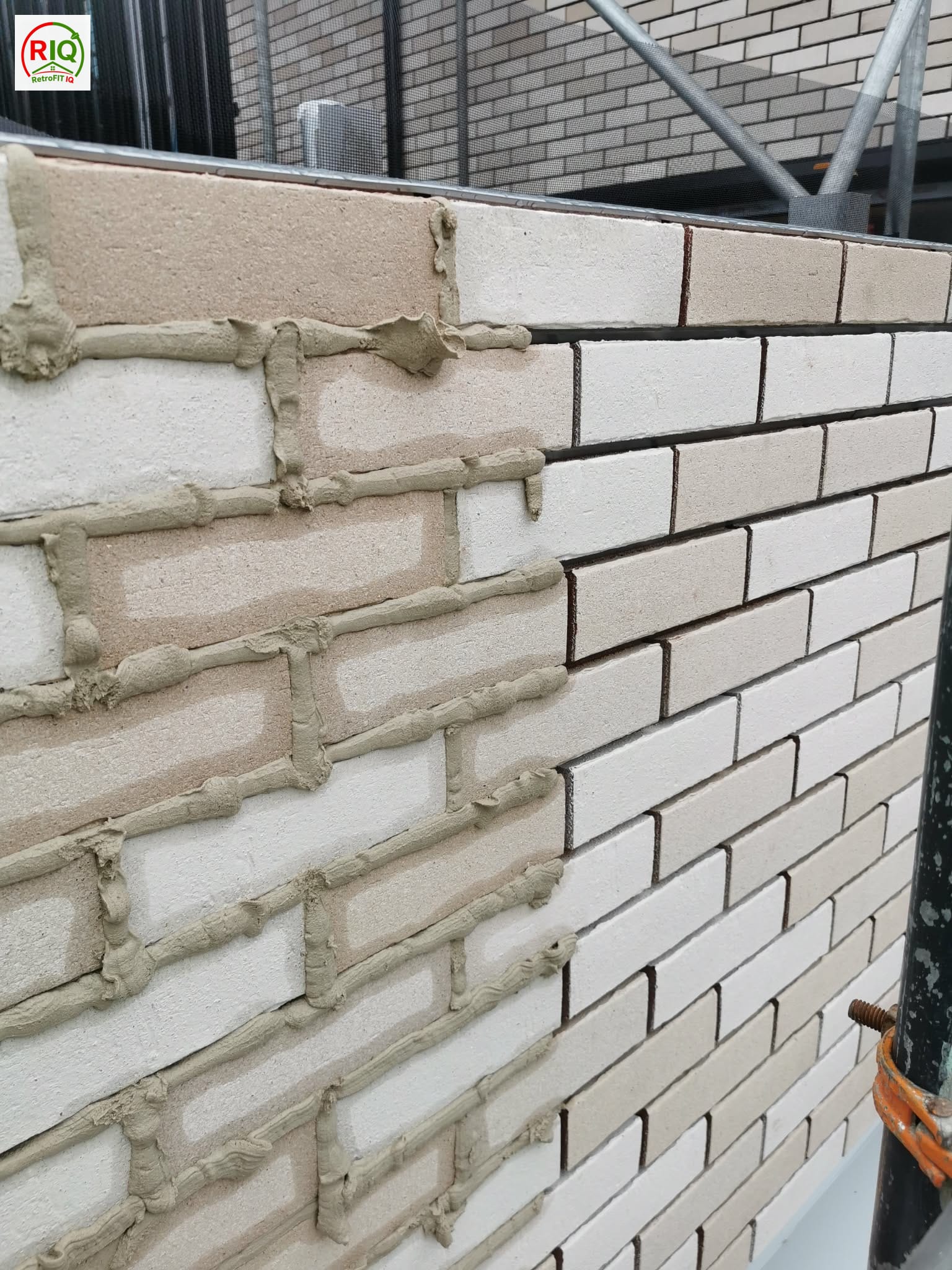


Ventilated brick-slip cladding system over mineral wool insulation — prefabricated panels, rail-mounted, finished with mortar pointing.
External Wall Insulation & Cladding — in plain English.
External Wall Insulation (EWI) wraps the outside of the building in a continuous insulation layer, eliminating cold spots and thermal bridges in one move. Combined with a render, brick-slip or ventilated cladding finish, it's the highest-performing solid-wall retrofit option available — and the only one that fully protects the original masonry from frost and driving rain.
Why external wall insulation & cladding is important.
External wall insulation is the highest-performing solid-wall upgrade available, because wrapping the building externally keeps the original masonry warm and dry and bridges almost every previous cold spot in a single move — without losing internal floor area. But that performance lives or dies in the detailing at windows, sills, eaves, ground level and party walls, where unmanaged junctions can create thermal bridges and moisture traps. Specified and detailed with building physics, EWI transforms comfort, energy use and the life of the wall; done carelessly, it simply moves the problem outside.
The right time to bring us in.
- On solid-wall homes where the façade can be altered and floor area must be preserved
- When the render or wall finish is tired and needs weatherproofing as well as insulation
- On non-traditional construction (concrete panel, no-fines) with chronic cold walls
- Across estates or HMOs needing a uniform, low-maintenance external upgrade
- When you want to combine a major performance gain with a façade refresh
The symptoms that bring people to this service.
- 01Solid-wall homes with poor U-values and high energy bills
- 02Cold-bridging at lintels, jambs, eaves and intermediate floors
- 03Tired or damp masonry needing weatherproofing as well as thermal upgrade
- 04Mid-century non-traditional construction (concrete panel, no-fines) with chronic cold-bridging
- 05Estates and HMOs needing a uniform, low-maintenance external upgrade
- 06Conservation-area-friendly brick-slip systems where rendered EWI isn't appropriate
What you tend to notice first.
- Solid-wall home with high bills and cold internal surfaces
- Cold bridging at lintels, jambs, eaves and intermediate floors
- Tired, cracked or damp render needing weatherproofing as well as insulation
- Non-traditional construction with chronic cold walls
- An estate or HMO needing a uniform, low-maintenance external upgrade
- A wish to refresh the façade while dramatically improving performance
Our diagnostic approach
- 01External thermal scan to map heat-loss patterns wall by wall
- 02Construction survey — masonry condition, frost damage, render adhesion
- 03Wind / driving-rain exposure category check (BS 8104)
- 04Reveal, sill, eaves and roof-junction detailing planned for thermal continuity
- 05Ventilated cavity vs. closed render system selected on building-physics basis
What we bring on site
- FLIR thermal camera (external, paired with internal-side verification)
- Pull-off adhesion tester for existing render assessment
- Moisture meter + RH probes for masonry condition
- Laser distance + level for substrate setting-out
- Mechanical anchor pull-out tester for fixing specification
The science behind the diagnosis.
An external insulation layer keeps the original masonry warm — well above dewpoint — so condensation forms in the (vapour-open) outer finish instead of inside the wall. Continuous insulation also bridges every previous cold-bridge: lintels, sills, intermediate floors and party-wall junctions are wrapped in one move. Done properly, EWI is the most thermally-efficient solid-wall retrofit by a wide margin.
Measured benefits — not vague promises.
- U-values typically improving from 2.0–2.2 W/m²K → 0.20–0.28 W/m²K
- Continuous insulation — thermal bridges essentially eliminated
- Original masonry kept warm and dry, extending its life
- Façade refresh: render, brick slip or ventilated cladding — your choice
- No loss of internal floor area (a major IWI trade-off)
What we design and deliver next.
Every recommendation follows our methodology — Investigate → Design → Verify — so the diagnosis on this page leads directly into an engineered, buildable and independently verified solution.
- A continuous external insulation system designed to eliminate thermal bridges
- Building-physics-led junction detailing at openings, eaves, sills and ground level
- A render, brick-slip or ventilated cladding finish matched to performance and planning
- Vapour-open build-ups that keep the masonry warm and dry
- Coordination with windows, roofs and services for thermal continuity
- Quality-assured installation with verification of the finished performance
What goes wrong on site — and why it matters.
Our diagnoses are grounded in real site experience. These are the workmanship and detailing failures we repeatedly find on this kind of work — the difference between a building that should perform and one that actually does.
Insulation boards butt-jointed in line and left with open joints create continuous thermal and air paths straight through the system.
Too few fixings, or the wrong anchor for the substrate, lead to bulging, drumminess and — in extreme cases — detachment of the system.
Reveals, sills and heads not insulated and detailed leave cold bridges around every opening and a route for water to track behind the system.
A base track set at or below ground level, with no drip, lets water track up behind the insulation and saturate the base of the wall.
In ventilated systems, missing cavity barriers compromise both fire performance and the controlled drainage the cavity relies on.
Systems
- Render-finished External Wall Insulation (EWI)
- Ventilated façade systems with rainscreen cladding
- Brick-slip, fibre-cement, timber and composite cladding
- Insulated render and silicone top-coat finishes
- Detailing for windows, reveals, sills, eaves and verges
Why ventilated façades?
- Drained, drying cavity behind the cladding
- Improved long-term durability of the substrate
- Easy panel replacement and serviceability
- Continuous external insulation reduces thermal bridging
What we commonly discover during external wall insulation & cladding investigations
- 01Solid-wall homes losing 35–45% of their heat through external walls
- 02Cold external-wall surfaces creating condensation in bedrooms
- 03Existing renders cracked, allowing moisture ingress
- 04Brick-slip cladding systems with poor support-rail detailing
- 05Thermal bridges at openings (window reveals, lintels) reducing real-world performance
Findings reflect patterns observed across completed RetrofitIQ projects — every survey is interpreted in the building’s specific context.
External Wall Insulation & Cladding — common questions
What is external wall insulation (EWI)?+
EWI adds a continuous layer of insulation to the outside face of your walls, finished with render or a cladding system such as brick slips. Because the insulation wraps the building externally, it dramatically reduces heat loss and thermal bridging while keeping the existing wall warm and dry — and it doesn't reduce your internal floor area.Should I choose EWI or internal wall insulation (IWI)?+
EWI is usually the better technical choice where it is permitted: it keeps the masonry warm, virtually eliminates thermal bridges and doesn't lose internal space. IWI is the right answer where the façade must be preserved (conservation areas, listed buildings) or where only one flat is being upgraded. We diagnose the wall and advise on the lowest-risk option for your specific property.Do I need planning permission for EWI?+
It depends. EWI is often permitted development on a typical house, but planning permission or consent is usually required in conservation areas, on listed buildings, and where it changes the appearance of a flat or terrace materially. We help you check before committing to the work.Will EWI cause damp or trap moisture?+
Done correctly, EWI keeps walls warmer and drier and reduces condensation risk. The risk comes from poor detailing — unmanaged junctions at the roof, windows, ground level and party walls. We design vapour-open, well-detailed build-ups and address any existing penetrating-damp source before installation.What finishes are available?+
Through-coloured silicone or mineral render in a wide range of colours and textures, and ventilated brick-slip or board cladding systems where a brick or panel appearance is required (for example to match neighbouring properties or satisfy planning). We specify the finish to suit both performance and appearance.Does EWI cure condensation and mould?+
It usually eliminates condensation that is caused by cold wall surfaces, because the internal surface temperature rises well above dewpoint once the wall is externally insulated. Where condensation is also driven by high indoor humidity, we pair the EWI with a ventilation strategy so the cause is fully addressed.Do you assess the building before installing EWI?+
Yes. We carry out thermal imaging and a fabric assessment first so the insulation is specified against measured heat-loss and thermal-bridge data, and so any existing damp source is corrected before the works. After installation we can verify the improvement with a follow-up thermal survey.How much disruption is involved and how long does it take?+
EWI is external, so internal disruption is minimal — you can usually stay in the property throughout. Duration depends on the size of the building and the finish; a typical house is usually a matter of weeks including scaffolding, insulation, render or cladding and detailing.
Weighing this up against the alternatives?
Independent, building-physics-led comparisons from our knowledge base — written to help you understand the difference before you decide which survey or approach you actually need.
- Internal vs External Wall InsulationRetrofit & Insulation
- U-values vs Thermal Bridging in Heat LossHeat Loss
- PIR vs Mineral Wool InsulationRetrofit & Insulation
- Loft Insulation vs Wall InsulationRetrofit & Insulation
Common problems we diagnose
The symptoms that most often lead homeowners to a external wall insulation & cladding. Each guide explains the building physics behind the problem — and how we diagnose the real cause before any work begins.
- Why are my walls cold?
- Should I get external or internal wall insulation?
- How do I reduce traffic and outside noise?
- Did insulating my walls cause damp or mould?
Part of one connected building-performance journey.
Every Retrofit IQ service is one stage of a single methodology — Investigate → Design → Verify. Explore how this service connects to the wider network of diagnostics, engineering and quality assurance.
The engineering and quality-assurance services that most often follow this one.
One company. One process. One point of responsibility.
We don’t simply identify problems. We investigate, diagnose, design solutions, carry out the work and verify the results. Book a Home Health Diagnostic Survey and we’ll tell you exactly which remedial works (if any) are actually needed.
Commission a Retrofit IQ Building Physics Assessment
After this investigation, you can commission a Building Physics Assessment for an advanced engineering analysis. A standard survey identifies the problems; this uses advanced building physics modelling to predict how your building is expected to perform after the proposed upgrade — before any work begins.
Most contractors recommend insulation. Retrofit IQ predicts how your building is expected to perform first.
Investigate → Diagnose → Design → Remediate → Verify
RetrofitIQ is not only a diagnostics company. We take projects from first investigation through to verified improvement — and you decide how far we go. Engage us for an investigation on its own, an investigation plus targeted remedial works, or a complete building-performance and retrofit project.
A measured diagnosis — thermal imaging, blower door testing, moisture and building-physics analysis — with a clear, costed report you can act on however you choose.
We investigate, then carry out targeted remedial works — airtightness, insulation, ventilation or thermal-bridge corrections — and verify the result.
A full fabric-first, Passive House-informed retrofit from diagnosis through design, installation and verification — one accountable team, one point of responsibility.
- Airtightness improvements & draught-proofing
- Internal wall insulation (IWI)
- External wall insulation (EWI)
- Loft & roof insulation
- Suspended floor & underfloor insulation
- Thermal-bridge detailing & correction
- Extract ventilation & MVHR installation
- Soundproofing & acoustic upgrades
- General building-fabric improvements
Evidence from Real Projects (7)
Real project and investigation images from our own fieldwork, matched to this page — not stock photography.

Finished ventilated brick cladding elevation with drainage pebble strip at the base

Close-up of the brick-slip cladding system

Brick-slip cladding installed onto the panel system with fresh mortar pointing

Brick-slip panels being installed onto the metal rail system over the mineral wool insulat

Prefabricated brick-slip cladding panels prepared on site, ready for installation on the s

Completed brick cladding system on a contemporary new-build
No related investigations yet.
Browse all investigationsExternal Wall Insulation & Cladding across London & the surrounding areas.
Explore building performance diagnostics, damp and condensation investigations, airtightness testing and retrofit advice in your area. We cover London, Greater London, East London, Essex, Kent, Surrey, Hertfordshire and the surrounding counties.