
Should I repair or replace my flat roof?
Deciding whether to repair or replace a flat roof is not just about the leak in front of you — it depends on the condition and age of the covering, how the roof is insulated, and whether it is a 'cold deck' or 'warm deck' construction, because those determine both how long a repair will last and whether the roof is at risk of hidden condensation. A patch repair can be sensible for an isolated fault in an otherwise sound roof, but where the covering is near the end of its life, or the build-up is a cold deck prone to condensation and rot, replacement that also corrects the insulation and ventilation is usually the better value. The right call comes from assessing the whole construction, not just the visible defect.
 Reviewed by George Sora, Certified Passive House DesignerUpdated June 2026
Quick answer & key takeaways
9 min read- The decision depends on the covering's condition and age, and on the build-up.
- Flat roofs are 'cold deck' or 'warm deck', and the type affects condensation risk.
- A patch repair suits an isolated fault in an otherwise sound roof.
- Replacement is better value where the covering is failing or the build-up is at risk.
- Biggest misconception: just fix the leak. The whole construction should be assessed.
- Retrofit IQ's approach: assess the covering, insulation and deck type, then repair or replace accordingly.
What this usually means
A flat roof has a waterproof covering over a deck, with insulation somewhere in the build-up, and how those are arranged matters as much as the covering itself. In a 'cold deck' the insulation sits below the deck, between the joists, leaving the deck and covering cold; this older arrangement is prone to condensation forming on the cold underside of the deck unless it is well ventilated, and that hidden moisture can rot the timber. In a 'warm deck' the insulation sits above the deck, so the deck and structure stay warm and dry — the more robust modern arrangement. When you face a leak or a tired roof, the build-up determines whether a repair addresses the real situation or just the symptom.
A repair makes sense when the covering is otherwise sound and the fault is localised — a split, a failed flashing, a blocked outlet — and the build-up underneath is healthy. Patching such a defect is far cheaper than replacing the roof and can give years more service. But repairs are a poor investment when the covering has reached the end of its life and is failing in multiple places, when water has already got into the build-up and the deck or insulation is wet or rotten, or when the roof is a cold deck suffering condensation that ventilation cannot resolve. In those cases each repair buys a little time while the underlying problem continues, and the costs mount.
Replacement, though more expensive up front, is often the better value where the construction is at the end of its life or fundamentally at risk, because it allows the roof to be rebuilt correctly — typically as a warm deck with the insulation above the deck, which both meets modern thermal standards and removes the condensation risk that plagues cold-deck roofs. The decision therefore turns on an assessment of the whole roof: the covering's condition and remaining life, whether the deck and insulation are dry and sound, the deck type, and the moisture behaviour. That tells you whether a targeted repair is genuinely worthwhile or whether replacement that corrects the insulation and ventilation will save money and trouble over time — rather than repeatedly patching a roof that needs rebuilding.
Common causes
End-of-life covering
A covering failing in several places is past economical repair.
Cold deck condensation
Insulation below a cold deck risks condensation and rot unless well ventilated.
Water in the build-up
A wet or rotten deck or insulation means a patch will not resolve the problem.
Localised, repairable fault
An isolated split, flashing or outlet failure in a sound roof suits a repair.
Poor original detailing
Inadequate falls, upstands or ventilation can make a roof keep failing.
Signs and symptoms
Repeated or spreading leaks
Multiple or recurring leaks suggest the covering is failing, not just faulty in one spot.
Sagging or soft deck
A deck that flexes or feels soft indicates water in the build-up and possible rot.
Condensation under the ceiling
Damp on the ceiling below can be cold-deck condensation rather than a leak.
Ponding water
Standing water from poor falls shortens the covering's life and points to detailing faults.
Old, brittle covering
A cracked, blistered or brittle covering is near the end of its serviceable life.
What most people check first
- Whether the covering is sound or failing in multiple places.
- Whether the deck and insulation are dry or water has got in.
- Whether it is a cold deck at risk of condensation.
- Whether the fault is isolated and repairable.
What most people miss
- That the deck type and insulation matter as much as the covering.
- That ceiling damp can be condensation, not a leak.
- That repeated repairs can cost more than a correct replacement.
- That replacement allows the roof to be rebuilt as a warm deck.
The building physics
A flat roof must both shed water and manage water vapour, and its build-up determines how well it does the second. In a cold-deck construction the insulation lies between the joists below the deck, so the deck and covering run cold; warm, moist air from the rooms below that reaches the underside of the cold deck can condense there, and because the space is enclosed, this interstitial condensation accumulates and can rot the timber unless a reliable ventilation path keeps the void dry — a path that is often inadequate or blocked in practice. In a warm-deck construction the insulation sits above the deck, keeping the deck and structure above the dew point, so condensation within the build-up is very unlikely; this is why the warm deck is the more robust modern standard.
The covering's condition and the state of the build-up set the durability of any intervention. A waterproof covering has a finite life and fails by cracking, blistering, splitting at upstands or failing at flashings and outlets; an isolated such failure on an otherwise sound roof with a dry build-up is genuinely repairable. But once water has entered — through the covering or via condensation — the deck and insulation can become wet and rotten, and a surface patch over a saturated build-up neither dries the structure nor restores its integrity. Poor original detailing, such as inadequate falls causing ponding or insufficient upstands, also predisposes a roof to repeated failure, so repairs to such a roof tend to be short-lived.
The repair-or-replace judgement is therefore an assessment of the whole assembly, not the leak alone. It weighs the covering's remaining life, the dryness and soundness of the deck and insulation, the deck type and its condensation behaviour, and the quality of the falls and detailing. Where these are sound and the fault isolated, a targeted repair is the proportionate, economical choice; where the covering is failing, the build-up is wet or rotten, or a cold deck is suffering unresolvable condensation, replacement — rebuilding as a warm deck with insulation above the deck — corrects the thermal and moisture performance and is the better long-term value. A building-physics assessment of the roof distinguishes these cases, preventing both unnecessary replacement and the false economy of patching a roof that needs rebuilding.
How to decide whether to repair or replace a flat roof
Assess the whole construction — the covering's life, the dryness of the deck and insulation, and the deck type — then repair an isolated fault or replace and rebuild as a warm deck where the roof is failing or at risk.
- 01
Assess the covering
Establish its condition, age and remaining life and whether failures are isolated or widespread.
- 02
Check the build-up
Determine whether the deck and insulation are dry and sound or water has got in.
- 03
Identify the deck type
Establish whether it is a cold or warm deck and its condensation behaviour.
- 04
Repair an isolated fault
Patch a localised defect where the covering and build-up are otherwise sound.
- 05
Replace where failing or at risk
Rebuild as a warm deck where the covering is failing or the build-up is wet or condensation-prone.
- 06
Correct falls and detailing
Put right inadequate falls, upstands and outlets so the new roof lasts.
How to prevent it coming back
- Assess the whole build-up, not just the leak.
- Rebuild as a warm deck to remove condensation risk where replacing.
- Correct falls and detailing to prevent ponding and repeat failure.
- Catch water in the build-up early before the deck rots.
How Retrofit IQ investigates this
We assess the covering, the build-up and the deck type so the repair-or-replace decision corrects the whole roof, not just the leak.
Do not spend money fixing symptoms before you understand the cause — investigate first, then build with confidence.
Do I need a professional investigation?
If a flat roof keeps leaking, the deck feels soft, or there is damp on the ceiling below, it is worth assessing the whole construction before deciding. Establishing the covering's remaining life, whether the deck and insulation are dry, and the deck type tells you whether a targeted repair is worthwhile or whether replacement — rebuilt as a warm deck — will correct the thermal and moisture performance and save money over repeated patching.
Where to go next
Relevant services
From the Academy
Related case studies
Evidence from Real Projects (22)
Real project and investigation images from our own fieldwork, matched to this page — not stock photography.
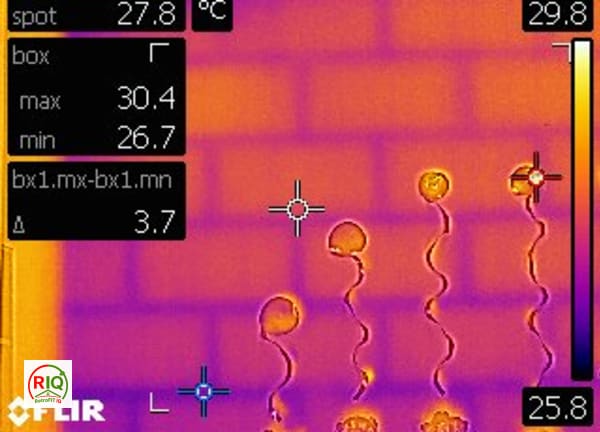
Thermal Bridging Visible Through Masonry Blockwork Wall

Thermal Bridge at Internal Corner Wall Junction

Sample Building Performance Investigation Report — Thermal Imaging

Thermal Bridge at Wall-Ceiling Junction Near Window

Bathroom external wall

Internal door head and reveal next to a framed picture on a warmer external wall
No related investigations yet.
Browse all investigationsFrequently asked questions
Should I repair or replace my flat roof?+
It depends on more than the leak: the condition and age of the covering, whether the deck and insulation are dry and sound, and whether it is a cold or warm deck. A patch repair suits an isolated fault in an otherwise sound roof; replacement — ideally rebuilt as a warm deck — is better value where the covering is failing, the build-up is wet, or a cold deck is suffering condensation.
What is a cold deck and why does it matter?+
A cold deck has the insulation below the deck, so the deck and covering run cold and moist air can condense on the underside of the deck, rotting the timber unless the void is well ventilated. It is the riskier older arrangement, which is why replacing such a roof as a warm deck — insulation above the deck — removes the condensation risk.
Is the damp on my ceiling a leak or condensation?+
It can be either. A leak lets rain in through a covering or flashing fault; cold-deck condensation forms inside the build-up from the moist air below. Distinguishing them matters, because patching the covering will not fix condensation — which is why the construction, not just the surface, should be assessed.
Are repeated repairs worth it?+
Only up to a point. Patching an isolated fault on a sound roof is economical, but once the covering is failing in several places or water has rotted the build-up, repairs buy a little time while the underlying problem continues and the costs mount. At that stage a correct replacement is usually the better value.
Why replace as a warm deck?+
Because putting the insulation above the deck keeps the deck and structure warm and dry, meeting modern thermal standards and removing the interstitial condensation that plagues cold-deck roofs. Rebuilding correctly is what turns a recurring problem roof into a durable one.
How do you decide for my roof?+
We assess the covering's condition and remaining life, check whether the deck and insulation are dry, identify the deck type and its condensation behaviour, and review the falls and detailing — then specify a targeted repair or a warm-deck replacement, so the decision corrects the whole roof rather than just the leak.
Stop guessing — find the real cause
Do not spend money fixing symptoms before you understand the cause. Every home behaves differently, and the only reliable way to know what is happening in yours is professional building performance diagnostics. At RetrofitIQ we verify buildings using the right combination of investigations:
- Thermal imaging
- Blower door testing
- Moisture & dew point readings
- Ventilation review
- Building physics assessment
- Passive House methodology