
How do I stop condensation in my bathroom?
Bathroom condensation is one of the most common and most solvable damp problems, because the moisture has a clear source — showering and bathing — and the answer is to remove it at source before it spreads and condenses on the cold walls, ceiling, mirror and window. The key is effective extraction that actually clears the steam, run for long enough, combined with keeping the surfaces warm enough not to condense. Where a bathroom keeps misting up and growing mould, it is usually because the extraction is too weak, badly placed or not run long enough, the room is cold, or moist air is escaping into the rest of the home — all of which can be put right.
 Reviewed by George Sora, Certified Passive House DesignerUpdated June 2026
Quick answer & key takeaways
8 min read- Bathroom moisture has a clear source — showering and bathing — best removed at source.
- Effective extraction that clears the steam is the primary measure.
- The fan must be adequate, well placed, and run long enough after use.
- Warmer surfaces and keeping the door shut stop the moisture spreading and condensing.
- Biggest misconception: wiping it up is enough. The steam must be extracted before it condenses.
- Retrofit IQ's approach: get the extraction right and warm the surfaces, so condensation cannot form.
What this usually means
A bathroom generates a large burst of moisture in a short time when someone showers or bathes, filling the air with warm, humid air. That moisture condenses wherever it meets a surface below its dew point — the cold window, the tiled walls, the ceiling, the mirror — leaving them wet and, over time, growing mould. The most effective way to stop this is to capture the moisture at source: extract the steam directly from the bathroom, while it is concentrated, before it spreads to cold surfaces and into the rest of the home. Trying to manage it after it has condensed — wiping surfaces, running a dehumidifier — treats the symptom while the moisture keeps being generated.
The reason bathrooms keep misting up despite having an extractor is usually that the extraction is not doing its job. The fan may be underpowered for the room, poorly positioned (too far from the shower, or where it cannot capture the steam), ducted poorly so it moves little air, or — very commonly — simply not run for long enough: a fan switched off as soon as the shower stops leaves most of the moisture still in the room. An overrun timer that keeps the fan running for a period after use, and a fan sized and placed to clear the steam, make the difference. Keeping the bathroom door closed during and after use stops the moist air spreading to cooler rooms where it condenses instead.
Surface temperature is the other half. A cold bathroom — an unheated room, cold external walls, a cold single-glazed window — has surfaces that readily fall below the dew point, so even with reasonable extraction some condensation forms; warming the room and the cold surfaces (gentle heating, insulating a cold external wall, better glazing) raises them above the dew point so condensation is less likely. The reliable cure therefore combines removing the moisture at source with effective, adequately run extraction, and keeping the surfaces warm enough not to condense. Where bathroom condensation persists, an assessment of the extraction performance, the surface temperatures and the humidity identifies which is at fault, so the fix is targeted rather than another fan that still does not clear the steam.
Common causes
Weak or poorly placed extraction
An underpowered or badly sited fan cannot clear the steam at source.
Fan not run long enough
Switching the fan off too soon leaves most of the moisture in the room.
Cold surfaces
Cold walls, ceiling, window and mirror fall below the dew point and condense.
Moist air spreading
Leaving the door open lets humid air spread to cooler rooms and condense.
Poor ducting
Badly ducted fans move little air and fail to remove the moisture.
Signs and symptoms
Misted window and mirror
Steamed-up glass after showering shows moisture not being extracted.
Wet walls and ceiling
Condensation on the surfaces indicates weak extraction and cold surfaces.
Mould in corners and grout
Mould reflects repeated condensation the extraction is not clearing.
Steam lingering after a shower
Steam that hangs around shows the fan is too weak or run too briefly.
Condensation in adjoining rooms
Damp spreading beyond the bathroom means moist air is escaping the room.
What most people check first
- Whether the extractor is adequate, well placed and clears the steam.
- Whether the fan is run long enough, ideally with an overrun timer.
- Whether the surfaces are cold enough to condense.
- Whether the door is kept shut to contain the moist air.
What most people miss
- That moisture must be extracted at source before it condenses.
- That a fan run too briefly leaves most of the moisture behind.
- That cold surfaces condense even with some extraction.
- That an open door spreads the moisture to cooler rooms.
The building physics
Bathing produces a concentrated, high-rate release of water vapour that sharply raises the bathroom air's moisture content and dew point. Condensation forms on any surface below that dew point, and bathrooms abound in cold surfaces — glazing, tiled external walls, ceilings under a cold roof, mirrors — so without rapid moisture removal, condensation is immediate and widespread. Source extraction is the most efficient control because it removes the vapour while it is concentrated at its origin, before it disperses through the dwelling; the effectiveness depends on the fan's capacity relative to the moisture release, its position relative to the source, the duct resistance, and the duration of operation, since much of the vapour remains airborne after the activity stops and is only cleared by continued extraction.
Containment and surface temperature complete the picture. An open door allows the buoyant, humid air to migrate to cooler rooms, where it condenses on their surfaces, spreading the problem; keeping the door closed during and after use confines the moisture to where the extract can capture it. Surface temperature sets the threshold: warming the room and raising the temperature of cold surfaces — through heating, insulating a cold external wall, or improving the glazing — lifts them above the dew point so the same moisture is less likely to condense. The two levers, moisture removal and surface warmth, act together; weak on either, the bathroom condenses.
Diagnosis therefore measures the extraction performance and the surface conditions rather than assuming. The fan's actual airflow and overrun, its placement and ducting, the surface temperatures, and the humidity profile reveal whether the problem is insufficient extraction, premature switch-off, cold surfaces, or escape of moist air. The remedy follows: an adequately sized, well-placed, well-ducted fan with an overrun timer, run long enough; the door kept closed; and the cold surfaces warmed. This targeted approach stops the condensation forming, in contrast to repeatedly wiping surfaces or fitting another underperforming fan — and it prevents the recurring mould that bathroom condensation otherwise sustains.
How to stop bathroom condensation for good
Remove the moisture at source with effective, adequately run extraction, contain it by keeping the door shut, and warm the cold surfaces so condensation cannot form.
- 01
Get the extraction right
Fit an adequately sized, well-placed, well-ducted fan that actually clears the steam.
- 02
Run it long enough
Use an overrun timer so the fan keeps running after showering to remove the lingering moisture.
- 03
Keep the door closed
Contain the moist air in the bathroom during and after use so it does not spread and condense elsewhere.
- 04
Warm the cold surfaces
Heat the room and address cold walls and glazing so surfaces stay above the dew point.
- 05
Check the ducting
Ensure the fan ducts efficiently to outside rather than struggling against resistance.
- 06
Verify it clears
Confirm the steam is removed and the surfaces stay dry after use.
How to prevent it coming back
- Extract the moisture at source every time the bathroom is used.
- Run the fan long enough with an overrun timer.
- Keep the door shut to contain the moist air.
- Warm cold surfaces so they do not condense.
How Retrofit IQ investigates this
We measure whether the extraction clears the moisture and whether the surfaces are too cold, so bathroom condensation is stopped at source.
Do not spend money fixing symptoms before you understand the cause — investigate first, then build with confidence.
Do I need a professional investigation?
If your bathroom keeps misting up and growing mould despite an extractor, it is worth checking why the extraction is not clearing the steam and whether the surfaces are too cold. Measuring the fan's airflow and overrun, the surface temperatures and the humidity identifies whether the problem is weak extraction, premature switch-off, cold surfaces or escaping moist air — so the fix actually stops the condensation.
Where to go next
Relevant services
Related comparisons
From the Academy
Related case studies
Related problems you may also have
Evidence from Real Projects (18)
Real project and investigation images from our own fieldwork, matched to this page — not stock photography.


No related investigations yet.
Browse all investigationsFrequently asked questions
How do I stop condensation in my bathroom?+
Remove the moisture at source with effective extraction that actually clears the steam, run for long enough — ideally with an overrun timer — keep the door closed so the moist air does not spread, and warm the cold surfaces so they stay above the dew point. Bathroom condensation is very solvable because the moisture has a clear source to extract.
Why does my bathroom mist up even with a fan?+
Usually because the extraction is not doing its job: the fan may be underpowered, poorly placed, badly ducted, or — very commonly — simply switched off too soon, leaving most of the moisture in the room. A fan sized and placed to clear the steam, run long enough, makes the difference.
How long should I run the extractor?+
Long enough to remove the moisture that lingers after showering, not just during it. An overrun timer that keeps the fan running for a period after use is the reliable way to clear the remaining humid air, rather than switching it off as soon as you finish.
Should I keep the bathroom door open or closed?+
Closed during and after use. An open door lets the warm, humid air spread to cooler rooms, where it condenses on their surfaces — spreading the problem. Keeping it shut contains the moisture where the extractor can remove it.
Do I need to warm the bathroom too?+
It helps. A cold bathroom — unheated, with cold external walls or a cold window — has surfaces that readily fall below the dew point, so even with good extraction some condensation forms. Warming the room and the cold surfaces raises them above the dew point so condensation is less likely.
How do you find out what's wrong?+
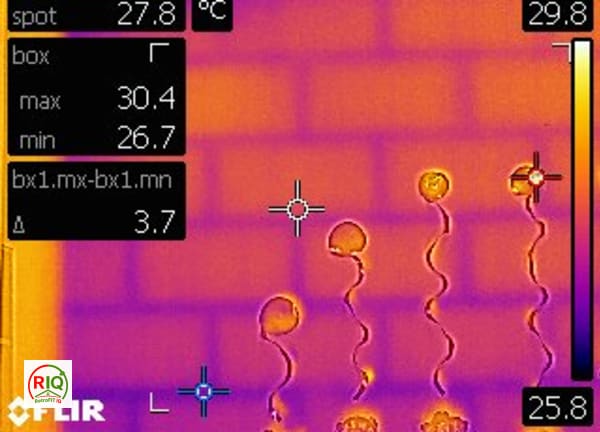
We check the fan's airflow, placement, ducting and overrun, log the humidity, and map the cold surfaces with thermal imaging — which identifies whether the problem is weak extraction, premature switch-off, cold surfaces or escaping moist air, so the fix actually stops the condensation.
Stop guessing — find the real cause
Do not spend money fixing symptoms before you understand the cause. Every home behaves differently, and the only reliable way to know what is happening in yours is professional building performance diagnostics. At RetrofitIQ we verify buildings using the right combination of investigations:
- Thermal imaging
- Blower door testing
- Moisture & dew point readings
- Ventilation review
- Building physics assessment
- Passive House methodology