
Can new windows make condensation worse?
Yes — new windows can make condensation worse, and it is a common and counter-intuitive outcome. Old, draughty windows let a lot of moisture-laden air escape; replacing them with well-sealed units stops that accidental ventilation, so indoor humidity rises. The condensation that used to form on the cold single-glazed windows (where it was visible and wiped away) now forms instead on the next-coldest surfaces — external walls, corners, behind furniture and in unheated rooms — where it is hidden and feeds mould. The windows did not create the moisture; they removed the ventilation that was managing it, so the fix is ventilation, not regret over the windows.
 Reviewed by George Sora, Certified Passive House DesignerUpdated June 2026
Quick answer & key takeaways
6 min read- New, sealed windows remove the accidental ventilation old ones provided.
- Indoor humidity rises, and condensation moves to other cold surfaces.
- It often shifts from the glass to walls, corners and behind furniture.
- The moisture was always there; the ventilation that managed it has gone.
- Biggest misconception: the windows are faulty. They removed the ventilation.
- RetrofitIQ's approach: add controlled ventilation to manage the now-trapped moisture.
What this usually means
A household generates several litres of water vapour a day. In a home with old, leaky windows, much of that escaped through the gaps, keeping indoor humidity down — and where condensation did form, it appeared on the cold single-glazed windows, which acted as a visible 'dehumidifier' that occupants wiped each morning. Fitting new, airtight windows removes both: the accidental ventilation that lowered humidity, and the cold glass that used to collect the condensation. Humidity therefore rises, and the moisture has to condense somewhere else.
That somewhere is the next-coldest surfaces in the home — poorly insulated external walls, corners, window reveals, behind wardrobes and in unheated rooms — where condensation is far more damaging than on glass because it is hidden, persistent and feeds mould. So a homeowner can replace their windows expecting to cure condensation and instead find damp walls and mould appearing, concluding the windows are faulty. They are not; they have shifted and concentrated a moisture problem the home was already producing. The proper response, ideally planned with the window replacement, is to add controlled ventilation — trickle vents (often built into the new windows), extract fans, or mechanical ventilation — so the moisture is removed rather than left to find the coldest wall.
Common causes
Lost accidental ventilation
Sealed windows stop the air change that lowered humidity.
Loss of the 'window dehumidifier'
Cold single glazing used to collect condensation visibly.
Higher indoor humidity
Trapped moisture raises humidity throughout the home.
Condensation shifting to walls
Moisture condenses on the next-coldest, hidden surfaces.
Signs and symptoms
Damp walls or mould after new windows
Condensation shifted from the glass to cold walls.
Mould behind furniture
Moisture condensing on cold, unventilated surfaces.
Stuffier air since the windows
Reduced ventilation raising humidity.
No trickle vents fitted or used
No replacement for the lost accidental ventilation.
What most people check first
- Whether ventilation fell when the windows were sealed.
- Whether trickle vents were fitted and are open.
- Whether condensation has moved to walls and corners.
- Whether indoor humidity is now high.
What most people miss
- That old windows were ventilating the home by accident.
- That cold glass used to collect condensation visibly.
- That the moisture moves to hidden, more damaging surfaces.
- That ventilation, not new glass, manages the moisture.
The building physics
Indoor humidity is set by the balance between moisture generation and the air-change rate. Leaky windows contribute a large, uncontrolled air change, so replacing them with airtight units cuts the ventilation and raises the equilibrium humidity and dew point for the same moisture generation. Condensation then forms wherever a surface is below that higher dew point; previously the coldest such surface was the single glazing, but the new, warmer glazing no longer condenses, so the next-coldest surfaces — under-insulated walls, thermal bridges at corners and reveals, and cold spots behind furniture — take over. Because these are hidden and persistently damp, the condensation that used to be a wipeable nuisance becomes a mould problem.
Preventing it means restoring controlled air change to offset the airtightness gained. Trickle ventilators in the new windows, demand-controlled extract in kitchens and bathrooms, or mechanical ventilation provide the deliberate ventilation that removes the moisture the home produces, holding humidity and dew point low enough that no surface condenses. Where the walls are also cold, raising their surface temperature with insulation further reduces the risk. Measuring indoor humidity confirms the deficit, so the window replacement is completed with the ventilation it requires — turning new windows from a cause of hidden condensation into part of a warmer, drier, properly ventilated home.
How to stop new windows worsening condensation
Restore the ventilation the old windows provided — trickle vents, extract or mechanical ventilation — and warm cold walls where needed, so the trapped moisture is removed rather than condensing on hidden surfaces.
- 01
Confirm the humidity rise
Measure indoor humidity to verify the ventilation deficit.
- 02
Open or fit trickle vents
Use the window trickle ventilators or add background ventilation.
- 03
Improve extract
Run effective kitchen and bathroom extract at source.
- 04
Consider mechanical ventilation
Add PIV or MVHR in tighter homes if needed.
- 05
Warm cold walls
Insulate cold surfaces where condensation has shifted to them.
- 06
Verify it clears
Confirm humidity and wall condensation fall.
How to prevent it coming back
- Plan ventilation as part of any window replacement.
- Fit and use trickle vents in new windows.
- Run extract fans when generating moisture.
- Warm cold walls so they don't become the new condensing surface.
How Retrofit IQ investigates this
We confirm the ventilation deficit new windows can create and specify the air change to fix it.
Do not spend money fixing symptoms before you understand the cause — investigate first, then build with confidence.
Do I need a professional investigation?
If condensation or mould has appeared on walls and corners since new windows were fitted, it is worth measuring the indoor humidity and reviewing the ventilation. That confirms the windows removed the air change the home relied on, so adding controlled ventilation — and warming cold walls — manages the moisture properly.
Where to go next
Relevant services
Related problems you may also have
Evidence from Real Projects (18)
Real project and investigation images from our own fieldwork, matched to this page — not stock photography.
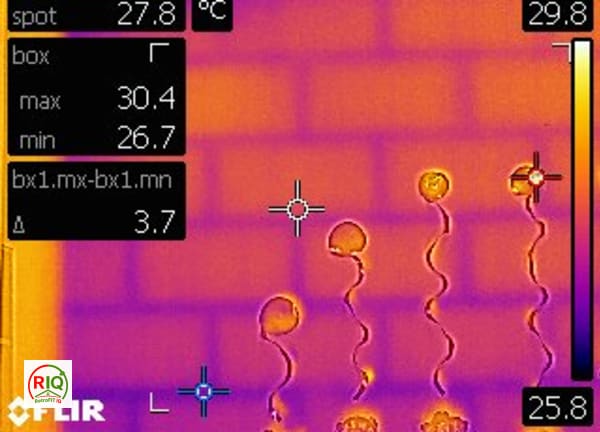
Thermal Bridging Visible Through Masonry Blockwork Wall

Sample Building Performance Investigation Report — Thermal Imaging

Thermal Bridge at Internal Corner Wall Junction

Thermal Bridge at Wall-Ceiling Junction Near Window

Airtightness Testing in a Stratford Victorian Terrace

Calibrated blower door fan installed in the front doorway, sealed with the red airtight pa
No related investigations yet.
Browse all investigationsFrequently asked questions
Can new windows make condensation worse?+
Yes. Old, draughty windows let moisture-laden air escape; new, sealed ones stop that, so indoor humidity rises. The condensation that used to form on the cold single glazing now forms on the next-coldest surfaces — walls, corners and behind furniture — where it's hidden and feeds mould. The windows removed the ventilation that managed the moisture.
Are my new windows faulty?+
Usually not. They've done their job of sealing the home; the problem is that the moisture the home produces is now trapped because the accidental ventilation has gone. The fix is to add controlled ventilation, not to replace the windows.
Why has condensation moved to my walls?+
Because the new glazing is warmer and no longer the coldest surface, so the rising humidity condenses instead on the next-coldest surfaces — under-insulated walls, corners and reveals. This is more damaging than condensation on glass because it's hidden and persistent and grows mould.
How do I fix it?+
Restore the ventilation: open or fit trickle vents in the windows, run effective extract fans, and in tighter homes consider PIV or MVHR. Where walls are cold, insulating them helps too. Measuring the indoor humidity shows how much extra air change is needed.
Could this have been prevented?+
Yes — ventilation should be planned as part of any window replacement. Fitting and using trickle ventilators and ensuring adequate extract keeps humidity down so the new windows make the home drier, not damper.
Stop guessing — find the real cause
Do not spend money fixing symptoms before you understand the cause. Every home behaves differently, and the only reliable way to know what is happening in yours is professional building performance diagnostics. At RetrofitIQ we verify buildings using the right combination of investigations:
- Thermal imaging
- Blower door testing
- Moisture & dew point readings
- Ventilation review
- Building physics assessment
- Passive House methodology