
Thermal Imaging vs Visual Inspection: Seeing What the Eye Cannot
Thermal imaging (infrared inspection) vs Visual inspection.
 Reviewed by George Sora, Certified Passive House DesignerUpdated June 2026
Quick answer & key takeaways
5 min read- Bottom line: A visual inspection records the condition of what you can see; thermal imaging reveals what you cannot — insulation gaps, thermal bridges, air leakage and damp hidden behind finishes.
- When Thermal imaging is enough: You need to find a hidden insulation gap, bridge or air path
- When Visual inspection is the better choice: You are assessing condition, cracks or movement
- When you need both: You want a full picture of condition and performance
- Biggest misconception: “A good surveyor can see insulation problems by eye.” — Concealed insulation gaps and thermal bridges leave no visible sign. They show up as temperature patterns, not surface marks.
- Retrofit IQ’s approach: We pair the infrared camera with a trained eye: the camera shows what is concealed, the visual inspection reads condition, and together they prevent the classic error of judging a building only by what can be seen.
Quick answer
A visual inspection records the condition of what you can see; thermal imaging reveals what you cannot — insulation gaps, thermal bridges, air leakage and damp hidden behind finishes. They are complementary: the eye catches cracks, staining and obvious defects, while the camera exposes the building-physics problems concealed inside walls and ceilings. For diagnosing performance issues such as cold rooms, draughts or mould, the visual check alone is rarely enough.
At a glance
| Attribute | Thermal imaging (infrared inspection) | Visual inspection |
|---|---|---|
| Sees hidden defects | Yes — within ΔT limits | No — surface only |
| Detects insulation gaps | Yes | Only where exposed |
| Detects thermal bridges | Yes | No |
| Detects air leakage | Yes (with pressure) | Rarely |
| Records condition/cracks | Indirectly | Yes — its core strength |
| Needs temperature difference | Yes | No |
| Best for | Performance diagnosis | Condition assessment |
What is Thermal imaging (infrared inspection)?
An infrared camera detects temperature differences on surfaces, revealing problems hidden behind plaster and finishes — missing insulation, cold bridges, air leakage and evaporating moisture — that are completely invisible to the eye.
What is Visual inspection?
A trained surveyor or builder looks at the building and records what can be seen: cracks, staining, condition of finishes, obvious defects and signs of wear. It is essential for assessing condition but cannot reveal what is concealed within the construction.
What each method measures — and what it doesn’t
Thermal imaging
- Surface temperature differences invisible to the eye
- Concealed insulation gaps and slumping
- Thermal bridging at hidden junctions
- Cool, evaporating damp signatures
- Whether a crack is structurally significant
- Moisture content (needs a meter to confirm)
- Defects with no temperature signature
Visual inspection
- Visible cracks, movement and staining
- Condition of finishes, pointing and seals
- Obvious water ingress and decay
- Workmanship visible on the surface
- Anything concealed behind plaster or cladding
- Insulation continuity inside a wall
- Air-leakage paths within the construction
The building science
Most building-performance problems live out of sight. Insulation is installed inside cavities, behind plasterboard or above ceilings; air-leakage paths run through service penetrations and junctions; thermal bridges occur where the construction changes behind the finish. None of this is accessible to a purely visual inspection, which can only report on the skin of the building.
Thermal imaging works because heat reveals these hidden features as patterns on the surface. Missing insulation lets a wall run colder; a thermal bridge draws heat to a localised cold line; air leakage produces moving cold plumes when the house is depressurised. The camera translates concealed building physics into a visible image — but it depends on there being a temperature difference to read, and on skilled interpretation to avoid mistaking a reflection or a thermal-mass effect for a defect.
A visual inspection retains its own irreplaceable value. It assesses condition and risk: the things you can and should see — cracking, movement, failed pointing, blocked gutters, decayed timber, staining. These are exactly what a buyer's surveyor is trained to record, and a thermal camera does not replace that judgement.
The two together form a complete picture: the eye for condition and obvious defects, the camera for the hidden performance problems. For comfort, energy and damp investigations, leaving the camera out means diagnosing with one eye closed — which is why instrumented diagnostics consistently find causes that a visual survey alone records only as symptoms.
Key differences
- Visual inspection sees the surface; thermal imaging sees beneath it.
- The eye catches cracks and condition; the camera catches insulation gaps, bridges and air paths.
- Thermal imaging needs a temperature difference; visual inspection works in any conditions.
- Neither replaces the other — condition and performance are different questions.
Common misconceptions
Myth: A good surveyor can see insulation problems by eye.
Concealed insulation gaps and thermal bridges leave no visible sign. They show up as temperature patterns, not surface marks.
Myth: If nothing is visible, the building is fine.
Many serious performance and moisture problems are hidden until they cause damage. Imaging finds them earlier.
Myth: Thermal imaging makes a visual survey unnecessary.
It doesn't. Condition, structural movement and obvious defects still need a trained visual assessment.
Real-world situations
A cold room with no visible cause
Thermal imaging to reveal the hidden insulation gap or thermal bridge behind the finish.
Buying a property and assessing condition and risk
A visual condition survey; add thermal imaging if comfort, damp or retrofit potential matter to you.
Recurring mould with clean, intact decoration
Thermal imaging plus moisture and humidity logging — the cause is usually a cold surface or air path you cannot see.
Checking the quality of recent insulation work
Thermal imaging to confirm continuity, since a tidy visible finish can hide gaps and slumping behind it.
Which do you actually need?
When Thermal imaging is enough
- You need to find a hidden insulation gap, bridge or air path
- You are diagnosing cold spots, draughts or concealed damp
- You want to verify hidden work
When Visual inspection is the better choice
- You are assessing condition, cracks or movement
- You need a record of visible defects for buying or maintenance
- There is no useful temperature difference to image
When you need both
- You want a full picture of condition and performance
- You are planning a retrofit or investigating comfort problems
- Symptoms are visible but the cause is not
What Retrofit IQ checks on site
We pair the infrared camera with a trained eye: the camera shows what is concealed, the visual inspection reads condition, and together they prevent the classic error of judging a building only by what can be seen.
- Full thermal imaging survey of accessible elements with interpretation
- Visual assessment of condition, finishes and obvious defects
- Depressurisation with the blower door to amplify air-leakage signatures
- Moisture and humidity readings to confirm any damp the camera flags
- Correlation of hidden findings with the visible context of the building
- A clear distinction between condition issues and performance issues
What a Certified Passive House Designer recommends
A visual inspection answers 'what can I see?'; thermal imaging answers 'what is actually happening?'. Most of the problems that make a home cold, draughty or mouldy are concealed, so relying on the eye alone means recording symptoms while the cause stays hidden behind the plaster.
I use the two deliberately together: the visual assessment grounds the survey in the building's condition and history, and the camera — under depressurisation, with moisture readings to confirm — turns invisible building physics into evidence. That is how you specify a fix for the cause rather than redecorating over it.
— George Sora, Certified Passive House Designer, Founder, RetrofitIQ
Reviewed using current building physics principles and Passive House methodology.
Related services
Related comparisons
Related investigations
Compare another way
Closely related comparisons our clients read next.
Building Performance Diagnostic vs a Standard Survey
A standard survey tells you the condition of the building; a building performance diagnostic tells you how it actually performs — where it loses heat, leaks air, suffers damp and wastes energy — using instruments rather than visual inspection alone.
Read comparisonThermal Imaging vs Borescope Inspection
Thermal imaging maps where problems are across whole surfaces without touching the building; a borescope lets you look directly inside a cavity at a single point, but only after drilling a small hole.
Read comparisonThermal Imaging vs Moisture Meter for Finding Damp
Thermal imaging finds where to look; a moisture meter confirms what is actually there.
Read comparisonInvestigation-led Retrofit vs Build First, Diagnose Later
Investigation-led retrofit measures and diagnoses the cause before any work is specified; 'build first, diagnose later' recommends work from visible symptoms and fixes problems afterwards.
Read comparisonEvidence from Real Projects (12)
Real project and investigation images from our own fieldwork, matched to this page — not stock photography.
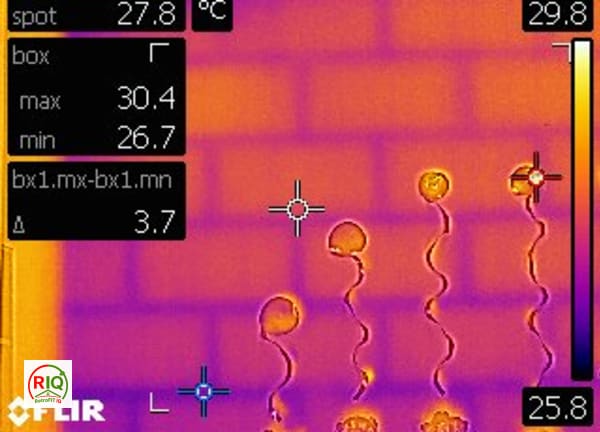
Thermal Bridging Visible Through Masonry Blockwork Wall

Sample Building Performance Investigation Report — Thermal Imaging

Thermal Bridge at Wall-Ceiling Junction Near Window

Thermal Bridge at Internal Corner Wall Junction

Airtightness Testing in a Stratford Victorian Terrace

Acoustic Floor Upgrades: Mineral Wool Insulation Between Joists
No related investigations yet.
Browse all investigationsFrequently asked questions
Can a visual inspection find missing insulation?+
Only where it is exposed. Insulation concealed within walls, cavities or ceilings leaves no visible sign — it shows up as a temperature pattern under thermal imaging.
Is thermal imaging better than a normal survey?+
It is different. A normal visual survey assesses condition; thermal imaging diagnoses hidden performance and moisture problems. For most homes the two together are best.
What can thermal imaging see that the eye can't?+
Concealed insulation gaps and slumping, thermal bridges, air-leakage paths and cool evaporating-damp signatures — all invisible on an intact, well-decorated surface.
Does thermal imaging work through walls?+
No. It reads surface temperature, not through-wall images. It detects how hidden features affect the surface temperature you can measure.
When is a visual inspection enough on its own?+
When you only need to assess condition, cracks and obvious defects — for example a basic maintenance check — and performance or damp is not a concern.
Why didn't my surveyor spot the cold-wall problem?+
A visual survey is not designed to detect hidden insulation gaps or thermal bridges; those need infrared imaging and an understanding of building physics.
Can the camera confirm damp?+
It flags cool, suspect areas, but moisture must be confirmed with a meter. A cold patch is not automatically wet.
Do I need a temperature difference for the camera to work?+
Yes — typically around 10–15°C between inside and outside. Without it, surfaces look uniform and defects are hard to see.
Will furniture and clutter affect the survey?+
Furniture against external walls and items on the floor can mask areas, so we ask for key surfaces to be accessible where possible.
Is the inspection non-destructive?+
Yes. Both visual inspection and thermal imaging are entirely non-invasive; any moisture confirmation uses minimal-impact readings.
Can you tell a structural crack from a thermal one?+
We combine visual assessment with imaging; significant structural concerns are referred for specialist structural advice — our focus is building performance.
How long does a combined survey take?+
For a typical home, a few hours on site, depending on size, access and the number of issues being investigated.
Can thermal imaging verify a builder's insulation work?+
Yes. It reveals whether the insulation is continuous and effective, even when the visible finish looks perfect.
Do you provide annotated images?+
Yes — the report includes interpreted thermal images alongside the visual findings, so you can see exactly what was found and where.
Who interprets the images?+
A Certified Passive House Designer, so findings are read in the context of how the building should perform, not just as colourful pictures.
Need professional advice?
A comparison like this helps you understand the theory, but every property behaves differently. The only reliable way to establish the real cause in your home — rather than guessing — is professional building performance diagnostics. At RetrofitIQ we verify buildings using the appropriate combination of investigations:
- Thermal imaging
- Blower door testing
- Moisture investigation
- Building physics assessment
- Passive House methodology