
Thermal Imaging vs Borescope: Mapping the Problem vs Looking Inside
Thermal imaging vs Borescope inspection.
 Reviewed by George Sora, Certified Passive House DesignerUpdated June 2026
Quick answer & key takeaways
5 min read- Bottom line: Thermal imaging maps where problems are across whole surfaces without touching the building; a borescope lets you look directly inside a cavity at a single point, but only after drilling a small hole.
- When Thermal imaging is enough: You need to survey whole surfaces quickly
- When Borescope is the better choice: You need to confirm what is actually inside a cavity
- When you need both: You want to map a problem and prove its cause
- Biggest misconception: “A borescope can survey the whole house.” — It only sees a few centimetres around each hole. To cover a building you would need countless holes — which is why imaging comes first.
- Retrofit IQ’s approach: We let the camera decide where to look and the borescope confirm what is there, so any drilling is targeted and minimal — diagnosing cavity and insulation condition from evidence rather than assumption.
Quick answer
Thermal imaging maps where problems are across whole surfaces without touching the building; a borescope lets you look directly inside a cavity at a single point, but only after drilling a small hole. The camera is the survey tool that finds and prioritises suspect areas; the borescope is the confirmation tool that verifies exactly what is happening at a chosen location. Used in sequence — image first, then borescope the key spots — they give both breadth and certainty.
At a glance
| Attribute | Thermal imaging | Borescope inspection |
|---|---|---|
| Coverage | Whole surfaces at once | One point per hole |
| Invasive? | No — non-contact | Yes — requires a small hole |
| Shows actual cavity contents | No — infers from temperature | Yes — direct view |
| Locates defects across a room | Yes | No — point only |
| Confirms what is inside | Indirectly | Directly |
| Speed for whole house | Fast | Slow, targeted |
| Best role | Find and prioritise | Confirm and verify |
What is Thermal imaging?
A non-contact infrared survey that maps temperature patterns across whole walls and ceilings, revealing where insulation is missing, where thermal bridges occur and where air or moisture is moving — across large areas in a short time.
What is Borescope inspection?
A small camera on a flexible probe inserted through a drilled hole into a cavity, void or wall build-up to look directly at what is inside — the actual insulation, debris, cavity condition or construction — at one specific point.
What each method measures — and what it doesn’t
Thermal imaging
- Surface-temperature patterns across whole elements
- Where insulation appears missing, slumped or bridged
- Air movement and damp signatures (with context)
- The literal contents of a cavity
- Certainty about what causes a cold pattern without confirmation
Borescope
- The actual contents and condition of a specific cavity
- Whether insulation is present, the type and how it sits
- Debris, mortar snots, cavity bridging or trapped moisture at that point
- Anything beyond the immediate field of view of the probe
- The extent of a problem across the whole wall
- Where else the same defect occurs
The building science
These two tools sit at opposite ends of a useful spectrum: breadth versus certainty. Thermal imaging scans large areas quickly and non-invasively, but it infers what is happening inside from the temperature it reads on the outside. A cold band might be missing insulation, a mortar bridge or a structural element — the image narrows it down but does not always prove the cause.
A borescope removes that doubt at a point. Drill a discreet hole, feed in the probe, and you see the cavity itself: whether insulation is present, what type, whether it has slumped, whether debris is bridging the cavity, or whether there is trapped moisture. The certainty is high, but the view is tiny — a few centimetres around the probe — and each location needs its own hole.
The building-physics logic is to use them in order. The thermal survey identifies the suspect zones and patterns across the whole building; the borescope then confirms the cause at the handful of locations that matter, so any remedial specification is based on proof rather than inference. Drilling at random without imaging first is wasteful and often misses the real problem area.
This pairing is particularly valuable for cavity walls and concealed insulation, where the question is not just 'is it cold here?' but 'why, and is it the same everywhere?'. The camera answers the first and maps the extent; the borescope answers the second with a direct look — together they support a confident, targeted fix.
Key differences
- Thermal imaging is broad and non-invasive; the borescope is pinpoint and slightly invasive.
- The camera infers from surface temperature; the borescope shows the cavity directly.
- Imaging maps the extent of a problem; the borescope confirms its cause at a point.
- Best practice is to image first, then borescope the key locations.
Common misconceptions
Myth: A borescope can survey the whole house.
It only sees a few centimetres around each hole. To cover a building you would need countless holes — which is why imaging comes first.
Myth: Thermal imaging proves what is inside the wall.
It strongly indicates, but a direct look with a borescope removes the doubt where it matters.
Myth: Borescope inspection is very destructive.
It needs only a small, easily made-good hole per location — minor compared with opening up construction.
Real-world situations
Cold patterns suggest cavity insulation has slumped
Thermal imaging to map the affected areas, then a borescope at the worst points to confirm slumping or gaps.
Suspected debris or bridging in a cavity wall
Borescope at the location the camera flags, to see the obstruction directly before deciding on remedial work.
Verifying retrofitted cavity-wall insulation
Imaging to check overall coverage and continuity, with borescope spot-checks where coverage looks doubtful.
Damp at a localised cold spot
Imaging plus moisture readings to map it, then a borescope if the cause is likely inside the cavity.
Which do you actually need?
When Thermal imaging is enough
- You need to survey whole surfaces quickly
- You want to find and prioritise suspect areas
- You prefer a non-invasive first pass
When Borescope is the better choice
- You need to confirm what is actually inside a cavity
- You are verifying insulation type or slumping at a point
- You suspect debris, bridging or trapped moisture
When you need both
- You want to map a problem and prove its cause
- You are specifying remedial cavity works
- You are verifying retrofitted insulation properly
What Retrofit IQ checks on site
We let the camera decide where to look and the borescope confirm what is there, so any drilling is targeted and minimal — diagnosing cavity and insulation condition from evidence rather than assumption.
- Thermal imaging of all accessible walls and ceilings to map suspect zones
- Targeted borescope inspection at the locations the imaging identifies
- Assessment of insulation type, condition and continuity within the cavity
- Checks for cavity bridging, debris and trapped moisture
- Making good of borescope holes after inspection
- A combined report linking mapped patterns to the confirmed cause
What a Certified Passive House Designer recommends
I treat thermal imaging and the borescope as a find-then-confirm pair. The camera does the heavy lifting across the whole building and tells me where to look; the borescope removes any remaining doubt at the few points that will drive the remedial decision. Drilling holes without imaging first is guesswork.
For cavity walls especially, this combination saves money. Instead of assuming the insulation is fine — or, worse, ripping it out wholesale — we map where it has failed and prove the cause at those points, so the repair is precise and proportionate.
— George Sora, Certified Passive House Designer, Founder, RetrofitIQ
Reviewed using current building physics principles and Passive House methodology.
Related services
Related comparisons
Related investigations
Compare another way
Closely related comparisons our clients read next.
Thermal Imaging vs Visual Inspection
A visual inspection records the condition of what you can see; thermal imaging reveals what you cannot — insulation gaps, thermal bridges, air leakage and damp hidden behind finishes.
Read comparisonThermal Imaging vs Moisture Meter for Finding Damp
Thermal imaging finds where to look; a moisture meter confirms what is actually there.
Read comparisonInternal vs External Wall Insulation
EWI is generally the better building-physics solution because it keeps the wall warm and the insulation continuous, reducing thermal bridges and condensation risk.
Read comparisonThermal Imaging vs a Damp Survey
Thermal imaging is one tool within a proper damp survey, not a replacement for it.
Read comparisonEvidence from Real Projects (17)
Real project and investigation images from our own fieldwork, matched to this page — not stock photography.
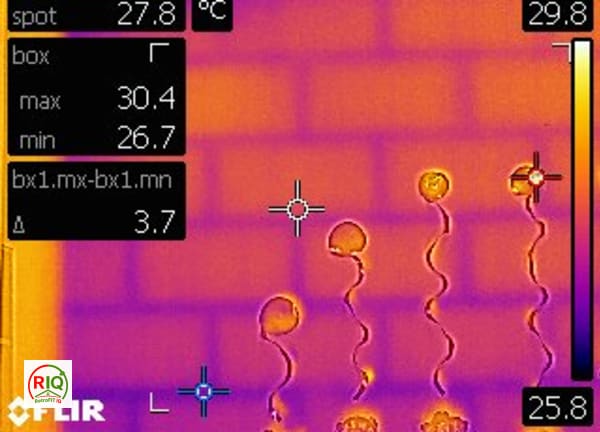
Thermal Bridging Visible Through Masonry Blockwork Wall

Thermal Bridge at Internal Corner Wall Junction

Sample Building Performance Investigation Report — Thermal Imaging

Thermal Bridge at Wall-Ceiling Junction Near Window

Acoustic Floor Upgrades: Mineral Wool Insulation Between Joists

Airtightness Testing in a Stratford Victorian Terrace
No related investigations yet.
Browse all investigationsFrequently asked questions
What is a borescope inspection?+
It uses a small camera on a flexible probe, inserted through a discreet hole, to look directly inside a cavity, void or wall build-up at a specific point.
Is thermal imaging or a borescope better?+
Neither alone — they do different jobs. Thermal imaging maps problems across whole surfaces; a borescope confirms exactly what is inside at a chosen point. Together they give breadth and certainty.
Does a borescope require drilling?+
Yes, a small hole per location, which is easily made good. It is far less disruptive than opening up the construction.
Can thermal imaging see inside a cavity?+
Not literally. It reads surface temperature and infers what is inside; a borescope provides the direct view to confirm it.
Why image before using a borescope?+
So the borescope is used precisely, at the points that matter, rather than drilling at random and possibly missing the real problem.
How many borescope holes are needed?+
Only as many as the imaging indicates — usually a small number at the key suspect locations, not throughout the wall.
Can this check retrofitted cavity insulation?+
Yes. Imaging checks overall coverage and continuity; borescope spot-checks confirm the insulation type and condition where coverage looks doubtful.
Will it find cavity bridging or debris?+
A borescope can show bridging, mortar snots and debris directly at the point inspected, which thermal imaging may have flagged as a cold or damp pattern.
Is the inspection messy?+
Minimal — a small amount of dust from each hole, which we make good. The borescope itself leaves nothing behind.
Does it work in solid walls?+
A borescope is most useful where there is a cavity or void to look into. For solid walls, thermal imaging and surface diagnostics usually tell us more.
Can you confirm slumped insulation?+
Yes — imaging shows the cold pattern slumping creates, and a borescope at that point confirms the insulation has dropped or compressed.
Is trapped moisture detectable?+
Imaging can flag a cool damp signature; a borescope may reveal visible dampness or staining inside the cavity, confirmed with moisture readings.
How long does the combined inspection take?+
Imaging is quick across the house; borescope work adds time per location, so allow extra for the targeted points.
Do I get photos from inside the cavity?+
Yes — borescope stills or video can be included in the report alongside the thermal images.
Who carries out the inspection?+
A Certified Passive House Designer, ensuring the findings are interpreted in terms of building performance and a proportionate remedy.
Need professional advice?
A comparison like this helps you understand the theory, but every property behaves differently. The only reliable way to establish the real cause in your home — rather than guessing — is professional building performance diagnostics. At RetrofitIQ we verify buildings using the appropriate combination of investigations:
- Thermal imaging
- Blower door testing
- Moisture investigation
- Building physics assessment
- Passive House methodology