

Soundproofing & Acoustics in East London
Acoustic assessments and full soundproofing solutions for residential properties — addressing both airborne noise (voices, TV, traffic) and impact noise (footsteps, vibrations). Specialist building-performance diagnostics across East London — E1-E20 · IG (Ilford, Woodford, Loughton) · RM (Romford, Hornchurch, Dagenham).
What we typically diagnose across East London.
From the converted Victorian terraces of Walthamstow and Leyton through the warehouse conversions of Hackney Wick and Bow to the new-build estates of Stratford and Canary Wharf — East London has one of the most varied building stocks in the capital. Our diagnostics-led approach matches the remedy to the actual construction, not a generic assumption.
- Solid-wall Victorian terraces in Stratford, Bethnal Green, Hackney, Leyton and Walthamstow with no cavity to fill
- Warehouse conversions with single-glazed industrial windows and no perimeter thermal break
- Bow and Hackney warehouse conversions with chronic mould on inside faces of single-skin brick walls
- High-occupancy HMOs across Newham and Waltham Forest with persistent kitchen and bathroom condensation
- Warehouse conversions with original cast-iron column-to-floor junctions left open
One process — every service is a stage of it.
We never jump to a fix. We investigate and measure, diagnose the real cause, design the solution, carry out the works and verify the result.
 RW5 Acoustic Mineral Wool
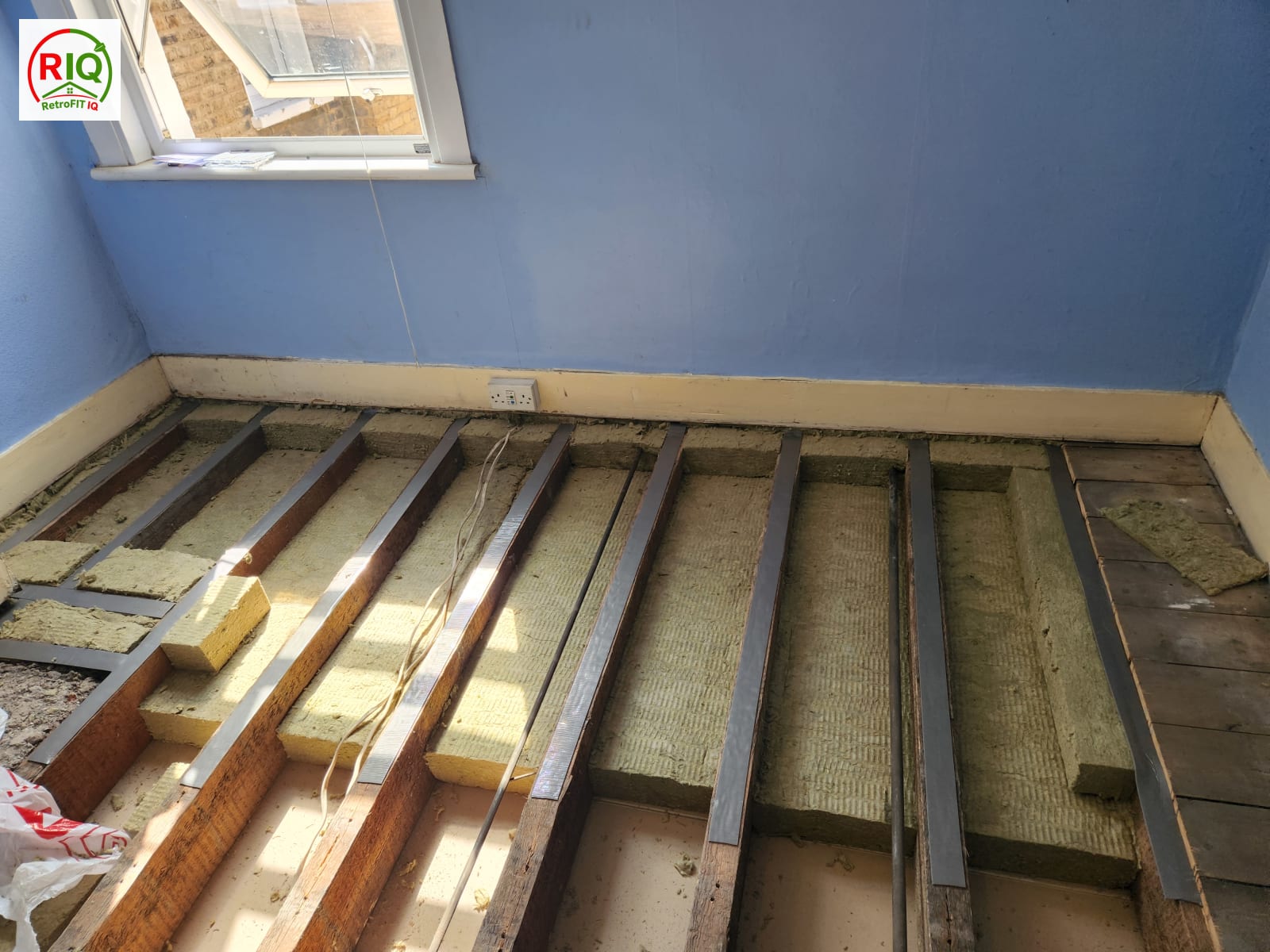 Resilient Decoupling
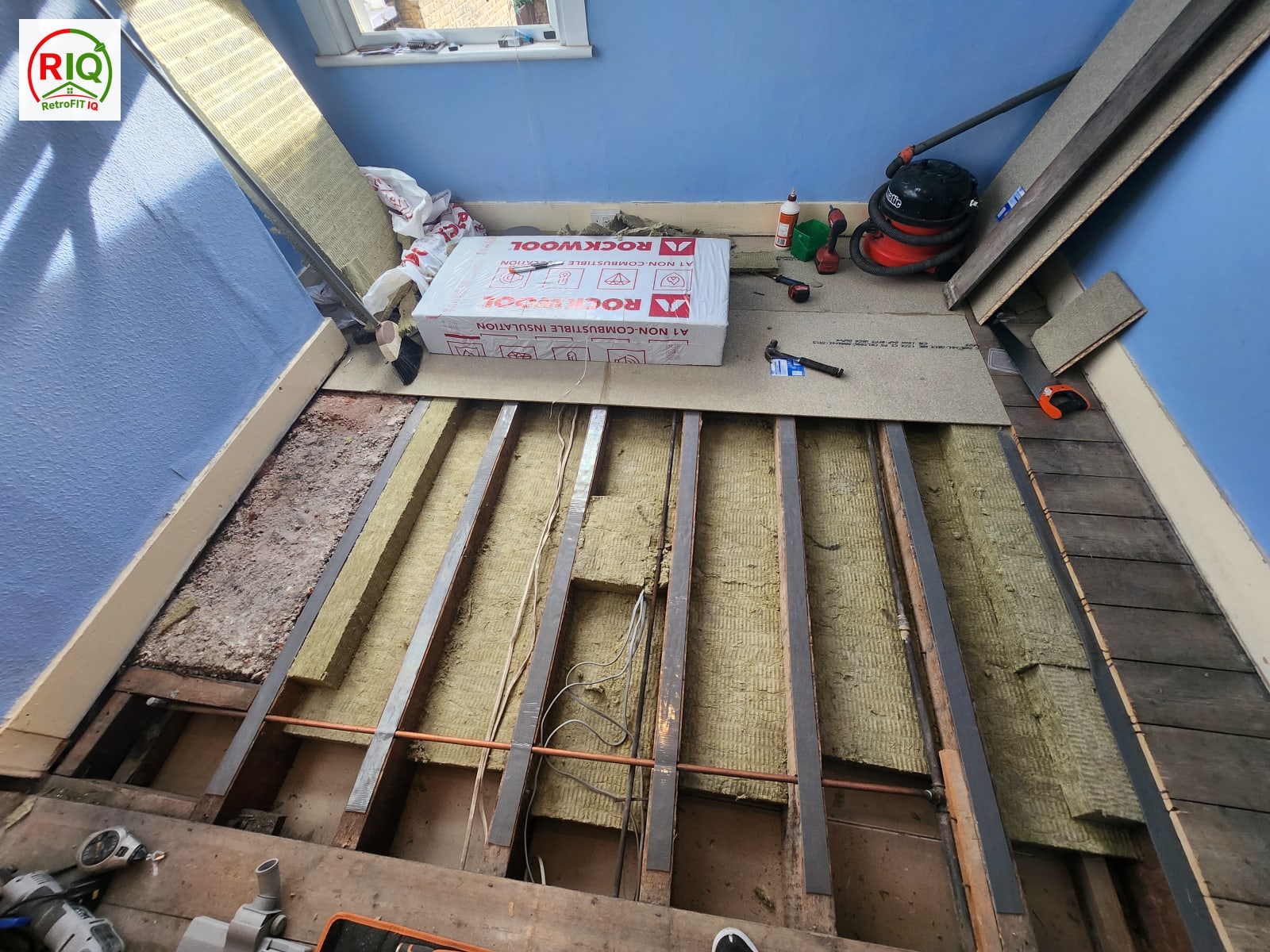 Acoustic Build-Up
 Finished Room
 Floor Lifted
 Acoustic Insulation
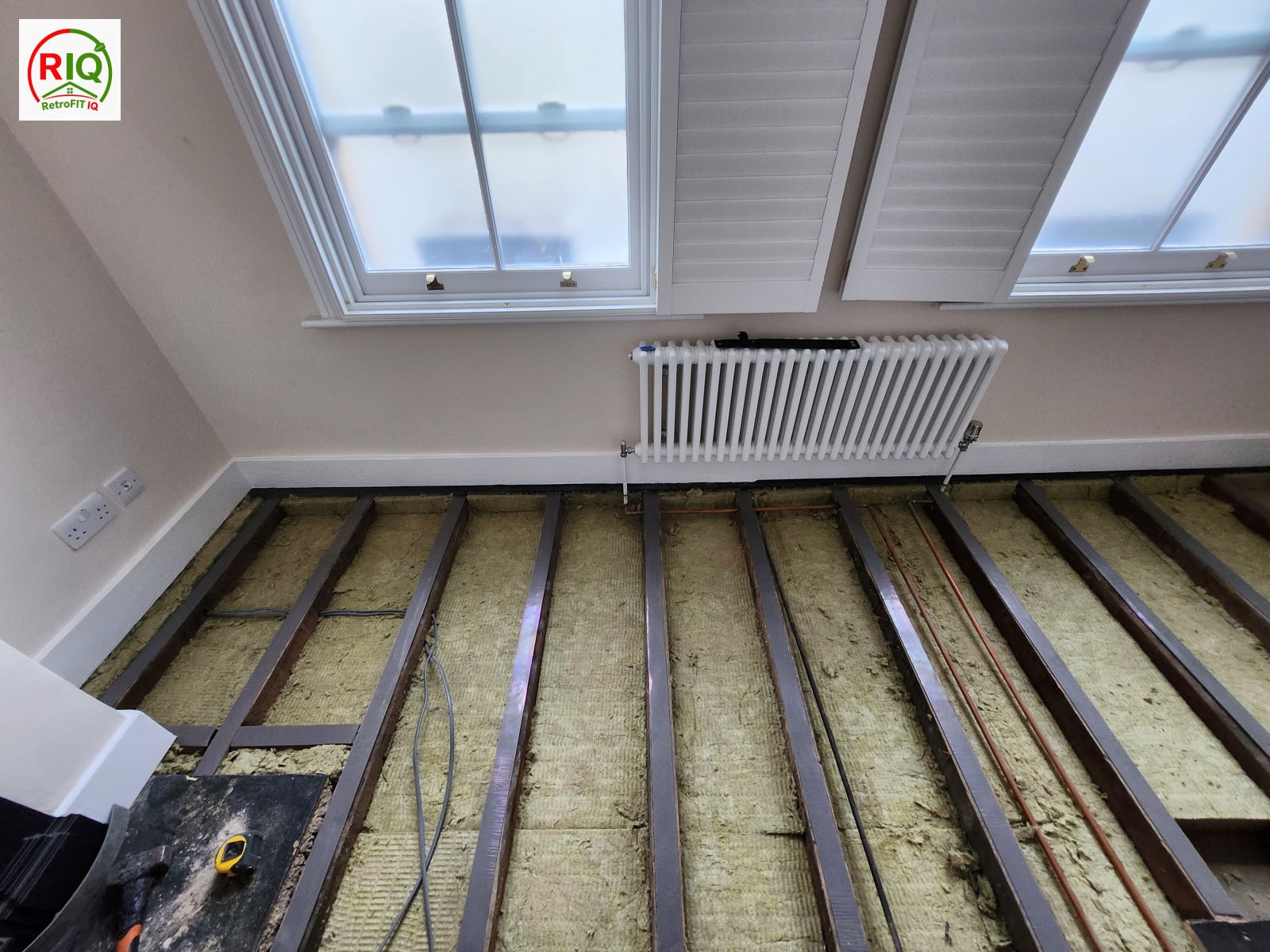 Resilient Bars
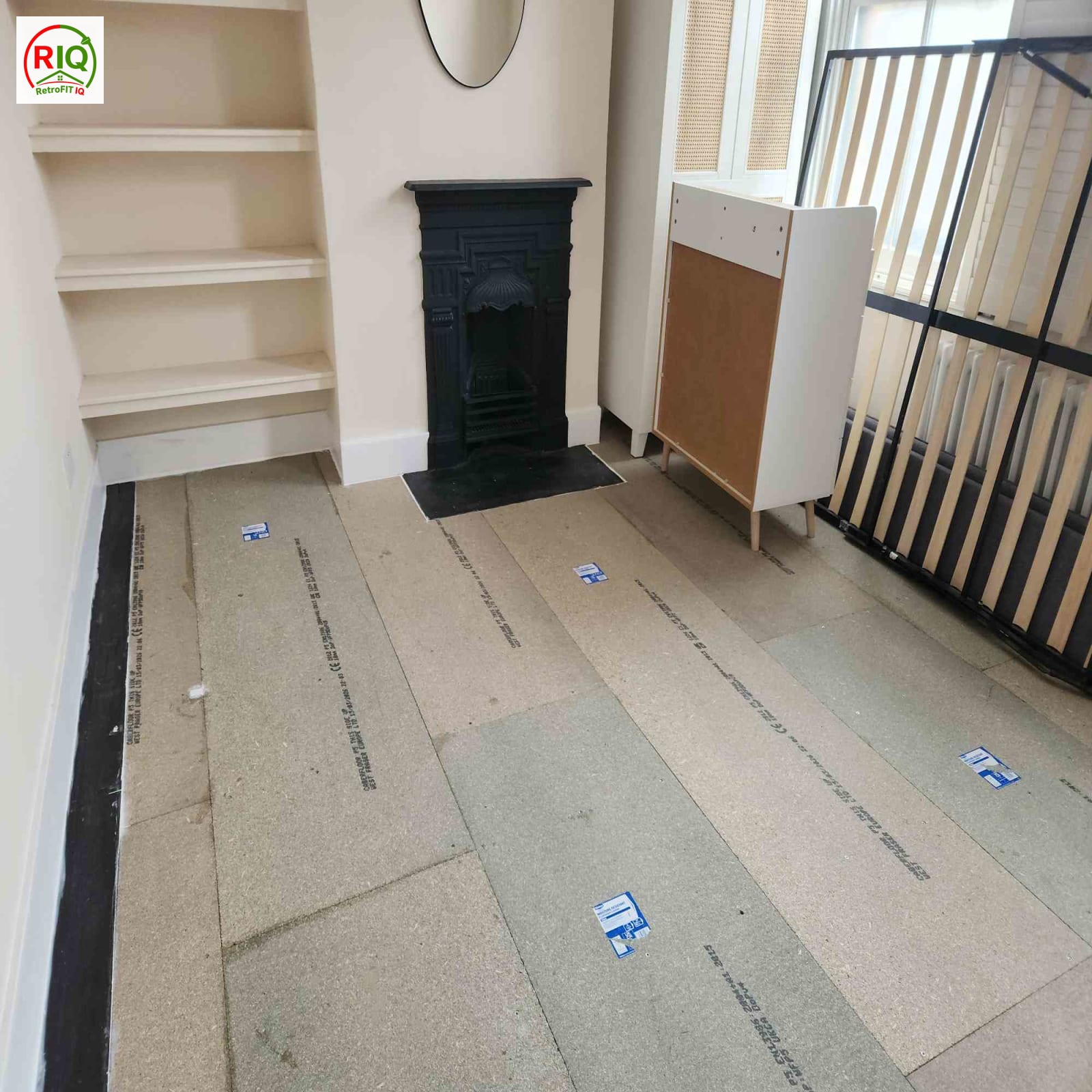 Finished Floor
Four-stage acoustic floor build-up: lifted floor → mineral wool insulation → resilient bars → finished decoupled deck.
Soundproofing & Acoustics — in plain English.
Acoustic diagnostics measure how sound actually moves through your floors, walls and ceilings — airborne (voices, TV, traffic) and impact (footfall, doors, drops). A measured assessment tells you which build-up will actually solve the problem, instead of guessing with mass-loaded vinyl or off-the-shelf foam.
Why soundproofing & acoustics is important.
Noise is a building-performance problem, not a decorating one. Effective sound control depends on three physical principles working together — mass, decoupling and absorption — and on closing the flanking paths that let sound travel around a partition through the structure. This is why carpet, foam tiles or mass-loaded vinyl applied in isolation almost always disappoint. A measured acoustic assessment identifies the dominant noise type and transmission path so the build-up is matched to the actual problem, achieving real, documented decibel reductions instead of expensive guesswork.
The right time to bring us in.
- When noise from neighbours, flats or rooms is affecting sleep, work or wellbeing
- Before a flat conversion or change of use that must meet Approved Document E
- When carpet, underlay or foam has already been tried without success
- When fitting out a home office, studio or cinema room that needs measurable isolation
- Whenever a floor is being lifted anyway, so acoustic treatment can be added cost-effectively
The symptoms that bring people to this service.
- 01Footfall noise from upstairs neighbours through timber floors
- 02TV / music bleed-through between flats or party walls
- 03Conversations clearly audible through stud walls
- 04Reverberant, echoey rooms in hard-finished interiors
- 05Building Regs Approved Document E failures on flat conversions
- 06Home cinemas, music rooms and offices needing measurable isolation
What you tend to notice first.
- Footfall and movement noise from neighbours above through timber floors
- Voices, TV and music clearly audible between flats or rooms
- Echoey, reverberant rooms in hard-finished interiors
- Noise still intrusive after carpet, underlay or foam was tried
- A flat conversion needing to meet Approved Document E
- A home office, studio or cinema room needing measurable isolation
Our diagnostic approach
- 01Listen-walk with the occupant to identify dominant noise sources and paths
- 02Sound pressure level (dBA) measurement of the offending noise at the receiving location
- 03Identify flanking paths — joist ends, party walls, service voids, partition penetrations
- 04Define target Rw / DnT,w / L'nT,w improvement (in dB) based on the use case
- 05Specify a decoupled mass-spring-mass build-up matched to the construction
What we bring on site
- Class 1 sound level meter with octave-band analysis
- Impact hammer / tapping machine for floor impact tests
- Speaker + signal generator for partition airborne tests
- Reverberation time logger for room-acoustic assessments
- Borescope for confirming wall / floor / ceiling build-ups before specifying
The science behind the diagnosis.
Sound is transmitted by vibration. To reduce it you need three things working together: mass (heavy layers that resist movement), decoupling (resilient bars or isolation hangers that break the rigid path) and absorption (mineral wool inside the cavity to dissipate trapped sound energy). Get one of the three wrong and the result barely changes — that's why so many DIY soundproofing jobs fail.
Measured benefits — not vague promises.
- Measured noise reduction (in dB) — not subjective improvement
- Mass-spring-mass build-ups designed for your specific construction
- Flanking paths identified and sealed — the single biggest failure point
- Compliance with Approved Document E (or better) for flat conversions
- A documented before/after sound test as proof
What we design and deliver next.
Every recommendation follows our methodology — Investigate → Design → Verify — so the diagnosis on this page leads directly into an engineered, buildable and independently verified solution.
- A decoupled mass-spring-mass build-up matched to your specific construction
- Flanking paths identified and sealed — the single biggest cause of failure
- Acoustic floor, wall or ceiling systems specified to a target dB improvement
- Air-sealing of penetrations, which double as sound paths
- Compliance detailing and a finished sound test where Building Regs apply
- Optional before/after decibel logging as documented proof
What goes wrong on site — and why it matters.
Our diagnoses are grounded in real site experience. These are the workmanship and detailing failures we repeatedly find on this kind of work — the difference between a building that should perform and one that actually does.
Adding mass on a soft, springy layer with no decoupling can actually worsen impact transmission — a common DIY mistake we are called in to correct.
Fixings driven through the resilient bar into the joist below rigidly reconnect the layers, cancelling the decoupling the bar was meant to provide.
Sound travelling through party walls, joist ends and service voids bypasses even a well-built floor — flanking is the single biggest cause of disappointing results.
Downlights, sockets and pipe holes are small air paths, and any air path is a sound path; unsealed, they undo much of the build-up.
Loft-grade lightweight wool used in place of dense acoustic mineral wool leaves the cavity resonating instead of absorbing.
Systems we install
- Independent acoustic wall systems
- Acoustic ceiling systems with resilient hangers
- Floating floors and resilient acoustic underlays
- Full-room treatments combining mass, decoupling, absorption and damping
- Targeted treatments for party walls and HMO conversions
How we design
- Acoustic assessment of the existing build-up
- Identification of flanking paths (often the real culprit)
- Specification based on mass-spring-mass and decoupling principles
- Installation with verified detailing — no shortcuts
What we commonly discover during soundproofing & acoustics investigations
- 01Sound transmission through suspended timber floors via the joists (flanking)
- 02Impact noise (footsteps, dropped objects) bypassing carpet alone
- 03Airborne noise (voices, TV) through wall/floor junctions with no decoupling
- 04Existing floors with no insulation between joists and no acoustic decoupling
- 05Party-wall junctions transmitting both airborne and impact noise
- 06Inadequate construction detailing where flanking paths short-circuit the build-up
Findings reflect patterns observed across completed RetrofitIQ projects — every survey is interpreted in the building’s specific context.
See this service applied on real investigations
Soundproofing & Acoustics — common questions
Why does carpet and underlay alone not always solve noise problems?+
Carpet and underlay reduce *impact* noise (footfall, dropped objects) to some extent but do very little for *airborne* noise (voices, music, TV) because they have low mass and no decoupling. Effective soundproofing requires three things working together — mass, decoupling and absorption — across the whole separating floor or wall assembly. Carpet alone delivers maybe 3-5 dB; a proper acoustic build-up delivers 20-25 dB on the same floor.What is impact noise?+
Impact noise is sound transmitted through structure when a force is applied — footfall, dropped objects, dragged furniture, door slams. It travels through joists, joins and structural connections far more efficiently than through the air. Impact noise is what most upstairs-neighbour complaints actually relate to, and it is the hardest to fix because it bypasses any soft surface treatment.What is airborne noise?+
Airborne noise is sound that travels through the air and then through a partition — voices, music, TV, traffic. It can be reduced by adding mass (heavy plasterboard, concrete), by decoupling (a flexible isolator between the two sides) and by absorption inside the cavity (acoustic mineral wool). Airborne noise control is what Approved Document E (Building Regs) measures with the DnT,w + Ctr metric.Why do floors transfer sound between flats so easily?+
Most London conversion flats have lightweight timber joist floors with no mass and rigid joist-to-wall connections. Sound vibration travels through the joists, into the party walls, and re-radiates as airborne sound in the neighbouring room — a phenomenon called *flanking transmission*. Without addressing both the direct transmission (through the floor) and the flanking (around it) the result is always disappointing.Can gaps and air leakage increase noise transfer?+
Yes — significantly. Sound passes through air more efficiently than through dense materials, so a single 5 mm gap around a downlight or service penetration can degrade the acoustic performance of an entire floor by 5-10 dB. Air-sealing is therefore as important to soundproofing as it is to heat-loss control. Every penetration we install in an acoustic build-up is sealed with acoustic mastic.What is acoustic mineral wool used for in soundproofing?+
Mineral wool (typically 60-80 kg/m³ rock-fibre density) fills the cavity in a mass-spring-mass build-up and absorbs the sound energy that gets into the cavity, preventing it from being re-radiated by the inner leaf. Without absorption, the cavity acts as a resonator and the build-up's performance collapses. Standard loft-grade fibre mineral wool is not adequate; we use density-rated acoustic-spec material.Why is sealing important in soundproofing?+
Because sound is air-borne — any path for air is a path for sound. Acoustic-grade mastic, intumescent acoustic sleeves at service penetrations, perimeter compression seals and back-boxed sockets are essential. We pre-fit and pre-seal every penetration before the finished layer goes on; the acoustic survey we do afterwards confirms there are no flanking paths left.Can soundproofing be tested before and after works?+
Yes — and on Approved Document E-controlled jobs (flat conversions, change of use) a finished sound test is mandatory. For private domestic projects we offer optional pre- and post-works decibel logging, so the improvement is documented. The numbers typically lift by 18-25 dB on a properly-designed floor — equivalent to halving the perceived loudness 3-4 times over.What does a proper acoustic floor build-up look like?+
A typical four-stage acoustic floor for an existing timber joist floor: (1) 100 mm acoustic mineral wool between the joists; (2) resilient bars or isolation pads on top of the joists to decouple the new layer; (3) two layers of 19 mm or 22 mm acoustic chipboard or P5 deck, joints staggered; (4) perimeter compression strip and acoustic mastic seal at every wall junction. Each stage carries part of the work — remove one and the whole build-up underperforms.Can soundproofing be combined with floor replacement or refurbishment?+
Yes — and it is much more cost-effective when done at the same time. If the floor is being lifted for joist repair, services or refinishing, the acoustic build-up adds modest material cost and zero extra labour disruption. We strongly recommend pairing soundproofing with any planned floor works.How long does a typical soundproofing project take?+
A single bedroom floor: 4-7 working days including strip-out, joist preparation, services routing, acoustic build-up, finished deck and perimeter sealing. A whole-flat floor and ceiling project: typically 3-4 weeks including ceiling lift, perimeter detailing and finishes. We sequence the work to minimise disruption and we test the result on completion.Can soundproofing improve thermal comfort as well as noise reduction?+
Yes — substantially. The mineral wool used in the acoustic cavity is also a thermal insulator (typical λ ≈ 0.038 W/mK), so an acoustic floor build-up delivers ~2-3 m²K/W of additional thermal resistance compared with the unimproved floor. Cold ground-floor rooms and chilly bedrooms above unheated spaces both feel significantly warmer after the work.Do you inspect the floor before recommending a soundproofing system?+
Yes — every soundproofing project starts with an on-site inspection. We measure existing build-up depth, identify the joist orientation, check headroom constraints (you do not want to lose ceiling height), assess the structural condition of the joists and look for flanking paths in the surrounding partitions. The build-up we recommend is matched to your specific floor — not a generic catalogue solution.Can poor previous installation make noise problems worse?+
Yes. We have surveyed numerous flats where mass-loaded vinyl had been laid directly over an existing carpet (no decoupling, no absorption — added mass on a flexible substrate actually *increases* impact transmission). We have also seen plasterboard added to ceilings without resilient bars, rigidly screwed to the joists — which couples the new layer to the structure rather than decoupling from it. Diagnosis first; specification second.Do you provide a written scope and acoustic spec before works?+
Yes — every soundproofing project is delivered with a written scope, an acoustic specification of the proposed build-up (layer by layer), the expected dB performance, and a costed quote. The spec is yours to share with architects or to seek competitive quotes against — it is not tied to any single contractor.Do I need Building Regulations approval for soundproofing?+
If the works are part of a *change of use* (e.g. a single dwelling converted to flats) then yes — Approved Document E applies and a finished sound test is mandatory. For improvements to an existing flat or house in your own occupation, no Building Regs approval is normally needed. We can advise on the regulatory position before any works begin.
Weighing this up against the alternatives?
Independent, building-physics-led comparisons from our knowledge base — written to help you understand the difference before you decide which survey or approach you actually need.
- Airborne vs Impact SoundproofingSoundproofing & Acoustics
- Acoustic Mineral Wool vs PIR InsulationSoundproofing & Acoustics
- Floating Floor vs Direct-Fix FloorSoundproofing & Acoustics
- Resilient Bars vs Independent Wall SystemSoundproofing & Acoustics
Common problems we diagnose
The symptoms that most often lead homeowners to a soundproofing & acoustics. Each guide explains the building physics behind the problem — and how we diagnose the real cause before any work begins.
- Why can I hear my neighbours through the wall?
- Why can I hear footsteps from the flat above?
- How do I soundproof a room properly?
- Does soundproofing actually work?
- How do I reduce traffic and outside noise?
- How do I soundproof a party wall in a terraced house?
Part of one connected building-performance journey.
Every Retrofit IQ service is one stage of a single methodology — Investigate → Design → Verify. Explore how this service connects to the wider network of diagnostics, engineering and quality assurance.
The engineering and quality-assurance services that most often follow this one.
One company. One process. One point of responsibility.
We don’t simply identify problems. We investigate, diagnose, design solutions, carry out the work and verify the results. Book a Home Health Diagnostic Survey and we’ll tell you exactly which remedial works (if any) are actually needed.
Investigate → Diagnose → Design → Remediate → Verify
RetrofitIQ is not only a diagnostics company. We take projects from first investigation through to verified improvement — and you decide how far we go. Engage us for an investigation on its own, an investigation plus targeted remedial works, or a complete building-performance and retrofit project.
A measured diagnosis — thermal imaging, blower door testing, moisture and building-physics analysis — with a clear, costed report you can act on however you choose.
We investigate, then carry out targeted remedial works — airtightness, insulation, ventilation or thermal-bridge corrections — and verify the result.
A full fabric-first, Passive House-informed retrofit from diagnosis through design, installation and verification — one accountable team, one point of responsibility.
- Airtightness improvements & draught-proofing
- Internal wall insulation (IWI)
- External wall insulation (EWI)
- Loft & roof insulation
- Suspended floor & underfloor insulation
- Thermal-bridge detailing & correction
- Extract ventilation & MVHR installation
- Soundproofing & acoustic upgrades
- General building-fabric improvements
Evidence from Real Projects (11)
Real project and investigation images from our own fieldwork, matched to this page — not stock photography.


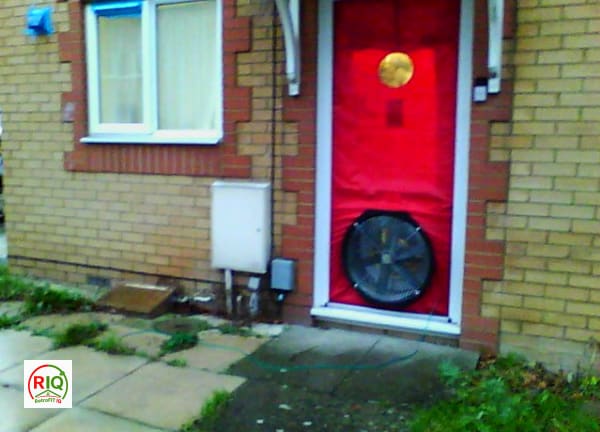


No related investigations yet.
Browse all investigationsSoundproofing & Acoustics across London & the surrounding areas.
Explore building performance diagnostics, damp and condensation investigations, airtightness testing and retrofit advice in your area. We cover London, Greater London, East London, Essex, Kent, Surrey, Hertfordshire and the surrounding counties.